Department of Integrative Physiology, University of North Texas Health Science Center at Fort Worth, 3500 Camp Bowie Blvd, Fort Worth, TX 76107, USA.
Hypertension. 2012 Jul;60(1):179-87. doi: 10.1161/HYPERTENSIONAHA.112.193789. Epub 2012 Jun 11.
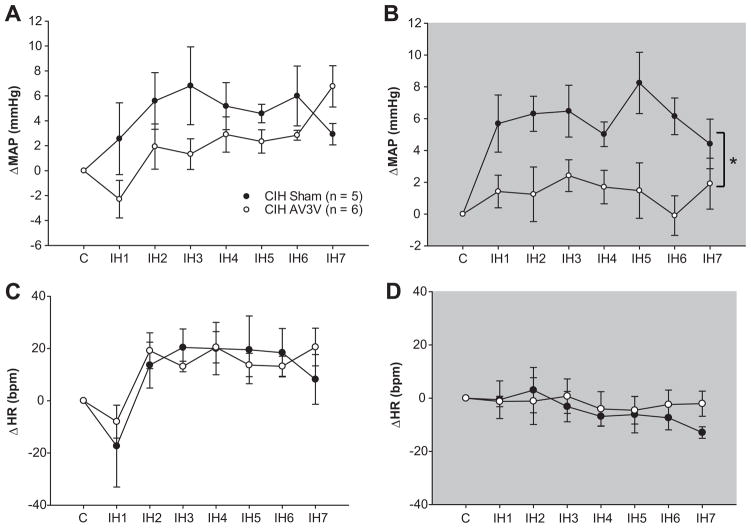
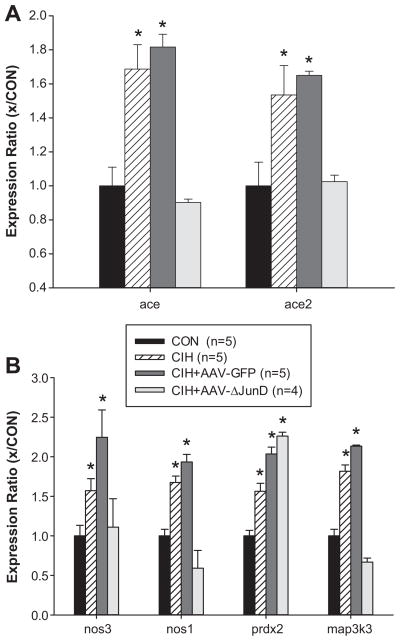
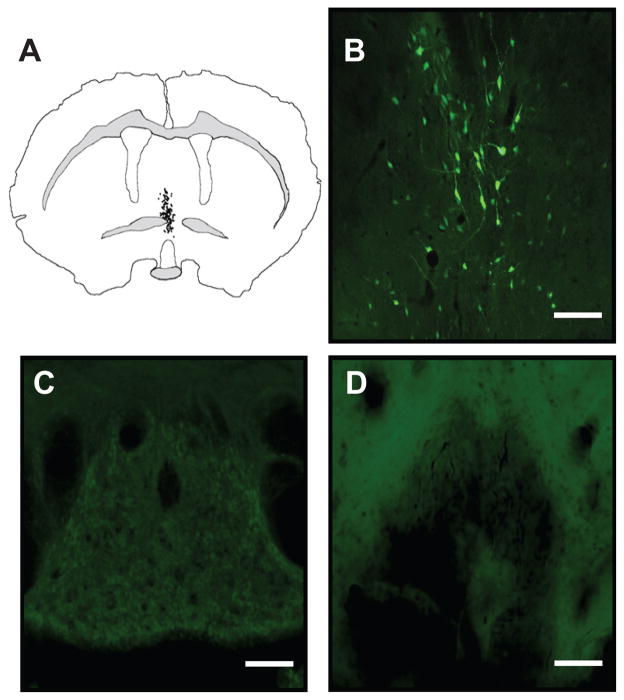
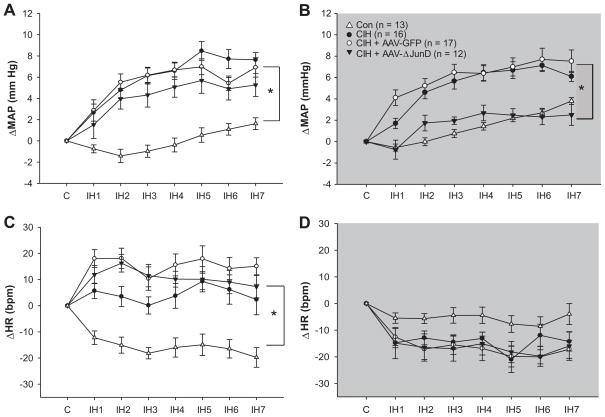
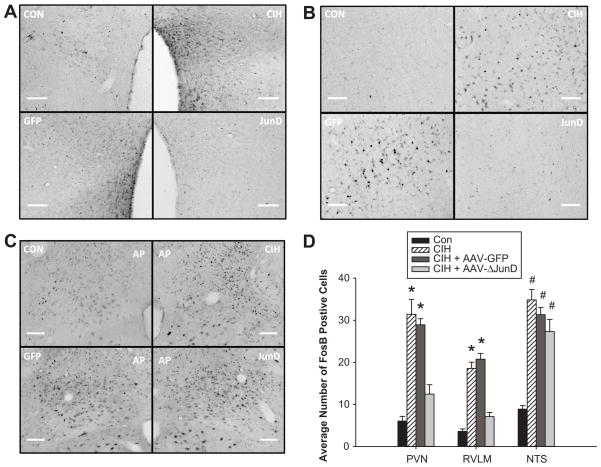
One of the main clinical features of obstructive sleep apnea is sustained hypertension and elevated sympathetic activity during waking hours. Chronic intermittent hypoxia (CIH), animal model of the hypoxemia associated with obstructive sleep apnea, produces a similar sustained increase in blood pressure. This study determined the role of ΔFosB in the median preoptic nucleus (MnPO) in the sustained increase in mean arterial pressure associated with CIH. Rats were injected in the MnPO with viral vectors that expressed green fluorescent protein alone or green fluorescent protein plus a dominant-negative construct that inhibits the transcriptional effects of ΔFosB. In green fluorescent protein-injected rats and uninjected controls, 7-day exposure to CIH increased mean arterial pressure by 7 to 10 mm Hg during both intermittent hypoxia exposure and normoxia. Dominant-negative inhibition of MnPO ΔFosB did not affect changes in mean arterial pressure during intermittent hypoxia exposure but significantly reduced the sustained component of the blood pressure response to CIH during the normoxic dark phase. Inhibition of MnPO ΔFosB reduced the FosB/ΔFosB staining in the paraventricular nucleus and rostral ventrolateral medulla but not the nucleus of the solitary tract. PCR array analysis identified 6 activator protein 1-regulated genes expressed in the MnPO that were increased by CIH exposure, ace, ace2, nos1, nos3, prdx2, and map3k3. Dominant-negative inhibition of ΔFosB in the MnPO blocked increased expression of each of these genes in rats exposed to CIH except for Prdx2. ΔFosB may mediate transcriptional activity in MnPO necessary for sustained CIH hypertension, suggesting that neural adaptations may contribute to diurnal hypertension in obstructive sleep apnea.
阻塞性睡眠呼吸暂停的主要临床特征之一是清醒时持续高血压和交感神经活动升高。慢性间歇性低氧(CIH),是与阻塞性睡眠呼吸暂停相关的低氧血症的动物模型,会导致血压持续升高。本研究旨在确定中脑前视核(MnPO)中ΔFosB 在与 CIH 相关的平均动脉压持续升高中的作用。研究人员将表达绿色荧光蛋白(GFP)的病毒载体或表达 GFP 加抑制ΔFosB 转录效应的显性负构建体的病毒载体注入 MnPO。在 GFP 注射大鼠和未注射对照大鼠中,7 天的 CIH 暴露使平均动脉压在间歇性低氧暴露和常氧期间分别升高了 7 至 10mmHg。MnPO ΔFosB 的显性负抑制作用不影响间歇性低氧暴露期间平均动脉压的变化,但显著降低了 CIH 期间常氧暗期血压反应的持续成分。MnPO ΔFosB 的抑制作用降低了室旁核和头侧腹外侧延髓中的 FosB/ΔFosB 染色,但不降低孤束核中的 FosB/ΔFosB 染色。PCR 阵列分析确定了 MnPO 中表达的 6 种受激活蛋白 1 调节的基因,这些基因在 CIH 暴露后表达增加,包括 ace、ace2、nos1、nos3、prdx2 和 map3k3。在 CIH 暴露大鼠中,MnPO 中 ΔFosB 的显性负抑制作用阻断了这些基因的表达增加,除了 Prdx2。ΔFosB 可能介导 MnPO 中持续 CIH 高血压所必需的转录活性,表明神经适应可能导致阻塞性睡眠呼吸暂停的昼夜高血压。