Department of Integrative Oncology, Fudan University Shanghai Cancer Center, Shanghai 200032, China.
Evid Based Complement Alternat Med. 2012;2012:635702. doi: 10.1155/2012/635702. Epub 2012 May 29.
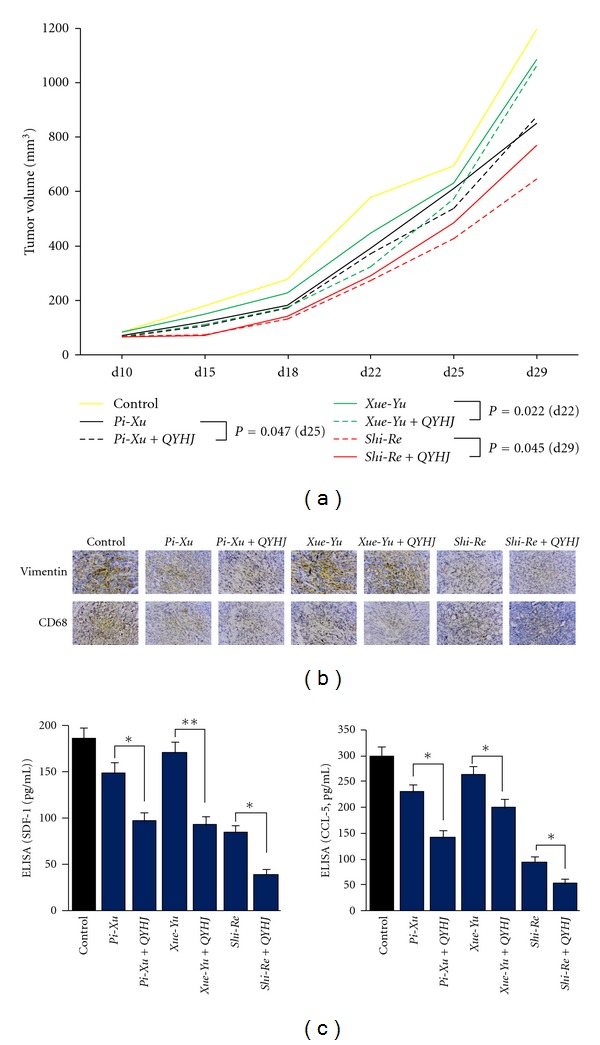
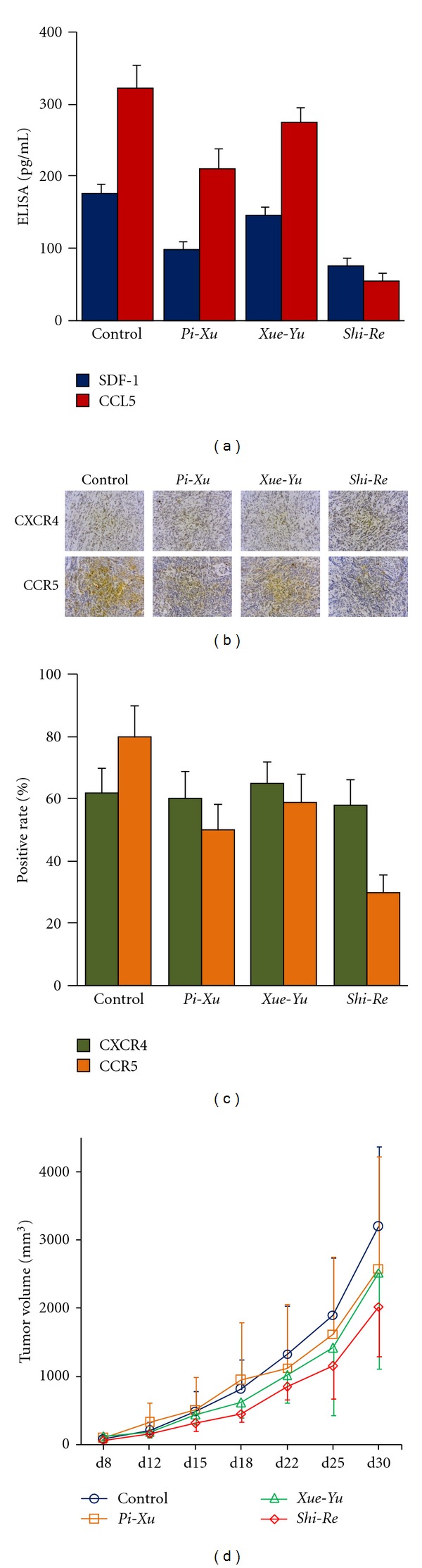
In traditional Chinese medicine (TCM), diagnosis of pathology and choice of treatment prescriptions are based on a method of differentiation of signs and symptoms known as syndrome differentiation or ZHENG. The cornerstone of TCM, ZHENG, relies on the gathering of clinical information through inspection, auscultation and olfaction, inquiry, and palpation. However, the biomolecular basis of the ZHENG remains unclear. In this study, we established mouse xenograft pancreatic cancer models with Shi-Re (Dampness-Heat), Pi-Xu (Spleen-Deficiency), or Xue-Yu (Blood-Stasis) ZHENG, which are regarded as the three major ZHENGs in pancreatic cancer. We found that tumors of the different ZHENG models exhibited significantly altered cancer-associated fibroblast (CAF) proliferative activity and tumor-associated macrophage (TAM) infiltration, which led to altered levels of CAF- and TAM-derived secreted cytokines such as SDF-1 and CCL5. The ZHENG model type also significantly influenced tumor growth, and administration of herbal medicine to the ZHENG model modified the tumor microenvironment. Therefore, this study partially unveiled the molecular basis of TCM ZHENG in pancreatic cancer.
在中医(TCM)中,病理诊断和治疗方案的选择基于一种称为辨证或证的症状和体征鉴别方法。中医的基石证依赖于通过望、闻、问、切收集临床信息。然而,证的生物分子基础仍不清楚。在这项研究中,我们建立了具有湿-热(Shi-Re)、脾-虚(Pi-Xu)或血-瘀(Xue-Yu)证的胰腺癌细胞移植小鼠模型,这些证被认为是胰腺癌的三个主要证。我们发现,不同证模型的肿瘤表现出明显改变的癌症相关成纤维细胞(CAF)增殖活性和肿瘤相关巨噬细胞(TAM)浸润,这导致 CAF 和 TAM 衍生的分泌细胞因子(如 SDF-1 和 CCL5)水平发生改变。证模型类型也显著影响肿瘤生长,而中药对证模型的给药修饰了肿瘤微环境。因此,本研究部分揭示了中医证在胰腺癌中的分子基础。