Clinica di Oncoematologia Pediatrica, Azienda Ospedaliera-Università di Padova, Via Giustiniani 3, Padova 35128, Italy.
BMC Cancer. 2012 Jun 12;12:233. doi: 10.1186/1471-2407-12-233.
The ubiquitin-proteasome system (UPS) and the heat shock response (HSR) are two critical regulators of cell homeostasis, as their inhibition affects growth and survival of normal cells, as well as stress response and invasiveness of cancer cells. We evaluated the effects of the proteasome inhibitor Bortezomib and of 17-DMAG, a competitive inhibitor of Hsp90, in rhabdomyosarcoma (RMS) cells, and analyzed the efficacy of single-agent exposures with combination treatments.
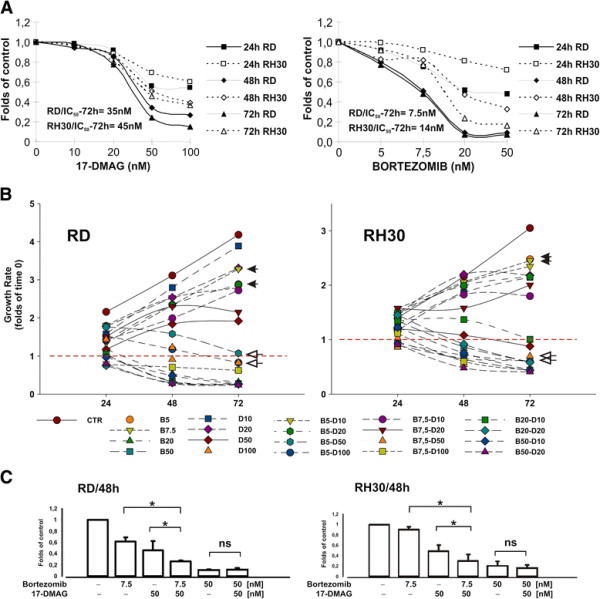
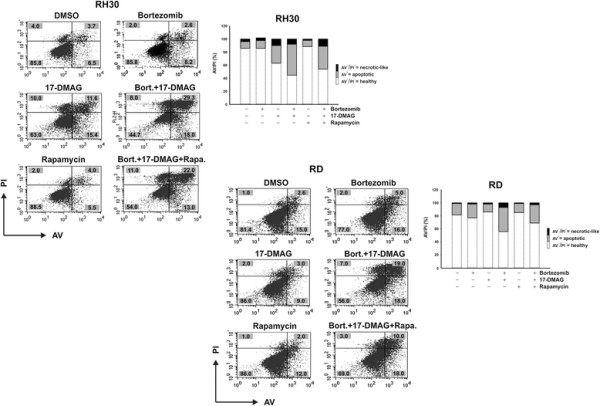
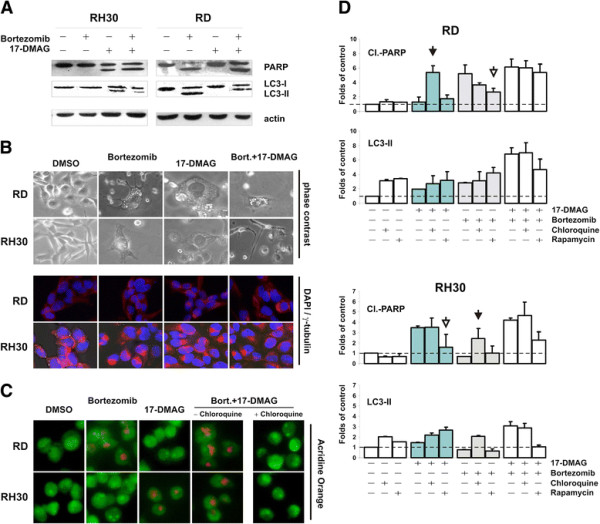
To assess cytotoxicity induced by Bortezomib and 17-DMAG in RMS cells, viability was measured by MTT assay after 24, 48 and 72 hours. Western blotting and immunofluorescence analyses were carried out to elucidate the mechanisms of action. Apoptosis was measured by FACS with Annexin-V-FITC and Propidium Iodide.
Bortezomib and 17-DMAG, when combined at single low-toxic concentrations, enhanced growth inhibition of RMS cells, with signs of autophagy that included intensive cytoplasmic vacuolization and conversion of cytosolic LC3-I protein to its autophagosome-associated form. Treatment with lysosomal inhibitor chloroquine facilitates apoptosis, whereas stimulation of autophagy by rapamycin prevents LC3-I conversion and cell death, suggesting that autophagy is a resistance mechanism in RMS cells exposed to proteotoxic drugs. However, combination treatment also causes caspase-dependent apoptosis, PARP cleavage and Annexin V staining, as simultaneous inhibition of both UPS and HSR systems limits cytoprotective autophagy, exacerbating stress resulting from accumulation of misfolded proteins.
The combination of proteasome inhibitor Bortezomib with Hsp90 inhibitor 17-DMAG, appears to have important therapeutic advantages in the treatment of RMS cells compared with single-agent exposure, because compensatory survival mechanisms that occur as side effects of treatment may be prevented.
泛素-蛋白酶体系统(UPS)和热休克反应(HSR)是细胞内稳态的两个关键调节剂,因为它们的抑制作用会影响正常细胞的生长和存活,以及癌细胞的应激反应和侵袭性。我们评估了蛋白酶体抑制剂硼替佐米(Bortezomib)和 Hsp90 竞争性抑制剂 17-DMAG 在横纹肌肉瘤(RMS)细胞中的作用,并分析了单一药物暴露与联合治疗的疗效。
为了评估 Bortezomib 和 17-DMAG 对 RMS 细胞的细胞毒性,通过 MTT 测定法在 24、48 和 72 小时后测量细胞活力。通过 Western blot 和免疫荧光分析阐明作用机制。通过 Annexin-V-FITC 和碘化丙啶的流式细胞术测量细胞凋亡。
Bortezomib 和 17-DMAG 以低毒性浓度联合使用时,增强了 RMS 细胞的生长抑制作用,并伴有自噬的迹象,包括细胞质内密集的空泡化和胞质 LC3-I 蛋白向其自噬体相关形式的转化。用溶酶体抑制剂氯喹处理可促进细胞凋亡,而用雷帕霉素刺激自噬可防止 LC3-I 转化和细胞死亡,这表明自噬是 RMS 细胞暴露于蛋白毒性药物时的一种抵抗机制。然而,联合治疗也会导致 caspase 依赖性细胞凋亡、PARP 切割和 Annexin V 染色,因为同时抑制 UPS 和 HSR 系统会限制细胞保护性自噬,加剧由于错误折叠蛋白积累而导致的应激。
与单一药物暴露相比,蛋白酶体抑制剂硼替佐米与 Hsp90 抑制剂 17-DMAG 的联合治疗似乎在治疗 RMS 细胞方面具有重要的治疗优势,因为作为治疗副作用发生的代偿性生存机制可能会被阻止。