Department of Cardiology, Vestfold Hospital Trust, Tønsberg, Norway.
BMC Med. 2012 Jun 12;10:58. doi: 10.1186/1741-7015-10-58.
The term non-specific chest pain (NSCP) is applied to hospitalized patients in order to designate that they neither have an acute coronary syndrome (ACS) nor display evidence of a coronary ischemia. The number of NSCP patients is increasing and comprehensive guidelines specifying their optimal management have not yet been introduced. The objective of this review was to explore the prevalence and prognosis of NSCP versus ACS among patients recruited in consecutive series hospitalized for chest pain suspected to be ACS.
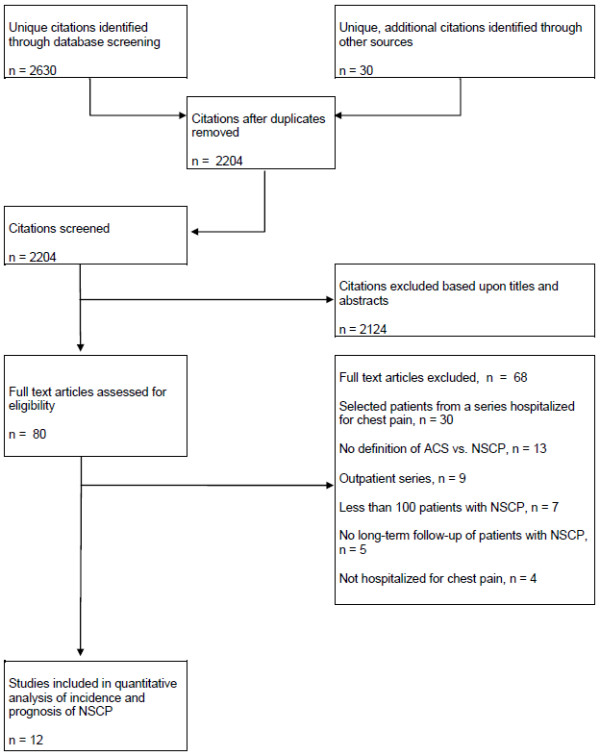
This is a systematic literature search where three databases were searched from 1990 to 14 November 2011. In addition, one database was searched for Epub ahead of print per 24 March 2012. Three inclusion criteria were applied: 1. documentation of an unselected consecutive series of patients admitted for chest pain, where this review is based upon two groups of patients defined as follows: a) 'ACS/high-risk' and b) NSCP; 2. at least 100 cases with NSCP; and 3. follow-up of hospital readmissions and mortality for at least six months.
A total of 2,204 citations were screened after removal of duplicates. Out of 80 full text articles assessed for eligibility 12 studies were included, comprising 24,829 patients (inter-study range 250 to 13,762), with 11,008 (44%) categorized as NSCP and 13,821 (56%) as 'ACS/high-risk'. The mean one-year total mortality rate among patients with NSCP in nine studies was 3.2% (inter-study range 1.4% to 8.1%), with the highest mortality among patients with pre-existing coronary heart disease (CHD). The mean one-year mortality rate among 'ACS/high-risk' patients was 18.0% (inter-study range 14.0% to 19.9%) in four studies with available data. In six studies the mean one-year readmission rate for patients with NSCP was 17.5% (inter-study range 2.5% to 40%).
Patients with NSCP represent a large, heterogeneous and important group. Due to co-existing CHD in nearly 40% of these patients, their prognosis is not necessarily benign. Although their average one-year mortality rate was almost six times lower than those with 'ACS/high-risk', the subset with concomitant CHD had a relatively poor prognosis when compared with NSCP patients without evidence of CHD.
非特异性胸痛(NSCP)这一术语用于描述住院患者,旨在表明他们既没有急性冠脉综合征(ACS),也没有冠状动脉缺血的证据。NSCP 患者的数量正在增加,但尚未引入全面的指南来规范其最佳管理。本综述的目的是探讨在连续系列因疑似 ACS 而住院的胸痛患者中,NSCP 与 ACS 的患病率和预后。
这是一项系统文献检索,从 1990 年至 2011 年 11 月 14 日,在三个数据库中进行了检索。此外,还在 2012 年 3 月 24 日之前,在一个数据库中检索了预印本。应用了三个纳入标准:1. 记录了一组未经选择的连续因胸痛住院的患者,本综述基于以下两组患者:a)“ACS/高危”和 b)NSCP;2. 至少有 100 例 NSCP 病例;3. 至少随访 6 个月的医院再入院和死亡率。
剔除重复项后,共筛选出 2204 条引文。在评估的 80 篇全文文章中,有 12 项研究符合纳入标准,共纳入 24829 例患者(研究间范围为 250-13762),其中 11008 例(44%)归类为 NSCP,13821 例(56%)归类为“ACS/高危”。在 9 项研究中,NSCP 患者的一年总死亡率平均为 3.2%(研究间范围为 1.4%-8.1%),在伴有先前存在的冠心病(CHD)的患者中死亡率最高。在有可用数据的四项研究中,“ACS/高危”患者的一年死亡率平均为 18.0%(研究间范围为 14.0%-19.9%)。在 6 项研究中,NSCP 患者的一年再入院率平均为 17.5%(研究间范围为 2.5%-40%)。
NSCP 患者代表了一个庞大、异质且重要的群体。由于近 40%的这些患者存在合并的 CHD,因此他们的预后不一定是良性的。尽管这些患者的一年平均死亡率比“ACS/高危”患者低近 6 倍,但伴有 CHD 的亚组与无 CHD 证据的 NSCP 患者相比,预后较差。