Department of Biology, Plant Biotechnology, ETH Zurich, Zurich, Switzerland.
Plant Methods. 2012 Jun 13;8(1):18. doi: 10.1186/1746-4811-8-18.
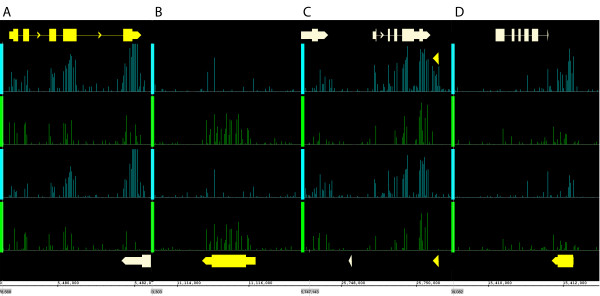
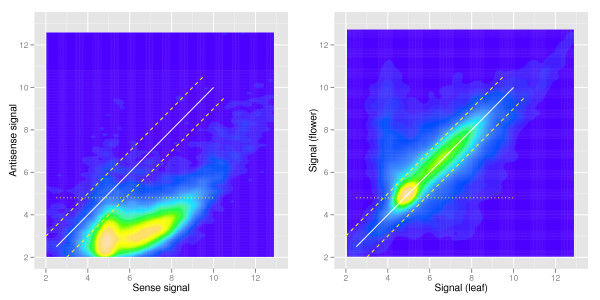
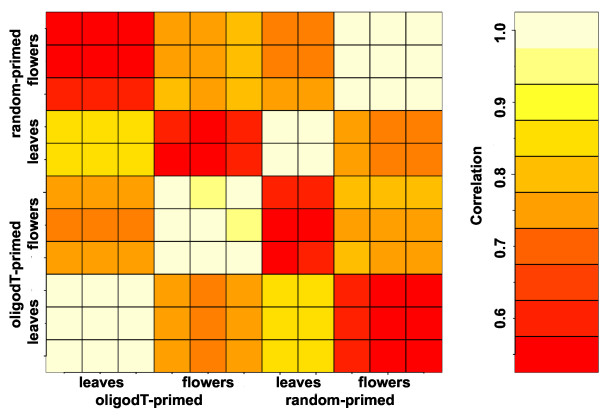
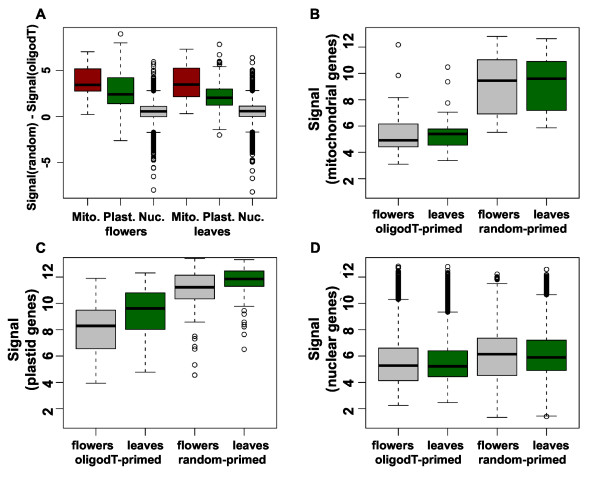
Microarrays are routine tools for transcript profiling, and genomic tiling arrays such as the Arabidopsis AGRONOMICS1 arrays have been found to be highly suitable for such experiments because changes in genome annotation can be easily integrated at the data analysis level. In a transcript profiling experiment, RNA labeling is a critical step, most often initiated by oligo-dT-primed reverse transcription. Although this has been found to be a robust and reliable method, very long transcripts or non-polyadenylated transcripts might be labeled inefficiently. In this study, we first provide data handling methods to analyze AGRONOMICS1 tiling microarrays based on the TAIR10 genome annotation. Second, we describe methods to easily quantify antisense transcripts on such tiling arrays. Third, we test a random-primed RNA labeling method, and find that on AGRONOMICS1 arrays this method has similar general performance as the conventional oligo-dT-primed method. In contrast to the latter, however, the former works considerably better for long transcripts and for non-polyadenylated transcripts such as found in mitochondria and plastids. We propose that researchers interested in organelle function use the random-primed method to unleash the full potential of genomic tiling arrays.
微阵列是转录组分析的常规工具,而基因组平铺阵列,如拟南芥农学 1 阵列,已被发现非常适合此类实验,因为基因组注释的变化可以在数据分析层面轻松整合。在转录组分析实验中,RNA 标记是一个关键步骤,通常由寡聚 dT 引物反转录启动。尽管这种方法被发现是一种强大且可靠的方法,但非常长的转录本或非多聚腺苷酸化的转录本可能标记效率低下。在这项研究中,我们首先提供了基于 TAIR10 基因组注释分析农学 1 平铺微阵列的数据分析方法。其次,我们描述了在这种平铺阵列上轻松定量反义转录本的方法。第三,我们测试了随机引物 RNA 标记方法,发现该方法在农学 1 阵列上的性能与传统的寡聚 dT 引物方法相似。然而,与后者相比,前者对于长转录本和线粒体和质体中发现的非多聚腺苷酸化转录本的效果要好得多。我们建议对细胞器功能感兴趣的研究人员使用随机引物方法来充分发挥基因组平铺阵列的潜力。