State Key Laboratory of Pharmaceutical Biotechnology, Department of Biology, Nanjing University, Nanjing, China.
BMC Evol Biol. 2012 Jun 14;12:86. doi: 10.1186/1471-2148-12-86.
Gene presence/absence (P/A) polymorphisms are commonly observed in plants and are important in individual adaptation and species differentiation. Detecting their abundance, distribution and variation among individuals would help to understand the role played by these polymorphisms in a given species. The recently sequenced 80 Arabidopsis genomes provide an opportunity to address these questions.
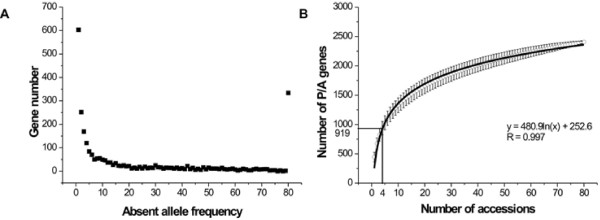
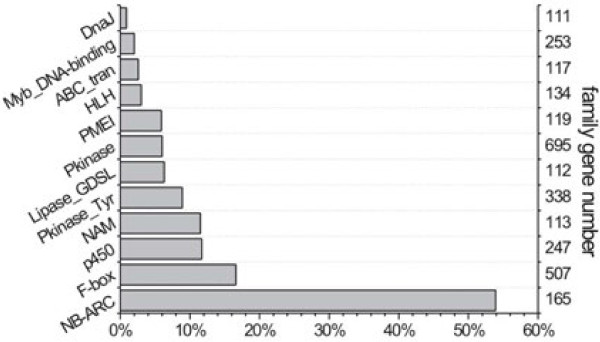
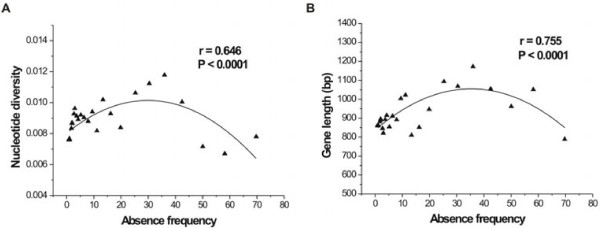
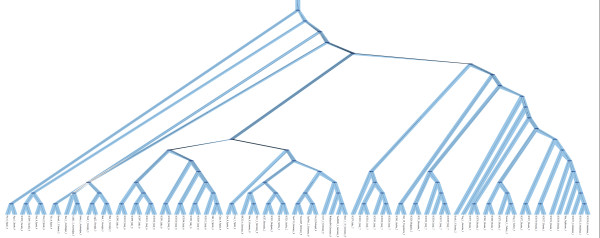
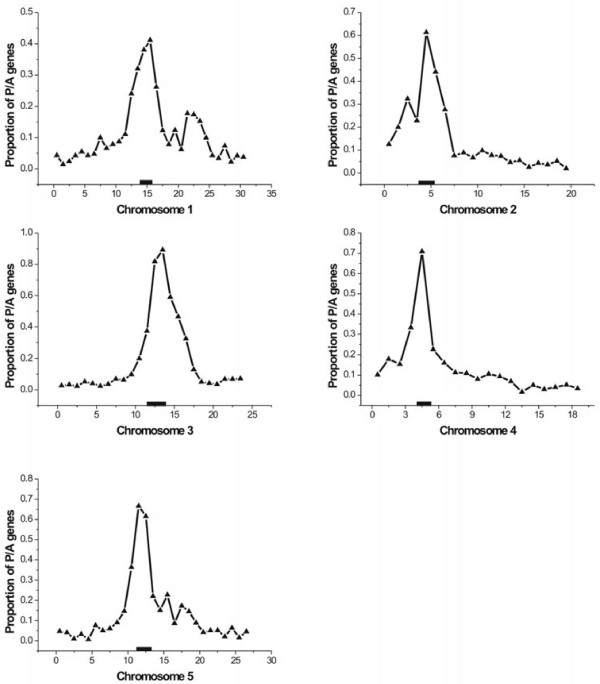
By systematically investigating these accessions, we identified 2,407 P/A genes (or 8.9%) absent in one or more genomes, averaging 444 absent genes per accession. 50.6% of P/A genes belonged to multi-copy gene families, or 31.0% to clustered genes. However, the highest proportion of P/A genes, outnumbered in singleton genes, was observed in the regions near centromeres. In addition, a significant correlation was observed between the P/A gene frequency among the 80 accessions and the diversity level at P/A loci. Furthermore, the proportion of P/A genes was different among functional gene categories. Finally, a P/A gene tree showed a diversified population structure in the worldwide Arabidopsis accessions.
An estimate of P/A genes and their frequency distribution in the worldwide Arabidopsis accessions was obtained. Our results suggest that there are diverse mechanisms to generate or maintain P/A genes, by which individuals and functionally different genes can selectively maintain P/A polymorphisms for a specific adaptation.
基因存在/缺失(P/A)多态性在植物中很常见,对个体适应和物种分化很重要。检测它们在个体中的丰度、分布和变异,有助于了解这些多态性在特定物种中所起的作用。最近测序的 80 个拟南芥基因组为此提供了机会。
通过系统地研究这些材料,我们鉴定出了 2407 个在一个或多个基因组中缺失的 P/A 基因(或 8.9%),每个材料平均缺失 444 个基因。50.6%的 P/A 基因属于多拷贝基因家族,31.0%属于聚类基因。然而,在着丝粒附近区域,单拷贝基因数量最多,其次是 P/A 基因。此外,80 个材料中 P/A 基因的频率与 P/A 基因座的多样性水平之间存在显著相关性。此外,P/A 基因在功能基因类别之间的比例不同。最后,P/A 基因树显示了全球拟南芥材料中多样化的群体结构。
获得了全球拟南芥材料中 P/A 基因及其频率分布的估计值。我们的结果表明,存在多种产生或维持 P/A 基因的机制,通过这些机制,个体和功能不同的基因可以选择性地为特定的适应保留 P/A 多态性。