Department of Molecular Medicine, Istituto Pasteur-Fondazione Cenci Bolognetti, University of Rome "La Sapienza", 00161 Rome, Italy.
Immunol Lett. 2012 Jul 30;145(1-2):39-46. doi: 10.1016/j.imlet.2012.04.014.
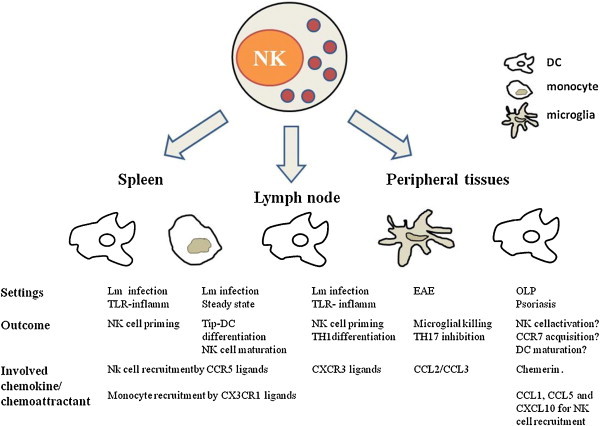
NK cells are innate lymphocytes capable of killing malignant or infected cells and to produce a wide array of cytokines and chemokines following activation. Chemokines, play critical roles in the regulation of NK cell tissue distribution in normal conditions as well as their rapid recruitment to the parenchyma of injured organs during inflammation, which is critical for NK cell ability to promote protective responses. In this regard, differences in chemokine receptor expression have been reported on specialized NK cell subsets with distinct effector functions and tissue distribution. Besides their role in the regulation of NK cell trafficking, chemotactic molecules can also affect NK cell effector functions by regulating their priming and their ability to kill and secrete cytokines.
自然杀伤 (NK) 细胞是先天淋巴细胞,能够杀伤恶性或感染细胞,并在激活后产生多种细胞因子和趋化因子。趋化因子在 NK 细胞在正常情况下的组织分布以及在炎症期间快速募集到受损器官实质中的调节中起着关键作用,这对于 NK 细胞促进保护反应的能力至关重要。在这方面,具有不同效应功能和组织分布的 NK 细胞亚群的趋化因子受体表达存在差异。除了在调节 NK 细胞迁移中的作用外,趋化分子还可以通过调节 NK 细胞的启动及其杀伤和分泌细胞因子的能力来影响 NK 细胞的效应功能。