Sunda William G
National Ocean Service, National Oceanic and Atmospheric Administration Beaufort, NC, USA.
Front Microbiol. 2012 Jun 7;3:204. doi: 10.3389/fmicb.2012.00204. eCollection 2012.
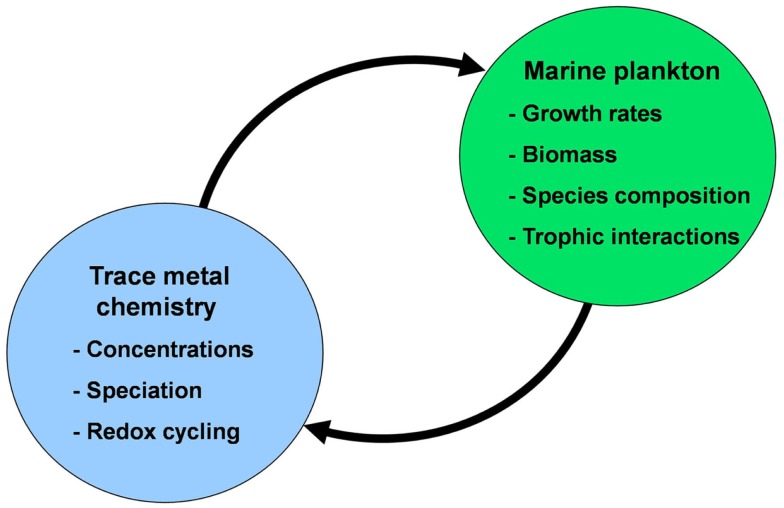
In addition to control by major nutrient elements (nitrogen, phosphorus, and silicon) the productivity and species composition of marine phytoplankton communities are also regulated by a number of trace metal nutrients (iron, zinc, cobalt, manganese, copper, and cadmium). Of these, iron is most limiting to phytoplankton growth and has the greatest effect on algal species diversity. It also plays an important role in limiting di-nitrogen (N(2)) fixation rates, and thus is important in controlling ocean inventories of fixed nitrogen. Because of these effects, iron is thought to play a key role in regulating biological cycles of carbon and nitrogen in the ocean, including the biological transfer of carbon to the deep sea, the so-called biological CO(2) pump, which helps regulate atmospheric CO(2) and CO(2)-linked global warming. Other trace metal nutrients (zinc, cobalt, copper, and manganese) have lesser effects on productivity; but may exert an important influence on the species composition of algal communities because of large differences in metal requirements among species. The interactions between trace metals and ocean plankton are reciprocal: not only do the metals control the plankton, but the plankton regulate the distributions, chemical speciation, and cycling of these metals through cellular uptake and recycling processes, downward flux of biogenic particles, biological release of organic chelators, and mediation of redox reactions. This two way interaction has influenced not only the biology and chemistry of the modern ocean, but has had a profound influence on biogeochemistry of the ocean and earth system as a whole, and on the evolution of marine and terrestrial biology over geologic history.
除了受主要营养元素(氮、磷和硅)的控制外,海洋浮游植物群落的生产力和物种组成还受到多种痕量金属营养元素(铁、锌、钴、锰、铜和镉)的调节。其中,铁对浮游植物生长的限制作用最大,对藻类物种多样性的影响也最为显著。它在限制双氮(N₂)固定速率方面也起着重要作用,因此在控制海洋中固定氮的存量方面至关重要。由于这些作用,铁被认为在调节海洋中碳和氮的生物循环中起着关键作用,包括碳向深海的生物转移,即所谓的生物CO₂泵,这有助于调节大气中的CO₂以及与CO₂相关的全球变暖。其他痕量金属营养元素(锌、钴、铜和锰)对生产力的影响较小;但由于不同物种对金属的需求差异很大,可能会对藻类群落的物种组成产生重要影响。痕量金属与海洋浮游生物之间的相互作用是相互的:金属不仅控制浮游生物,浮游生物还通过细胞摄取和循环过程、生物源颗粒的向下通量、有机螯合剂的生物释放以及氧化还原反应的介导来调节这些金属的分布、化学形态和循环。这种双向相互作用不仅影响了现代海洋的生物学和化学,而且对整个海洋和地球系统的生物地球化学以及地质历史时期海洋和陆地生物学的演化都产生了深远影响。