Butala Bina P, Shah Veena R, Bhosale Guruprasad P, Shah Rajkiran B
Department of Anaesthesia and Critical Care, Smt. K. M. Mehta and Smt. G. R. Doshi Institute of Kidney Diseases and Research Center, Dr. H. L. Trivedi Institute of Transplantation Sciences, Civil Hospital Campus, Asarwa, Ahmedabad, Gujarat, India.
Indian J Anaesth. 2012 Mar;56(2):168-70. doi: 10.4103/0019-5049.96335.
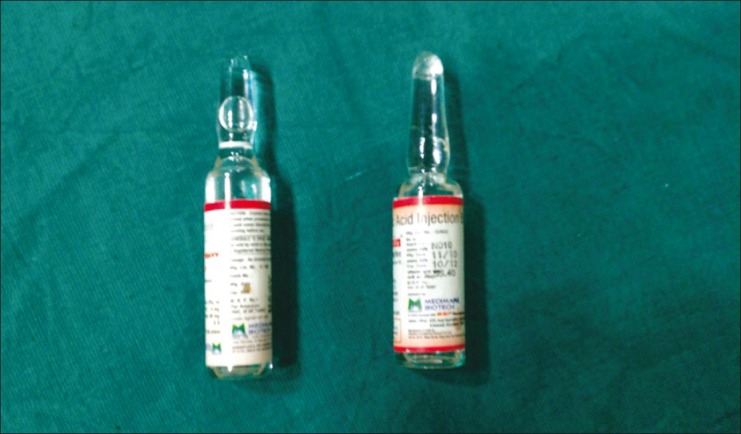
Some factors have been identified as contributing to medical errors, such as labels, appearance and location of ampoules. We present a case of accidental injection of tranexamic acid instead of Bupivacaine during spinal anaesthesia. One minute after the injection of 3 mL of the solution, the patient developed myoclonus of her lower extremities. Accidental intrathecal injection of the wrong drug was suspected and a used ampoule of tranexamic acid was discovered in the trash can. The ampoules of Bupivacaine (5 mg/mL, trade name "Sensovac Heavy") and tranexamic acid (500 mg/mL, Trade name "Nexamin") were similar in appearance. Her myoclonus was successfully treated with phenytoin, sodium valproate, thiopental sodium infusion, midazolam infusion and supportive care of haemodynamic and respiratory systems. The surgery was temporarily deferred. The patient's condition progressively improved to full recovery.
一些因素已被确定为导致医疗差错的原因,如安瓿瓶的标签、外观和位置。我们报告一例在脊髓麻醉期间意外注射氨甲环酸而非布比卡因的病例。注射3毫升溶液一分钟后,患者出现下肢肌阵挛。怀疑意外鞘内注射了错误药物,且在垃圾桶中发现了一个用过的氨甲环酸安瓿瓶。布比卡因(5毫克/毫升,商品名“Sensovac Heavy”)和氨甲环酸(500毫克/毫升,商品名“Nexamin”)的安瓿瓶外观相似。通过苯妥英钠、丙戊酸钠、硫喷妥钠输注、咪达唑仑输注以及血流动力学和呼吸系统的支持治疗,成功治疗了她的肌阵挛。手术暂时推迟。患者的病情逐渐好转直至完全康复。