Laboratory of Immunobiology, Institute of Molecular Genetics AS CR Prague, Czech Republic.
Front Immunol. 2012 Jun 12;3:155. doi: 10.3389/fimmu.2012.00155. eCollection 2012.
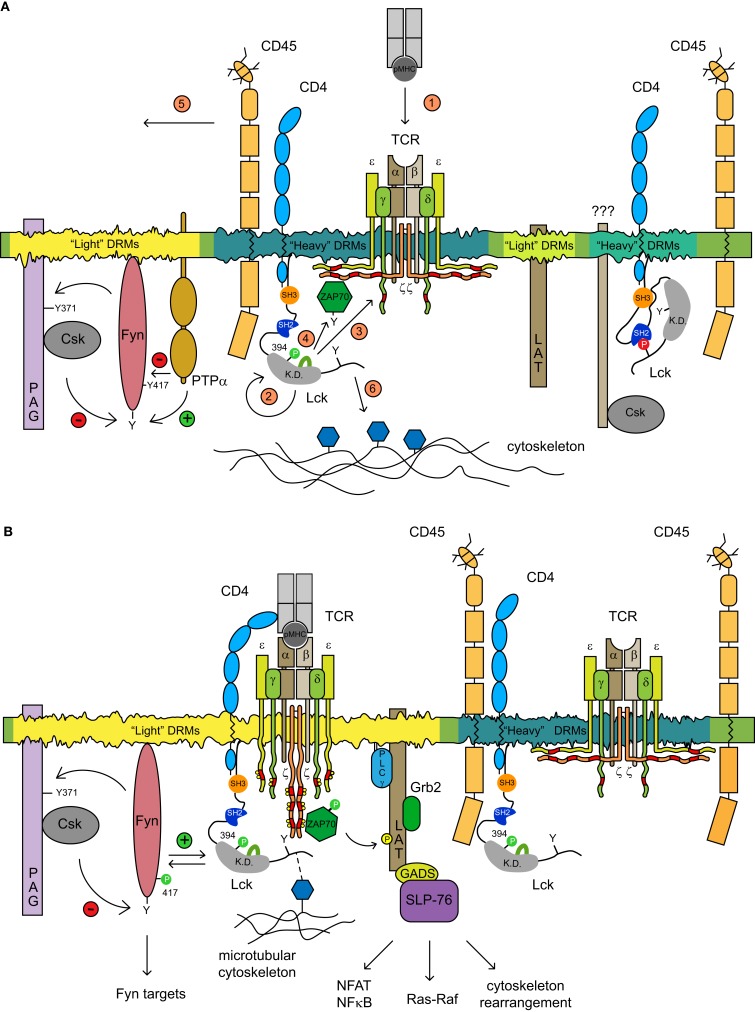
In spite of a comprehensive understanding of the schematics of T cell receptor (TCR) signaling, the mechanisms regulating compartmentalization of signaling molecules, their transient interactions, and rearrangement of membrane structures initiated upon TCR engagement remain an outstanding problem. These gaps in our knowledge are exemplified by recent data demonstrating that TCR triggering is largely dependent on a preactivated pool of Lck concentrated in T cells in a specific type of membrane microdomains. Our current model posits that in resting T cells all critical components of TCR triggering machinery including TCR/CD3, Lck, Fyn, CD45, PAG, and LAT are associated with distinct types of lipid-based microdomains which represent the smallest structural and functional units of membrane confinement able to negatively control enzymatic activities and substrate availability that is required for the initiation of TCR signaling. In addition, the microdomains based segregation spatially limits the interaction of components of TCR triggering machinery prior to the onset of TCR signaling and allows their rapid communication and signal amplification after TCR engagement, via the process of their coalescence. Microdomains mediated compartmentalization thus represents an essential membrane organizing principle in resting T cells. The integration of these structural and functional aspects of signaling into a unified model of TCR triggering will require a deeper understanding of membrane biology, novel interdisciplinary approaches and the generation of specific reagents. We believe that the fully integrated model of TCR signaling must be based on membrane structural network which provides a proper environment for regulatory processes controlling TCR triggering.
尽管对 T 细胞受体 (TCR) 信号转导的原理有了全面的了解,但调节信号分子区室化、它们的瞬时相互作用以及 TCR 结合引发的膜结构重排的机制仍然是一个悬而未决的问题。我们知识中的这些空白以最近的数据为例,这些数据表明 TCR 触发在很大程度上依赖于预先激活的 Lck 池,该池集中在特定类型的膜微域中的 T 细胞中。我们目前的模型假设,在静止的 T 细胞中,TCR 触发机制的所有关键组成部分,包括 TCR/CD3、Lck、Fyn、CD45、PAG 和 LAT,都与不同类型的基于脂质的微域相关联,这些微域是膜限制的最小结构和功能单位,能够负调控启动 TCR 信号所需的酶活性和底物可用性。此外,基于微域的分隔在 TCR 信号发生之前在空间上限制了 TCR 触发机制组件的相互作用,并允许它们在 TCR 结合后通过合并过程进行快速通讯和信号放大。因此,微域介导的区室化是静止 T 细胞中重要的膜组织原则。将这些结构和功能方面的信号整合到一个统一的 TCR 触发模型中,需要更深入地了解膜生物学、新的跨学科方法和特定试剂的产生。我们相信,TCR 信号的完全整合模型必须基于提供适当环境的膜结构网络,以控制 TCR 触发的调节过程。