National Marine Fisheries Service, Beaufort Laboratory, National Oceanic and Atmospheric Administration, Beaufort, North Carolina, United States of America.
PLoS One. 2012;7(6):e38120. doi: 10.1371/journal.pone.0038120. Epub 2012 Jun 6.
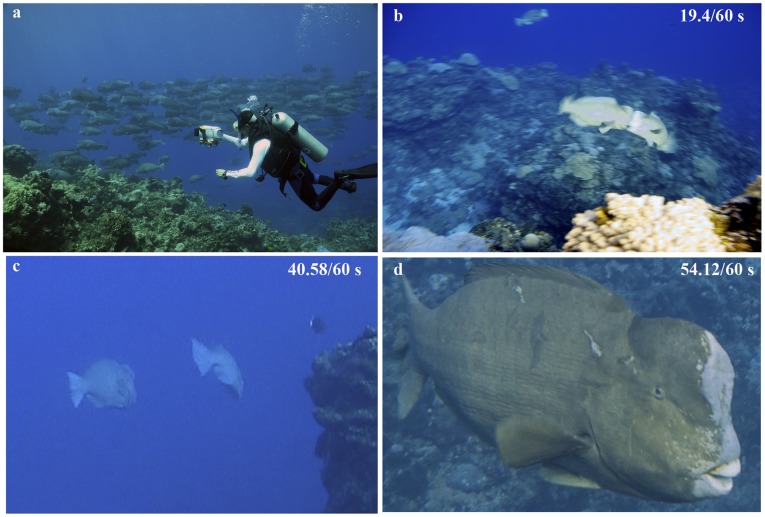
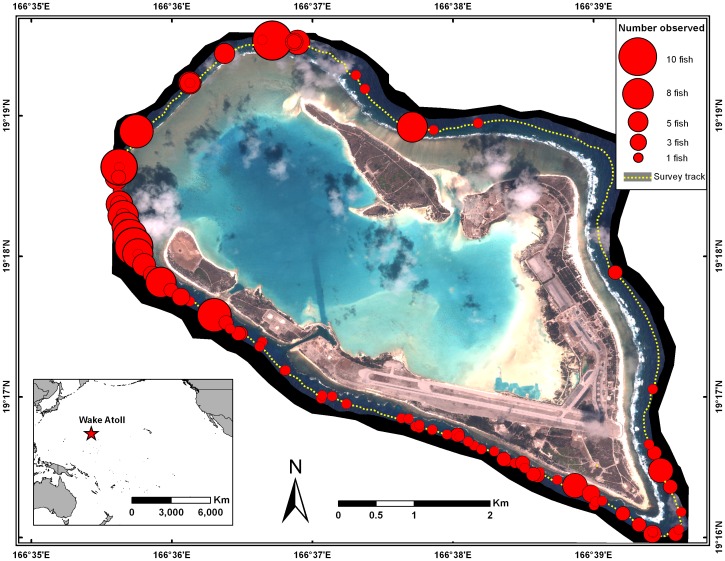
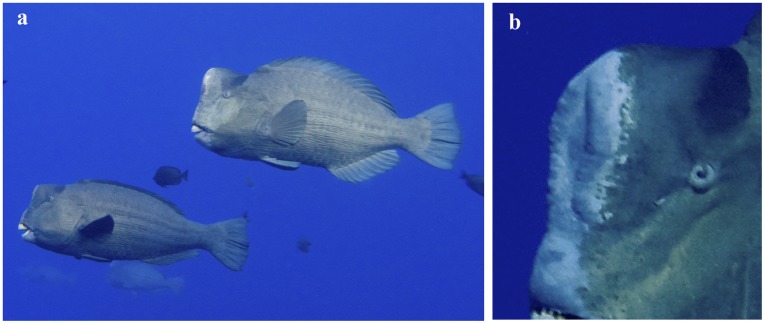
Human impacts to terrestrial and marine communities are widespread and typically begin with the local extirpation of large-bodied animals. In the marine environment, few pristine areas relatively free of human impact remain to provide baselines of ecosystem function and goals for restoration efforts. Recent comparisons of remote and/or protected coral reefs versus impacted sites suggest remote systems are dominated by apex predators, yet in these systems the ecological role of non-predatory, large-bodied, highly vulnerable species such as the giant bumphead parrotfish (Bolbometopon muricatum) has received less attention. Overfishing of Bolbometopon has lead to precipitous declines in population density and avoidance of humans throughout its range, contributing to its status as a candidate species under the U. S. Endangered Species Act and limiting opportunities to study unexploited populations. Here we show that extraordinary ecological processes, such as violent headbutting contests by the world's largest parrotfish, can be revealed by studying unexploited ecosystems, such as the coral reefs of Wake Atoll where we studied an abundant population of Bolbometopon. Bolbometopon is among the largest of coral reef fishes and is a well known, charismatic species, yet to our knowledge, no scientific documentation of ritualized headbutting exists for marine fishes. Our observations of aggressive headbutting by Bolbometopon underscore that remote locations and marine reserves, by inhibiting negative responses to human observers and by allowing the persistence of historical conditions, can provide valuable opportunities to study ecosystems in their natural state, thereby facilitating the discovery, conservation, and interpretation of a range of sometimes remarkable behavioral and ecological processes.
人类活动对陆地和海洋生物群落的影响广泛存在,通常始于大型动物的局部灭绝。在海洋环境中,几乎没有相对不受人类影响的原始区域,这些区域为生态系统功能提供了基准,并为恢复努力设定了目标。最近对偏远和/或受保护的珊瑚礁与受影响地点的比较表明,偏远系统由顶级捕食者主导,但在这些系统中,非捕食性、大型、高度脆弱的物种(如巨扁头鹦嘴鱼(Bolbometopon muricatum))的生态作用受到的关注较少。巨扁头鹦嘴鱼的过度捕捞导致其种群密度急剧下降,在其分布范围内对人类避之不及,这使其成为美国濒危物种法案下候选物种,并限制了对未开发种群进行研究的机会。在这里,我们表明,通过研究未受干扰的生态系统,如我们研究 Bolbometopon 丰富种群的威克环礁的珊瑚礁,可以揭示出非凡的生态过程,例如世界上最大的鹦嘴鱼的激烈碰头竞赛。Bolbometopon 是珊瑚礁鱼类中最大的鱼类之一,也是一种广为人知、魅力四射的物种,但据我们所知,海洋鱼类中没有关于仪式性碰头的科学记录。我们观察到 Bolbometopon 的攻击性碰头行为,这强调了偏远地区和海洋保护区通过抑制对人类观察者的负面反应并允许历史条件的持续存在,可以为研究自然状态下的生态系统提供宝贵的机会,从而促进一系列有时显著的行为和生态过程的发现、保护和解释。