Peking University Hepatology Institute, Peking University People’s Hospital, Beijing, China.
PLoS One. 2012;7(6):e38390. doi: 10.1371/journal.pone.0038390. Epub 2012 Jun 12.
To determine the capacity of dendritic cells (DCs) loaded with single or multiple-peptide mixtures of novel hepatitis C virus (HCV) epitopes to stimulate HCV-specific cytotoxic T lymphocyte (CTL) effector functions.
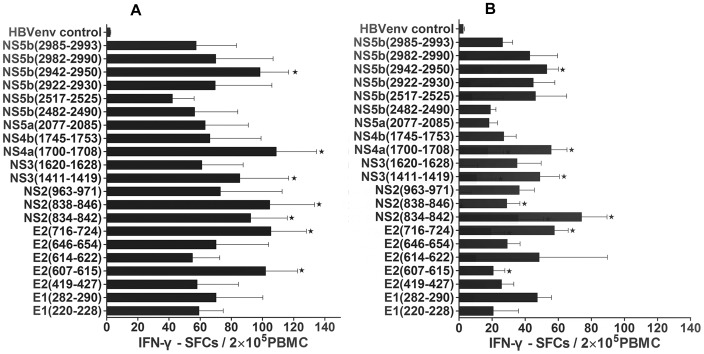
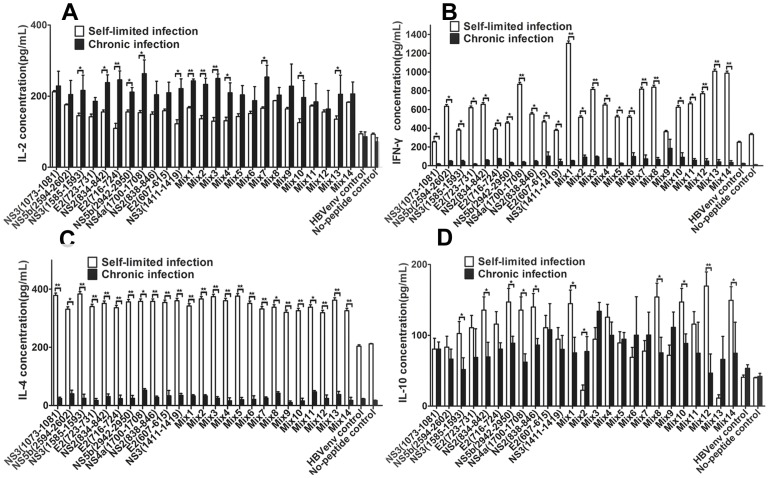
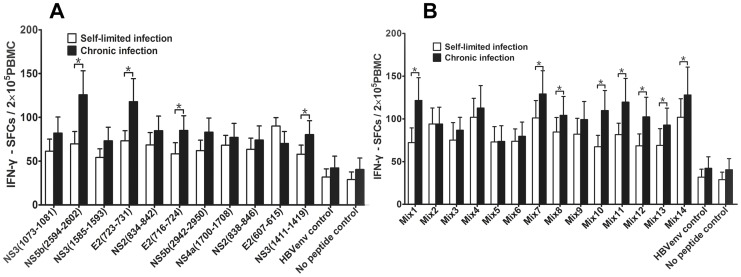
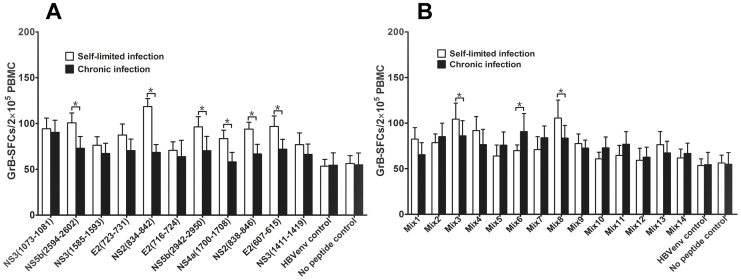
A bioinformatics approach was used to predict HLA-A2-restricted HCV-specific CTL epitopes, and the predicted peptides identified from this screen were synthesized. Subsequent IFN-γ ELISPOT analysis detected the stimulating function of these peptides in peripheral blood mononuclear cells (PBMCs) from both chronic and self-limited HCV infected subjects (subjects exhibiting spontaneous HCV clearance). Mature DCs, derived in vitro from CD14(+) monocytes harvested from the study subjects by incubation with appropriate cytokine cocktails, were loaded with novel peptide or epitope peptide mixtures and co-cultured with autologous T lymphocytes. Granzyme B (GrB) and IFN-γ ELISPOT analysis was used to test for epitope-specific CTL responses. T-cell-derived cytokines contained in the co-cultured supernatant were detected by flow cytometry.
We identified 7 novel HLA-A2-restricted HCV-specific CTL epitopes that increased the frequency of IFN-γ-producing T cells compared to other epitopes, as assayed by measuring spot forming cells (SFCs). Two epitopes had the strongest stimulating capability in the self-limited subjects, one found in the E2 and one in the NS2 region of HCV; five epitopes had a strong stimulating capacity in both chronic and self-limited HCV infection, but were stronger in the self-limited subjects. They were distributed in E2, NS2, NS3, NS4, and NS5 regions of HCV, respectively. We also found that mDCs loaded with novel peptide mixtures could significantly increase GrB and IFN-γ SFCs as compared to single peptides, especially in chronic HCV infection subjects. Additionally, we found that DCs pulsed with multiple epitope peptide mixtures induced a Th1-biased immune response.
Seven novel and strongly stimulating HLA-A2-restricted HCV-specific CTL epitopes were identified. Furthermore, DCs loaded with multiple-epitope peptide mixtures induced epitope-specific CTLs responses.
确定负载新型丙型肝炎病毒(HCV)表位的单一或多种肽混合物的树突状细胞(DC)刺激 HCV 特异性细胞毒性 T 淋巴细胞(CTL)效应功能的能力。
使用生物信息学方法预测 HLA-A2 限制的 HCV 特异性 CTL 表位,并从该筛选中鉴定出合成的预测肽。随后 IFN-γ ELISPOT 分析检测这些肽在慢性和自限性 HCV 感染受试者(表现出自发性 HCV 清除的受试者)的外周血单核细胞(PBMC)中的刺激功能。通过用适当的细胞因子鸡尾酒孵育从研究受试者中收获的 CD14+单核细胞,体外衍生成熟的 DC,用新型肽或表位肽混合物负载,并与自体 T 淋巴细胞共培养。用颗粒酶 B(GrB)和 IFN-γ ELISPOT 分析检测表位特异性 CTL 反应。通过流式细胞术检测共培养上清液中包含的 T 细胞衍生细胞因子。
我们鉴定了 7 种新型 HLA-A2 限制的 HCV 特异性 CTL 表位,与其他表位相比,通过测量斑点形成细胞(SFC),增加了 IFN-γ 产生 T 细胞的频率。在自限性受试者中,两个表位具有最强的刺激能力,一个位于 HCV 的 E2 区,一个位于 NS2 区;五个表位在慢性和自限性 HCV 感染中均具有很强的刺激能力,但在自限性受试者中更强。它们分别分布在 HCV 的 E2、NS2、NS3、NS4 和 NS5 区。我们还发现,与单一肽相比,负载新型肽混合物的 mDC 可显著增加 GrB 和 IFN-γ SFC,尤其是在慢性 HCV 感染受试者中。此外,我们发现,用多个表位肽混合物脉冲处理的 DC 诱导了 Th1 偏向的免疫反应。
确定了 7 种新型且强烈刺激的 HLA-A2 限制的 HCV 特异性 CTL 表位。此外,负载多种表位肽混合物的 DC 诱导了表位特异性 CTL 反应。