Gene Therapy and Hepatology Area, Centre for Applied Medical Research (CIMA), University of Navarra, Navarra, Spain.
J Transl Med. 2012 Jun 15;10:122. doi: 10.1186/1479-5876-10-122.
Adeno-associated vectors (rAAV) have been used to attain long-term liver gene expression. In humans, the cellular immune response poses a serious obstacle for transgene persistence while neutralizing humoral immunity curtails re-administration. Porphobilinogen deaminase (PBGD) haploinsufficiency (acute intermittent porphyria) benefits from liver gene transfer in mouse models and clinical trials are about to begin. In this work, we sought to study in non-human primates the feasibility of repeated gene-transfer with intravenous administration of rAAV5 vectors under the effects of an intensive immunosuppressive regimen and to analyze its ability to circumvent T-cell immunity and thereby prolong transgene expression.
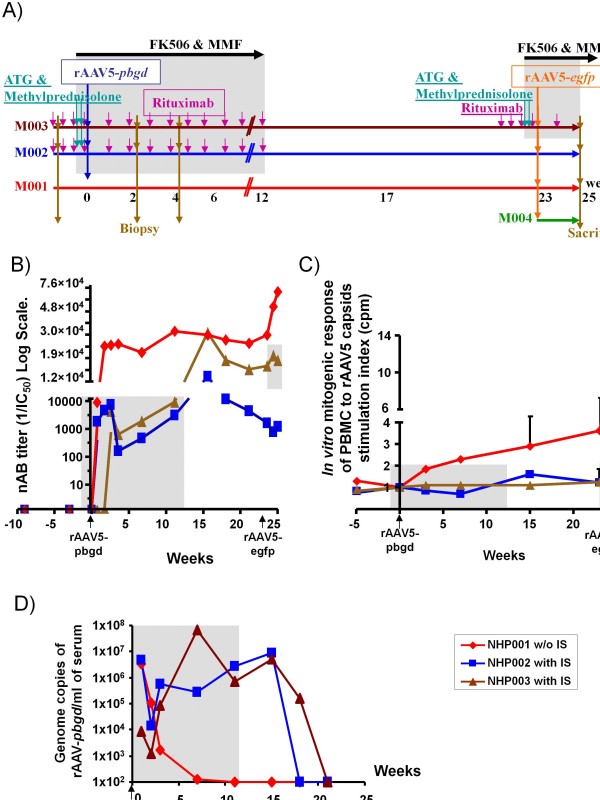
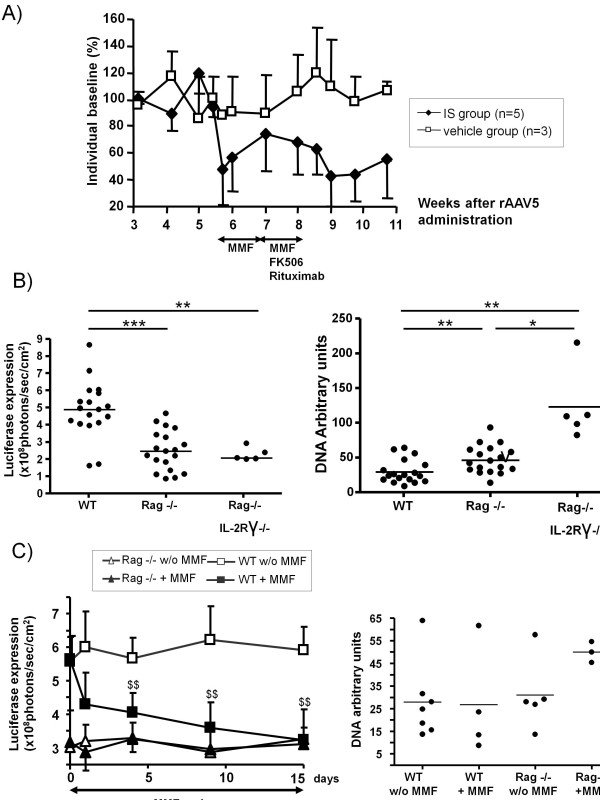
Three female Macaca fascicularis were intravenously injected with 1 x 10(13) genome copies/kg of rAAV5 encoding the human PBGD. Mycophenolate mofetil (MMF), anti-thymocyte immunoglobulin, methylprednisolone, tacrolimus and rituximab were given in combination during 12 weeks to block T- and B-cell mediated adaptive immune responses in two macaques. Immunodeficient and immunocompetent mice were intravenously injected with 5 x 10(12) genome copies/kg of rAAV5-encoding luciferase protein. Forty days later MMF, tacrolimus and rituximab were daily administrated to ascertain whether the immunosuppressants or their metabolites could interfere with transgene expression.
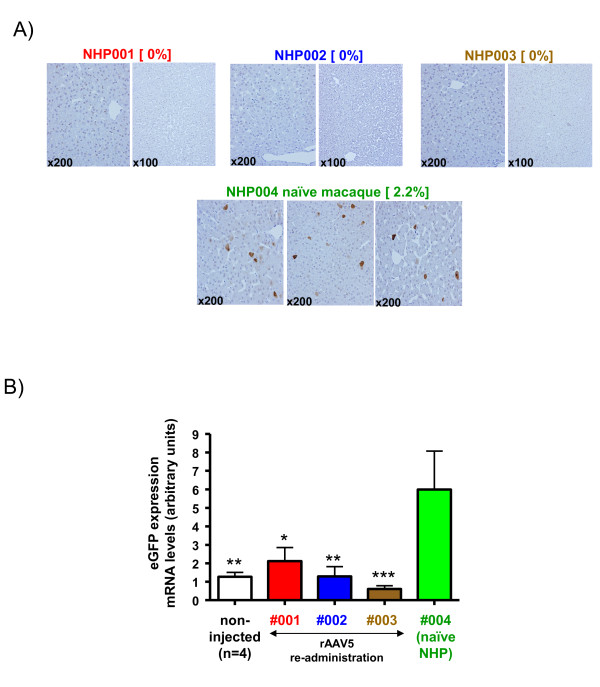
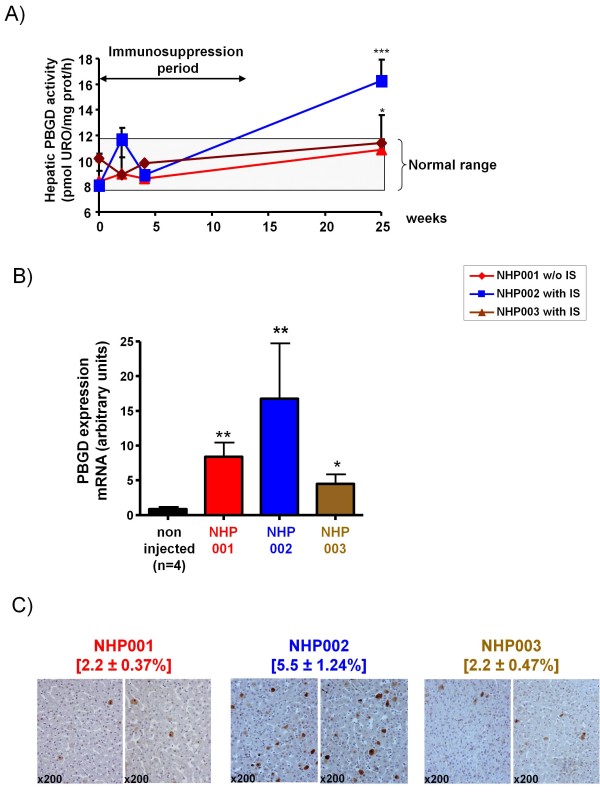
Macaques given a rAAV5 vector encoding human PBGD developed cellular and humoral immunity against viral capsids but not towards the transgene. Anti-AAV humoral responses were attenuated during 12 weeks but intensely rebounded following cessation of the immunosuppressants. Accordingly, subsequent gene transfer with a rAAV5 vector encoding green fluorescent protein was impossible. One macaque showed enhanced PBGD expression 25 weeks after rAAV5-pbgd administration but overexpression had not been detected while the animal was under immunosuppression. As a potential explanation, MMF decreases transgene expression in mouse livers that had been successfully transduced by a rAAV5 several weeks before MMF onset. Such a silencing effect was independent of AAV complementary strand synthesis and requires an adaptive immune system.
These results indicate that our transient and intensive pharmacological immunosuppression fails to improve AAV5-based liver gene transfer in non-human primates. The reasons include an incomplete restraint of humoral immune responses to viral capsids that interfere with repeated gene transfer in addition to an intriguing MMF-dependent drug-mediated interference with liver transgene expression.
腺相关病毒(rAAV)已被用于实现长期的肝脏基因表达。在人类中,细胞免疫反应对转基因的持续存在构成了严重障碍,而中和体液免疫则会限制再次给药。卟啉原脱氨酶(PBGD)单倍体不足(急性间歇性卟啉症)在小鼠模型中受益于肝基因转移,临床试验即将开始。在这项工作中,我们试图在非人类灵长类动物中研究静脉内给予 rAAV5 载体进行重复基因转移的可行性,该载体在强化免疫抑制方案的作用下,并分析其规避 T 细胞免疫的能力,从而延长转基因的表达。
三只雌性恒河猴经静脉注射 1×10(13)基因组拷贝/千克的 rAAV5 编码人 PBGD。在两只猕猴中,给予霉酚酸酯(MMF)、抗胸腺细胞免疫球蛋白、甲基强的松龙、他克莫司和利妥昔单抗联合使用 12 周,以阻断 T 和 B 细胞介导的适应性免疫反应。免疫缺陷和免疫功能正常的小鼠经静脉注射 5×10(12)基因组拷贝/千克的 rAAV5 编码荧光素酶蛋白。40 天后,每天给予 MMF、他克莫司和利妥昔单抗,以确定免疫抑制剂或其代谢物是否会干扰转基因的表达。
接受 rAAV5 载体编码人 PBGD 的恒河猴产生了针对病毒衣壳的细胞和体液免疫反应,但不针对转基因。抗 AAV 体液免疫反应在 12 周内减弱,但在免疫抑制剂停药后强烈反弹。因此,随后用 rAAV5 载体编码绿色荧光蛋白进行基因转移是不可能的。一只猕猴在接受 rAAV5-pbgd 治疗 25 周后 PBGD 表达增强,但在接受免疫抑制治疗时未检测到过表达。作为一种潜在的解释,MMF 降低了几周前被 rAAV5 成功转导的小鼠肝脏中的转基因表达。这种沉默效应独立于 AAV 互补链合成,需要适应性免疫系统。
这些结果表明,我们短暂而强烈的药物免疫抑制未能改善非人类灵长类动物的 rAAV5 为基础的肝脏基因转移。原因包括不完全抑制对病毒衣壳的体液免疫反应,从而干扰了重复基因转移,此外,还有一种有趣的 MMF 依赖性药物介导的肝转基因表达干扰。