National Program Office, Public Health Law Research Program, Temple University, USA.
Milbank Q. 2012 Jun;90(2):375-408. doi: 10.1111/j.1468-0009.2012.00667.x.
For three decades, experts have been stressing the importance of law to the effective operation of public health systems. Most recently, in a 2011 report, the Institute of Medicine recommended a review of state and local public health laws to ensure appropriate authority for public health agencies; adequate access to legal counsel for public health agencies; evaluations of the health effects and costs associated with legislation, regulations, and policies; and enhancement of research methods to assess the strength of evidence regarding the health effects of public policies. These recommendations, and the continued interest in law as a determinant of health system performance, speak to the need for integrating the emerging fields of Public Health Law Research (PHLR) and Public Health Systems and Services Research (PHSSR).
Expert commentary.
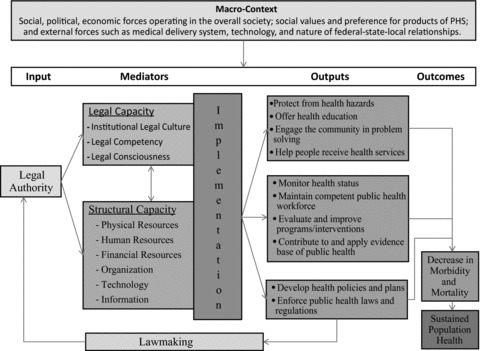
This article sets out a unified framework for the two fields and a shared research agenda built around three broad inquiries: (1) the structural role of law in shaping the organization, powers, prerogatives, duties, and limitations of public health agencies and thereby their functioning and ultimately their impact on public health ("infrastructure"); (2) the mechanisms through which public health system characteristics influence the implementation of interventional public health laws ("implementation"); and (3) the individual and system characteristics that influence the ability of public health systems and their community partners to develop and secure enactment of legal initiatives to advance public health ("innovation"). Research to date has laid a foundation of evidence, but progress requires better and more accessible data, a new generation of researchers comfortable in both law and health research, and more rigorous methods.
The routine integration of law as a salient factor in broader PHSSR studies of public health system functioning and health outcomes will enhance the usefulness of research in supporting practice and the long-term improvement of system performance.
三十年来,专家们一直强调法律对公共卫生系统有效运作的重要性。最近,在 2011 年的一份报告中,美国国家医学研究院建议审查州和地方公共卫生法,以确保公共卫生机构拥有适当的权力;为公共卫生机构提供充足的法律顾问;评估与立法、法规和政策相关的健康影响和成本;并加强研究方法,以评估有关公共政策对健康影响的证据力度。这些建议以及对法律作为健康系统绩效决定因素的持续关注,表明需要整合公共卫生法研究(PHLR)和公共卫生系统和服务研究(PHSSR)这两个新兴领域。
专家评论。
本文为这两个领域制定了一个统一的框架,并围绕三个广泛的问题制定了一个共同的研究议程:(1)法律在塑造公共卫生机构的组织、权力、特权、职责和限制方面的结构作用,从而影响其运作,并最终影响其对公共卫生的影响(“基础设施”);(2)公共卫生系统特征影响干预性公共卫生法实施的机制(“实施”);(3)影响公共卫生系统及其社区合作伙伴制定和确保法律举措的通过以促进公共卫生的能力的个人和系统特征(“创新”)。迄今为止,已有研究为证据奠定了基础,但要取得进展,需要更好、更易于获取的数据、新一代既熟悉法律又熟悉健康研究的研究人员,以及更严格的方法。
将法律作为公共卫生系统功能和健康结果更广泛的 PHSSR 研究中的一个突出因素进行常规整合,将提高研究在支持实践和长期改善系统绩效方面的实用性。