Department of Health Policy & Management, Columbia Mailman School of Public Health, New York, New York, United States of America.
Department of Health Research and Policy, Stanford School of Medicine, Stanford Law School, Palo Alto, California, United States of America.
PLoS One. 2019 Oct 1;14(10):e0220971. doi: 10.1371/journal.pone.0220971. eCollection 2019.
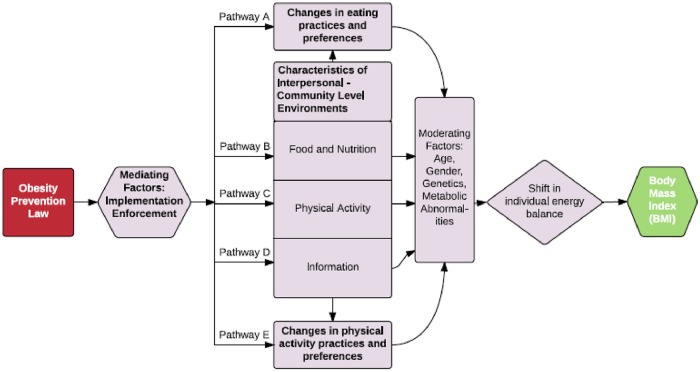
State lawmakers have explored numerous policy alternatives to reduce overweight and obesity. Evaluating effects of these laws is important but presents substantial methodological challenges. We present a conceptual framework that allows for classification of obesity prevention laws based on ecological level of influence and the underlying legal mechanism involved to guide analysis of the relationship between a substantial range of obesity prevention laws and BMI.
Obesity prevention laws (OPLs) for all 50 states and DC were obtained via primary legal research using the LexisNexis Advanced Legislative Services (ALS) database. For legal provisions that met inclusion criteria, reviewers abstracted information on bill state, citation, passage and effective dates, target population, and obesity prevention mechanism. Laws were categorized by ecological level of influence on weight-related behaviors and the legal mechanism utilized to change behavioral determinants of BMI.
Laws designed to increase community-level opportunities for physical activity were the most frequently enacted OPL while laws designed to alter nutrition standards for school meals or competitive foods were comparatively less common, appearing in only 16% and 34% of states, respectively.
Prior studies of obesity policies have focused on specific interventions. We identified and categorized state-level laws that operate at all ecological levels and found that laws passed during the initial burst of lawmaking were largely confined to measures aimed at increasing opportunities for physical activity. Creating public spaces for recreation is an important step to promoting healthier lifestyles to reduce obesity risk; more comprehensive, multilevel legal approaches should also be pursued.
州议员已经探索了许多政策选择来减少超重和肥胖。评估这些法律的效果很重要,但存在很大的方法学挑战。我们提出了一个概念框架,可以根据影响的生态水平和涉及的基本法律机制对肥胖预防法进行分类,以指导分析大量肥胖预防法与 BMI 之间的关系。
通过使用 LexisNexis 高级立法服务 (ALS) 数据库进行主要法律研究,获得了所有 50 个州和哥伦比亚特区的肥胖预防法 (OPL)。对于符合纳入标准的法律规定,审查员从法案状态、引文、通过和生效日期、目标人群和肥胖预防机制等方面提取信息。根据对与体重相关行为的生态影响水平和用于改变 BMI 的行为决定因素的法律机制对法律进行分类。
旨在增加社区层面体育活动机会的法律是最常颁布的肥胖预防法,而旨在改变学校膳食或竞争食品营养标准的法律则相对较少,分别仅出现在 16%和 34%的州。
先前对肥胖政策的研究集中在特定干预措施上。我们确定并分类了在所有生态水平上运作的州一级法律,发现在立法初始阶段通过的法律主要局限于旨在增加体育活动机会的措施。创造娱乐公共空间是促进更健康生活方式以降低肥胖风险的重要步骤;还应采取更全面、多层次的法律方法。