Molecular Therapeutics for Cancer Ireland, National Institute for Cellular Biotechnology, Dublin City University, Glasnevin, Dublin 9, Ireland.
Mol Cancer. 2012 Jun 18;11:41. doi: 10.1186/1476-4598-11-41.
Lapatinib, a tyrosine kinase inhibitor of HER2 and EGFR and is approved, in combination with capecitabine, for the treatment of trastuzumab-refractory metastatic breast cancer. In order to establish a possible gene expression response to lapatinib, a panel of breast cancer cell lines with varying sensitivity to lapatinib were analysed using a combination of microarray and qPCR profiling.
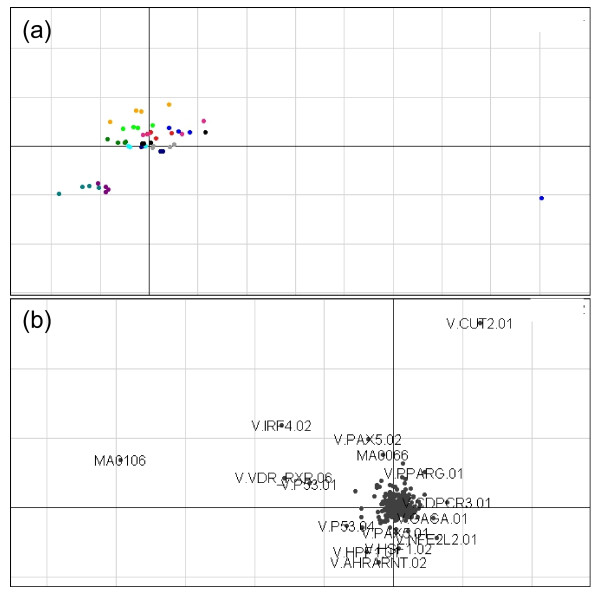
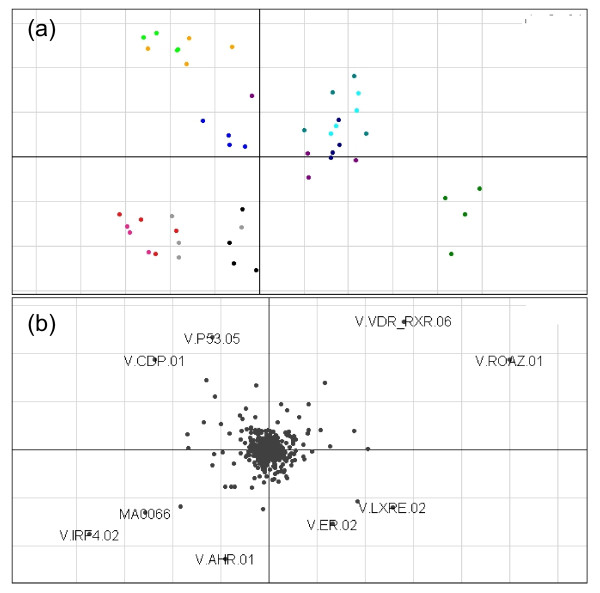
Co-inertia analysis (CIA), a data integration technique, was used to identify transcription factors associated with the lapatinib response on a previously published dataset of 96 microarrays. RNA was extracted from BT474, SKBR3, EFM192A, HCC1954, MDAMB453 and MDAMB231 breast cancer cell lines displaying a range of lapatinib sensitivities and HER2 expression treated with 1 μM of lapatinib for 12 hours and quantified using Taqman RT-PCR. A fold change ≥ ± 2 was considered significant.
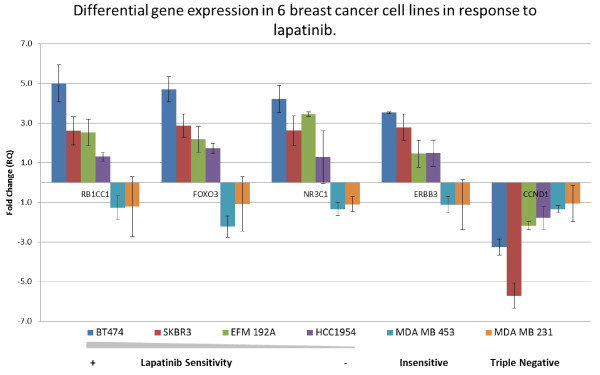
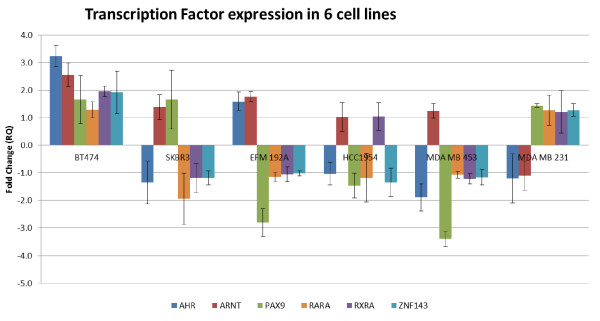
A list of 421 differentially-expressed genes and 8 transcription factors (TFs) whose potential regulatory impact was inferred in silico, were identified as associated with lapatinib response. From this group, a panel of 27 genes (including the 8 TFs) were selected for qPCR validation. 5 genes were determined to be significantly differentially expressed following the 12 hr treatment of 1 μM lapatinib across all six cell lines. Furthermore, the expression of 4 of these genes (RB1CC1, FOXO3A, NR3C1 and ERBB3) was directly correlated with the degree of sensitivity of the cell line to lapatinib and their expression was observed to "switch" from up-regulated to down-regulated when the cell lines were arranged in a lapatinib-sensitive to insensitive order. These included the novel lapatinib response-associated genes RB1CC1 and NR3C1. Additionally, Cyclin D1 (CCND1), a common regulator of the other four proteins, was also demonstrated to observe a proportional response to lapatinib exposure.
A panel of 5 genes were determined to be differentially expressed in response to lapatinib at the 12 hour time point examined. The expression of these 5 genes correlated directly with lapatinib sensitivity. We propose that the gene expression profile may represent both an early measure of the likelihood of sensitivity and the level of response to lapatinib and may therefore have application in early response detection.
拉帕替尼是一种针对 HER2 和 EGFR 的酪氨酸激酶抑制剂,与卡培他滨联合用于治疗曲妥珠单抗耐药的转移性乳腺癌。为了确定 lapatinib 可能的基因表达反应,我们使用微阵列和 qPCR 分析方法对一组对 lapatinib 敏感性不同的乳腺癌细胞系进行了分析。
共惯性分析(CIA)是一种数据整合技术,我们使用该技术对之前发表的 96 个微阵列数据集进行分析,确定与 lapatinib 反应相关的转录因子。从显示 lapatinib 敏感性和 HER2 表达范围的 BT474、SKBR3、EFM192A、HCC1954、MDAMB453 和 MDAMB231 乳腺癌细胞系中提取 RNA,用 1 μM lapatinib 处理 12 小时,用 Taqman RT-PCR 定量。倍数变化≥±2 被认为具有显著性。
我们鉴定出了一组 421 个差异表达基因和 8 个转录因子(TFs),它们的潜在调控作用是通过计算机推断出来的,这些基因与 lapatinib 反应相关。从这个组中,选择了 27 个基因(包括 8 个 TFs)进行 qPCR 验证。在 lapatinib 处理所有六种细胞系的 12 小时后,有 5 个基因被确定为显著差异表达。此外,这 4 个基因(RB1CC1、FOXO3A、NR3C1 和 ERBB3)的表达与细胞系对 lapatinib 的敏感性直接相关,当细胞系按 lapatinib 敏感性由高到低排列时,它们的表达从上调变为下调。这些基因包括 RB1CC1 和 NR3C1,它们是 lapatinib 反应相关的新基因。此外,细胞周期蛋白 D1(CCND1)是其他四个蛋白的常见调节剂,也被证明对 lapatinib 暴露有比例响应。
在我们检查的 12 小时时间点,确定了一组 5 个基因对 lapatinib 有差异表达。这 5 个基因的表达与 lapatinib 敏感性直接相关。我们提出,该基因表达谱可能既代表了对 lapatinib 敏感性的早期衡量,也代表了对 lapatinib 的反应水平,因此可能具有早期反应检测的应用价值。