Department of Pathology, Norris Comprehensive Cancer Center, University of Southern California, Los Angeles, California 90089, USA.
Cancer Res. 2011 May 15;71(10):3635-48. doi: 10.1158/0008-5472.CAN-10-2430. Epub 2011 Apr 4.
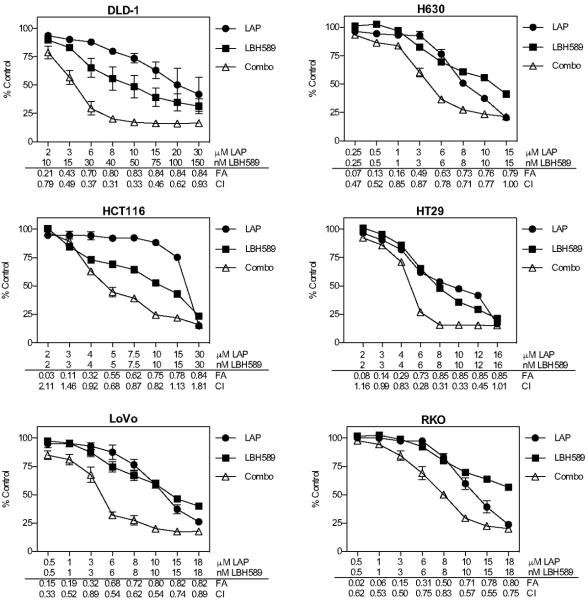
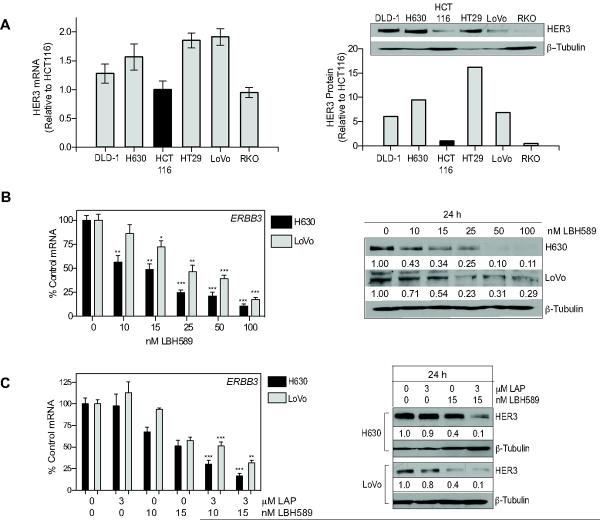
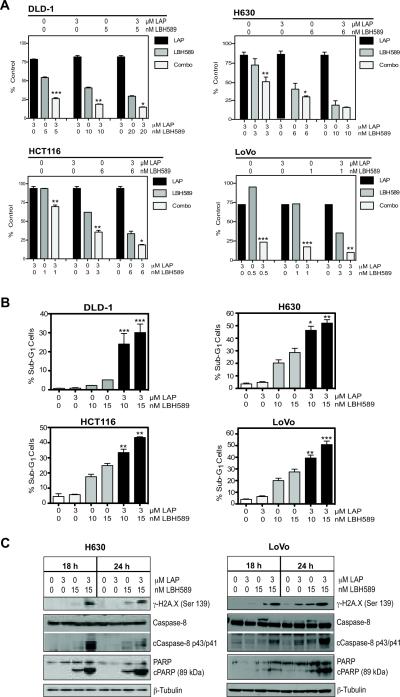
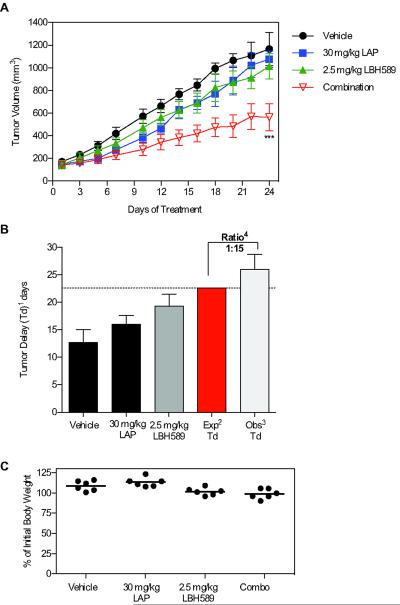
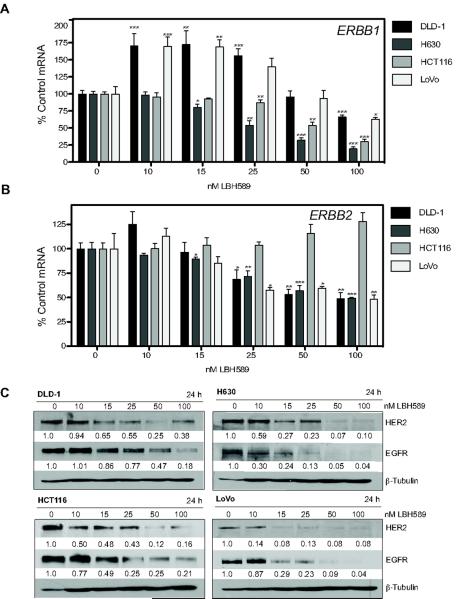
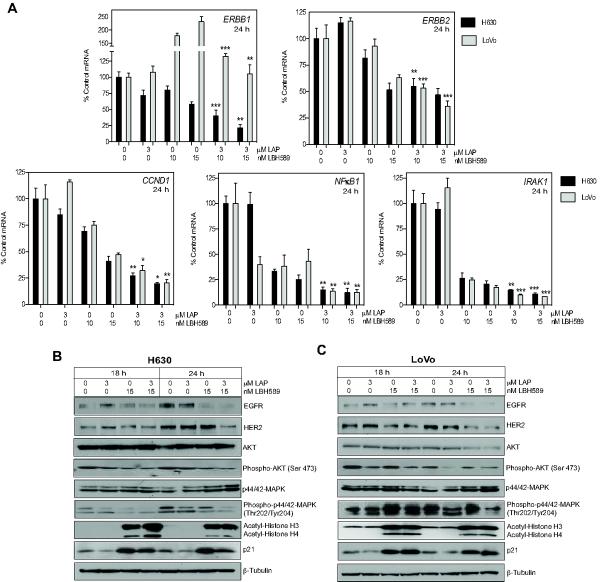
As key molecules that drive progression and chemoresistance in gastrointestinal cancers, epidermal growth factor receptor (EGFR) and HER2 have become efficacious drug targets in this setting. Lapatinib is an EGFR/HER2 kinase inhibitor suppressing signaling through the RAS/RAF/MEK (MAP/ERK kinase)/MAPK (mitogen-activated protein kinase) and PI3K (phosphoinositide 3-kinase)/AKT pathways. Histone deacetylase inhibitors (HDACi) are a novel class of agents that induce cell cycle arrest and apoptosis following the acetylation of histone and nonhistone proteins modulating gene expression and disrupting HSP90 function inducing the degradation of EGFR-pathway client proteins. This study sought to evaluate the therapeutic potential of combining lapatinib with the HDACi panobinostat in colorectal cancer (CRC) cell lines with varying EGFR/HER2 expression and KRAS/BRAF/PIK3CA mutations. Lapatinib and panobinostat exerted concentration-dependent antiproliferative effects in vitro (panobinostat range 7.2-30 nmol/L; lapatinib range 7.6-25.8 μmol/L). Combined lapatinib and panobinostat treatment interacted synergistically to inhibit the proliferation and colony formation in all CRC cell lines tested. Combination treatment resulted in rapid induction of apoptosis that coincided with increased DNA double-strand breaks, caspase-8 activation, and PARP cleavage. This was paralleled by decreased signaling through both the PI3K and MAPK pathways and increased downregulation of transcriptional targets including NF-κB1, IRAK1, and CCND1. Panobinostat treatment induced downregulation of EGFR, HER2, and HER3 mRNA and protein through transcriptional and posttranslational mechanisms. In the LoVo KRAS mutant CRC xenograft model, the combination showed greater antitumor activity than either agent alone, with no apparent increase in toxicity. Our results offer preclinical rationale warranting further clinical investigation combining HDACi with EGFR and HER2-targeted therapies for CRC treatment.
作为推动胃肠道癌症进展和化疗耐药的关键分子,表皮生长因子受体(EGFR)和 HER2 已成为该领域有效的药物靶点。拉帕替尼是一种 EGFR/HER2 激酶抑制剂,通过 RAS/RAF/MEK(MAP/ERK 激酶)/MAPK(丝裂原激活蛋白激酶)和 PI3K(磷酸肌醇 3-激酶)/AKT 通路抑制信号传导。组蛋白去乙酰化酶抑制剂(HDACi)是一类新型药物,通过乙酰化组蛋白和非组蛋白蛋白,调节基因表达和破坏 HSP90 功能,诱导 EGFR 通路客户蛋白降解,从而导致细胞周期停滞和凋亡。本研究旨在评估在 EGFR/HER2 表达和 KRAS/BRAF/PIK3CA 突变不同的结直肠癌(CRC)细胞系中联合使用拉帕替尼和 HDACi 帕比司他的治疗潜力。拉帕替尼和帕比司他在体外均表现出浓度依赖性的抗增殖作用(帕比司他浓度范围为 7.2-30 nmol/L;拉帕替尼浓度范围为 7.6-25.8 μmol/L)。联合使用拉帕替尼和帕比司他治疗可协同抑制所有测试的 CRC 细胞系的增殖和集落形成。联合治疗导致细胞凋亡迅速诱导,与 DNA 双链断裂增加、半胱天冬酶-8 激活和 PARP 切割同时发生。这与 PI3K 和 MAPK 通路的信号传导减少以及转录靶标(包括 NF-κB1、IRAK1 和 CCND1)的下调平行。帕比司他治疗通过转录和翻译后机制诱导 EGFR、HER2 和 HER3 mRNA 和蛋白的下调。在 LoVo KRAS 突变型 CRC 异种移植模型中,联合治疗比单独使用任何一种药物都具有更强的抗肿瘤活性,且毒性无明显增加。我们的研究结果提供了临床前依据,证明在 CRC 治疗中联合使用 HDACi 和 EGFR 和 HER2 靶向治疗具有进一步的临床研究价值。