Department of Obstetrics and Fetal-Maternal Medicine, Reproductive Biology Unit, Medical University of Vienna, Waehringer Guertel 18-20, A-1090 Vienna, Austria.
Placenta. 2012 Sep;33(9):696-703. doi: 10.1016/j.placenta.2012.05.008. Epub 2012 Jun 17.
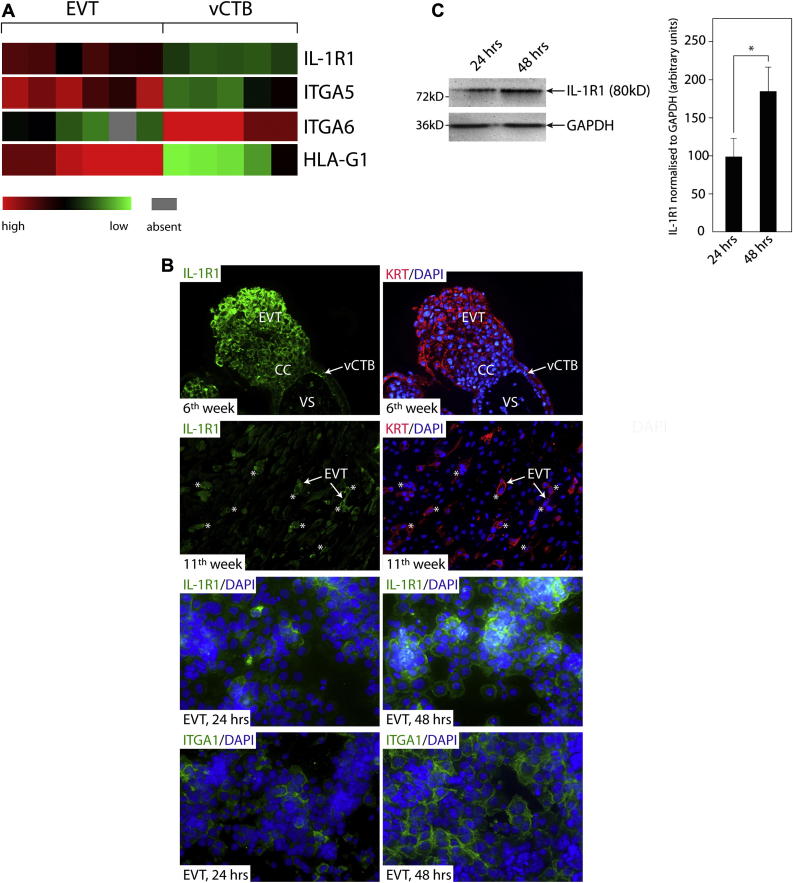
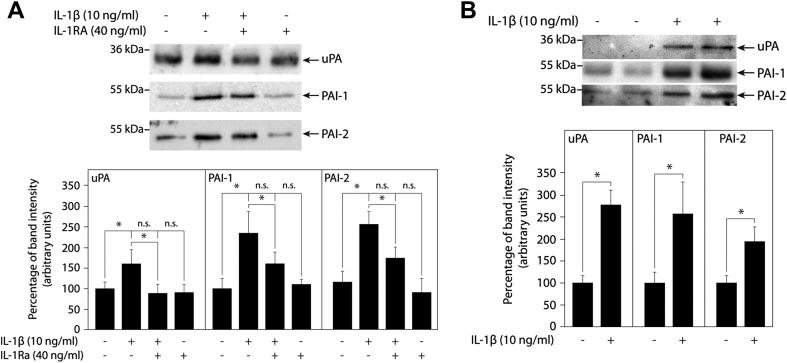
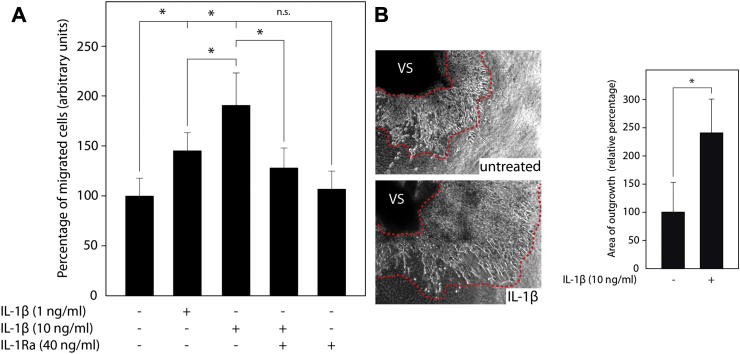
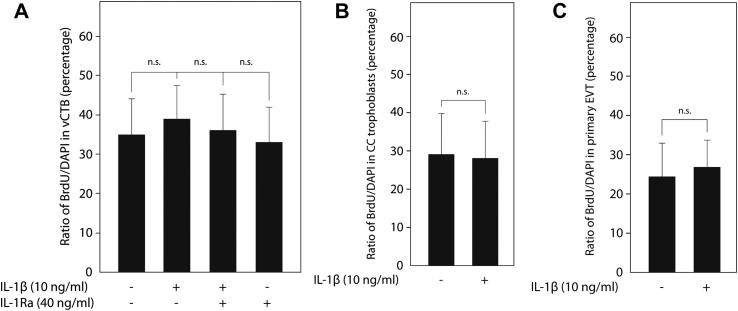
The pleiotropic cytokine interleukin-1β (IL-1β) can promote physiological cell migration, as well as cancer cell invasion and metastasis. Its role in human trophoblast invasion, however, has not been satisfactorily answered since direct, indirect as well as no effects on trophoblast motility have been published. Therefore, the role of IL-1β has been re-evaluated by exclusively using human primary trophoblast model systems. Immunofluorescence of first trimester placentae indicated IL-1 receptor 1 (IL-1R1) protein expression in first trimester villous cytotrophoblasts (vCTB) and extravillous trophoblasts (EVT). The latter expressed higher mRNA levels of the receptor as shown by comparative gene chip data of vCTB and EVT. Similarly, Western blot analyses and immunofluorescence revealed a time- and differentiation-dependent increase of IL-1R1 in primary EVT seeded on fibronectin. IL-1β dose-dependently elevated migration of isolated first trimester EVT through fibronectin-coated transwells, which was inhibited in the presence of IL-1R antagonist (IL-1Ra), whereas proliferation of these cells was not affected. Similarly, the interleukin did not alter proliferation of vCTB and cell column trophoblasts in floating villi of early pregnancy, but promoted migration in villous explant cultures seeded on collagen I. Western blot analyses of supernatants of primary EVT and first trimester villous explant cultures revealed IL-1β induced secretion of urokinase plasminogen activator (uPA), plasminogen activator inhibitor (PAI)-1 and PAI-2, which was diminished upon combined IL-1β/IL-1Ra treatment. In conclusion, these data suggest that IL-1β directly promotes trophoblast motility of first trimester EVT involving the uPA/PAI system.
白细胞介素-1β(IL-1β)是一种具有多种功能的细胞因子,可促进生理细胞迁移以及癌细胞侵袭和转移。然而,其在人类滋养细胞侵袭中的作用尚未得到满意解答,因为已有直接、间接和对滋养细胞迁移无影响的报道。因此,本研究仅使用人源滋养细胞模型系统重新评估了 IL-1β的作用。对早孕期胎盘进行免疫荧光染色,结果表明 IL-1 受体 1(IL-1R1)蛋白在绒毛细胞滋养层(vCTB)和绒毛外滋养层(EVT)中表达。比较 vCTB 和 EVT 的基因芯片数据表明,后者表达更高水平的受体 mRNA。同样,Western blot 分析和免疫荧光染色结果显示,在纤维连接蛋白上接种的原代 EVT 中,IL-1R1 呈时间和分化依赖性增加。IL-1β 剂量依赖性地增加了分离的早孕期 EVT 通过纤维连接蛋白包被的 Transwell 的迁移,而在存在 IL-1R 拮抗剂(IL-1Ra)的情况下,这种迁移被抑制,而这些细胞的增殖不受影响。同样,白细胞介素也没有改变早孕期妊娠绒毛中 vCTB 和细胞柱滋养层的增殖,但在胶原 I 上接种绒毛外植体培养物中促进了迁移。对原代 EVT 和早孕期绒毛外植体培养物上清液的 Western blot 分析显示,IL-1β 诱导尿激酶型纤溶酶原激活物(uPA)、纤溶酶原激活物抑制剂-1(PAI-1)和 PAI-2 的分泌,而联合使用 IL-1β/IL-1Ra 治疗则减少了这些物质的分泌。综上所述,这些数据表明,IL-1β 直接促进早孕期 EVT 的滋养细胞迁移,涉及 uPA/PAI 系统。