
COL7A1基因突变导致罗特斯 Höhenvieh 牛患营养不良性大疱性表皮松解症。
A COL7A1 mutation causes dystrophic epidermolysis bullosa in Rotes Höhenvieh cattle.
作者信息
Menoud Annie, Welle Monika, Tetens Jens, Lichtner Peter, Drögemüller Cord
机构信息
Institute of Genetics, Vetsuisse Faculty, University of Bern, Bern, Switzerland.
出版信息
PLoS One. 2012;7(6):e38823. doi: 10.1371/journal.pone.0038823. Epub 2012 Jun 8.
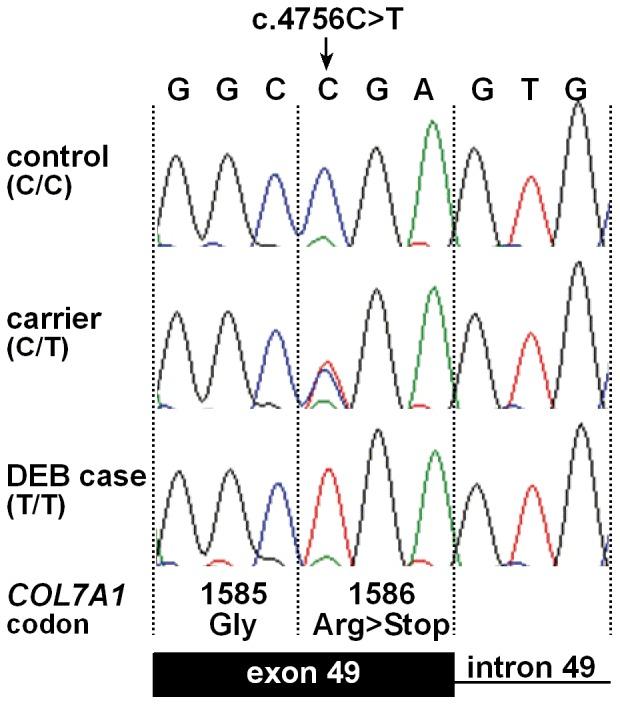
We identified a congenital mechanobullous skin disorder in six calves on a single farm of an endangered German cattle breed in 2010. The condition presented as a large loss of skin distal to the fetlocks and at the mucosa of the muzzle. All affected calves were euthanized on humane grounds due to the severity, extent and progression of the skin and oral lesions. Examination of skin samples under light microscopy revealed detachment of the epidermis from the dermis at the level of the dermo epidermal junction, leading to the diagnosis of a subepidermal bullous dermatosis such as epidermolysis bullosa. The pedigree was consistent with monogenic autosomal recessive inheritance. We localized the causative mutation to an 18 Mb interval on chromosome 22 by homozygosity mapping. The COL7A1 gene encoding collagen type VII alpha 1 is located within this interval and COL7A1 mutations have been shown to cause inherited dystrophic epidermolysis bullosa (DEB) in humans. A SNP in the bovine COL7A1 exon 49 (c.4756C>T) was perfectly associated with the observed disease. The homozygous mutant T/T genotype was exclusively present in affected calves and their parents were heterozygous C/T confirming the assumed recessive mode of inheritance. All known cases and genotyped carriers were related to a single cow, which is supposed to be the founder animal. The mutant T allele was absent in 63 animals from 24 cattle breeds. The identified mutation causes a premature stop codon which leads to a truncated protein representing a complete loss of COL7A1 function (p.R1586*). We thus have identified a candidate causative mutation for this genetic disease using only three cases to unravel its molecular basis. Selection against this mutation can now be used to eliminate the mutant allele from the Rotes Höhenvieh breed.
2010年,我们在一个濒危德国牛品种的单一农场的6头犊牛中发现了一种先天性机械性大疱性皮肤病。该病表现为跗关节远端皮肤和口鼻部黏膜大面积缺失。由于皮肤和口腔病变的严重程度、范围和进展情况,所有患病犊牛均出于人道考虑实施了安乐死。光学显微镜下对皮肤样本的检查显示,在真皮表皮交界处表皮与真皮分离,从而诊断为表皮下大疱性皮肤病,如大疱性表皮松解症。系谱符合单基因常染色体隐性遗传。通过纯合性定位,我们将致病突变定位到22号染色体上一个18 Mb的区间。编码VII型胶原蛋白α1的COL7A1基因位于该区间内,并且已证明COL7A1突变可导致人类遗传性营养不良性大疱性表皮松解症(DEB)。牛COL7A1外显子49中的一个单核苷酸多态性(c.4756C>T)与观察到的疾病完全相关。纯合突变T/T基因型仅存在于患病犊牛中,其父母为杂合子C/T,证实了假定的隐性遗传模式。所有已知病例和基因分型携带者都与一头母牛有关,这头母牛被认为是奠基动物。来自24个牛品种的63头动物中不存在突变T等位基因。所鉴定的突变导致一个过早的终止密码子,从而产生一种截短的蛋白质,代表COL7A1功能完全丧失(p.R1586*)。因此,我们仅使用3个病例就确定了这种遗传疾病的候选致病突变,以阐明其分子基础。现在可以针对这种突变进行选择,以从红高地牛品种中消除突变等位基因。


 Zotero 插件