Unité Peste, Institut Pasteur de Madagascar, Antananarivo, Madagascar.
PLoS One. 2012;7(6):e38630. doi: 10.1371/journal.pone.0038630. Epub 2012 Jun 18.
Plague is endemic within the central highlands of Madagascar, where its main reservoir is the black rat, Rattus rattus. Typically this species is considered susceptible to plague, rapidly dying after infection inducing the spread of infected fleas and, therefore, dissemination of the disease to humans. However, persistence of transmission foci in the same area from year to year, supposes mechanisms of maintenance among which rat immune responses could play a major role. Immunity against plague and subsequent rat survival could play an important role in the stabilization of the foci. In this study, we aimed to investigate serological responses to plague in wild black rats from endemic areas of Madagascar. In addition, we evaluate the use of a recently developed rapid serological diagnostic test to investigate the immune response of potential reservoir hosts in plague foci.
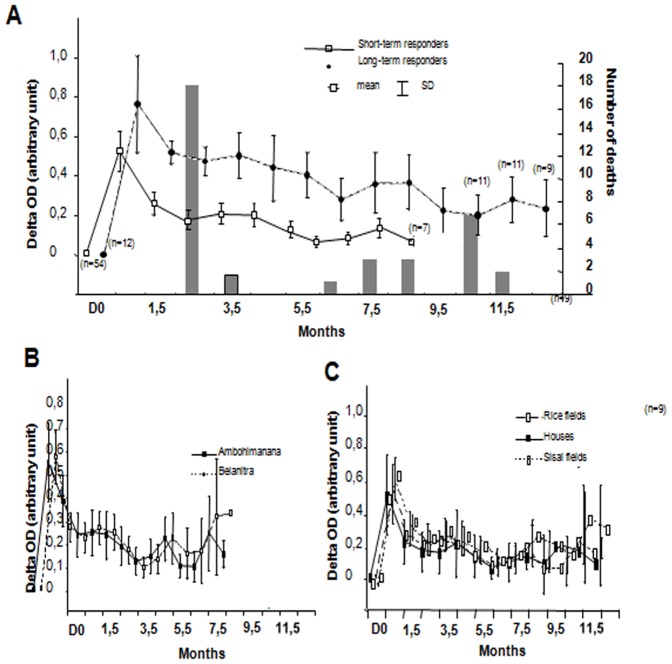
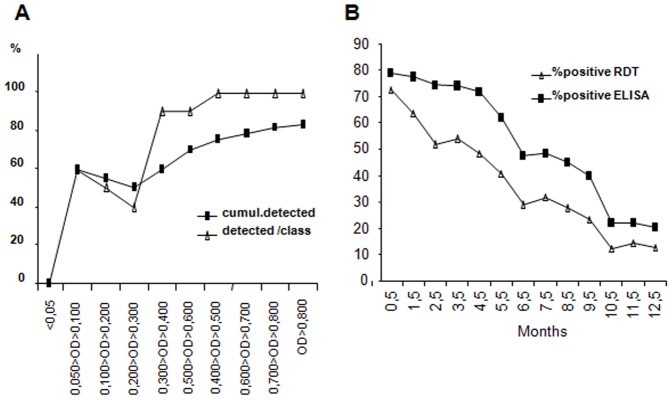
METHODOLOGY/PRINCIPAL FINDINGS: We experimentally infected wild rats with Yersinia pestis to investigate short and long-term antibody responses. Anti-F1 IgM and IgG were detected to evaluate this antibody response. High levels of anti-F1 IgM and IgG were found in rats one and three weeks respectively after challenge, with responses greatly differing between villages. Plateau in anti-F1 IgM and IgG responses were reached for as few as 500 and 1500 colony forming units (cfu) inoculated respectively. More than 10% of rats were able to maintain anti-F1 responses for more than one year. This anti-F1 response was conveniently followed using dipsticks.
CONCLUSION/SIGNIFICANCE: Inoculation of very few bacteria is sufficient to induce high immune response in wild rats, allowing their survival after infection. A great heterogeneity of rat immune responses was found within and between villages which could heavily impact on plague epidemiology. In addition, results indicate that, in the field, anti-F1 dipsticks are efficient to investigate plague outbreaks several months after transmission.
马达加斯加中部高地流行鼠疫,其主要宿主是黑家鼠(Rattus rattus)。通常认为该物种易感染鼠疫,感染后迅速死亡,从而导致受感染的跳蚤传播,并将疾病传播给人类。然而,每年同一地区都有传播焦点持续存在,这意味着存在维持传播的机制,其中老鼠的免疫反应可能发挥主要作用。对鼠疫的免疫反应和随后的老鼠存活可能在稳定传播焦点方面发挥重要作用。在这项研究中,我们旨在调查来自马达加斯加疫区的野生黑家鼠对鼠疫的血清学反应。此外,我们评估了一种新开发的快速血清学诊断检测方法,以调查鼠疫传播焦点中潜在宿主的免疫反应。
方法/主要发现:我们通过实验感染野生鼠以研究短期和长期抗体反应。检测抗 F1 IgM 和 IgG 以评估这种抗体反应。在挑战后一周和三周,大鼠体内分别检测到高水平的抗 F1 IgM 和 IgG,并且反应在不同村庄之间差异很大。达到 500 和 1500 个集落形成单位(cfu)接种量的平台,分别需要 1 和 3 周的时间。超过 10%的大鼠能够维持一年以上的抗 F1 反应。使用测试条可以方便地跟踪这种抗 F1 反应。
结论/意义:接种非常少量的细菌足以诱导野生鼠产生高免疫反应,使其在感染后能够存活。在村庄内部和之间发现了大鼠免疫反应的巨大异质性,这可能对鼠疫流行病学产生重大影响。此外,结果表明,在现场,抗 F1 测试条在传播后数月调查鼠疫爆发时非常有效。