Department of Psychology, Norwegian University of Science and Technology, Trondheim, Norway.
PLoS One. 2012;7(6):e38830. doi: 10.1371/journal.pone.0038830. Epub 2012 Jun 18.
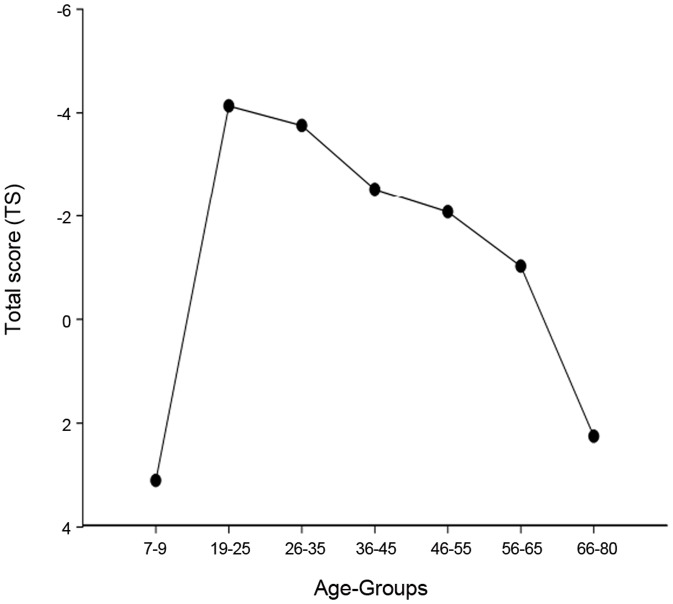
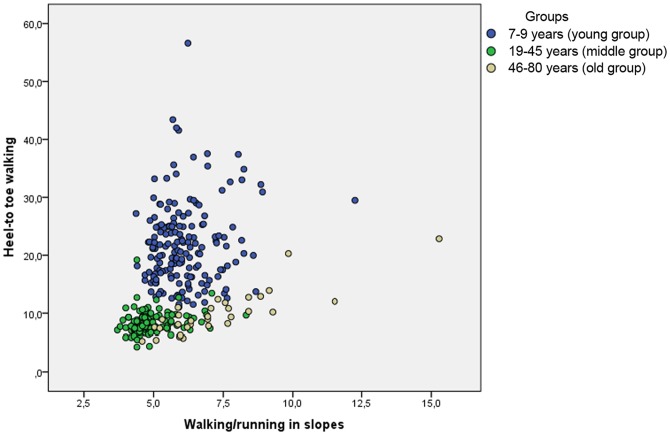
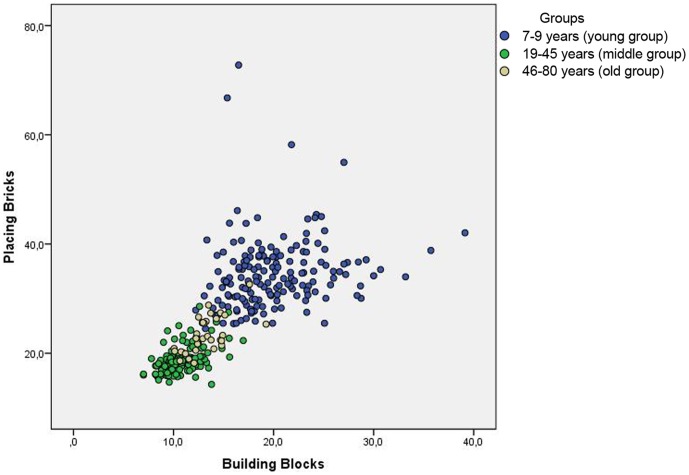
The life-span approach to development provides a theoretical framework to examine the general principles of life-long development. This study aims to investigate motor performance across the life span. It also aims to investigate if the correlations between motor tasks increase with aging. A cross-sectional design was used to describe the effects of aging on motor performance across age groups representing individuals from childhood to young adult to old age. Five different motor tasks were used to study changes in motor performance within 338 participants (7-79 yrs). Results showed that motor performance increases from childhood (7-9) to young adulthood (19-25) and decreases from young adulthood (19-25) to old age (66-80). These results are mirroring results from cognitive research. Correlation increased with increasing age between two fine motor tasks and two gross motor tasks. We suggest that the findings might be explained, in part, by the structural changes that have been reported to occur in the developing and aging brain and that the theory of Neural Darwinism can be used as a framework to explain why these changes occur.
寿命期发展方法为研究毕生发展的普遍原则提供了一个理论框架。本研究旨在调查整个生命周期的运动表现。本研究还旨在调查运动任务之间的相关性是否随着年龄的增长而增加。本研究采用横断面设计来描述不同年龄组(从儿童到青年到老年)的个体的运动表现随年龄变化的影响。本研究使用了 5 种不同的运动任务来研究 338 名参与者(7-79 岁)的运动表现变化。结果表明,运动表现从儿童期(7-9 岁)到青年期(19-25 岁)增加,从青年期(19-25 岁)到老年期(66-80 岁)下降。这些结果与认知研究的结果相呼应。随着年龄的增长,两个精细运动任务和两个粗略运动任务之间的相关性增加。本研究认为,这些发现部分可以用发育和衰老大脑中报告的结构变化来解释,神经达尔文主义理论可以作为解释这些变化发生的框架。