Ke Yazi D, Suchowerska Alexandra K, van der Hoven Julia, De Silva Dineeka M, Wu Christopher W, van Eersel Janet, Ittner Arne, Ittner Lars M
Alzheimer's and Parkinson's Disease Laboratory, Brain and Mind Research Institute, The University of Sydney, 100 Mallett Street, Camperdown, NSW 2050, Australia.
Int J Alzheimers Dis. 2012;2012:873270. doi: 10.1155/2012/873270. Epub 2012 Jun 6.
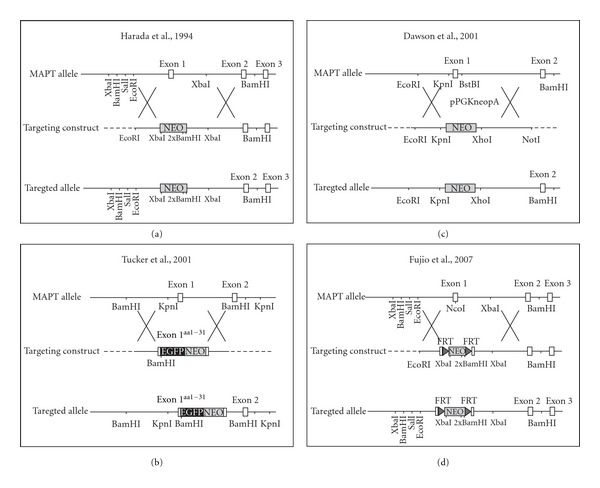
Both Alzheimer's disease (AD) and frontotemporal dementia (FTD) are characterized by the deposition of hyperphosphorylated forms of the microtubule-associated protein tau in neurons and/or glia. This unifying pathology led to the umbrella term "tauopathies" for these conditions, also emphasizing the central role of tau in AD and FTD. Generation of transgenic mouse models expressing human tau in the brain has contributed to the understanding of the pathomechanistic role of tau in disease. To reveal the physiological functions of tau in vivo, several knockout mouse strains with deletion of the tau-encoding MAPT gene have been established over the past decade, using different gene targeting constructs. Surprisingly, when initially introduced tau knockout mice presented with no overt phenotype or malformations. The number of publications using tau knockout mice has recently markedly increased, and both behavioural changes and motor deficits have been identified in aged mice of certain strains. Moreover, tau knockout mice have been instrumental in identifying novel functions of tau, both in cultured neurons and in vivo. Importantly, tau knockout mice have significantly contributed to the understanding of the pathophysiological interplay between Aβ and tau in AD. Here, we review the literature that involves tau knockout mice to summarize what we have learned so far from depleting tau in vivo.
阿尔茨海默病(AD)和额颞叶痴呆(FTD)均以微管相关蛋白tau的高度磷酸化形式在神经元和/或胶质细胞中沉积为特征。这种统一的病理学特征导致了这些病症的统称“tau蛋白病”,也强调了tau在AD和FTD中的核心作用。在大脑中表达人tau的转基因小鼠模型的产生有助于理解tau在疾病中的病理机制作用。为了揭示tau在体内的生理功能,在过去十年中,使用不同的基因靶向构建体建立了几种缺失编码tau的MAPT基因的基因敲除小鼠品系。令人惊讶的是,最初引入时tau基因敲除小鼠没有明显的表型或畸形。最近,使用tau基因敲除小鼠的出版物数量显著增加,并且在某些品系的老年小鼠中发现了行为变化和运动缺陷。此外,tau基因敲除小鼠在确定tau在培养神经元和体内的新功能方面发挥了重要作用。重要的是,tau基因敲除小鼠对理解AD中Aβ与tau之间的病理生理相互作用做出了重大贡献。在此,我们回顾涉及tau基因敲除小鼠的文献,以总结到目前为止我们从体内去除tau中学到的知识。