Department of Pathology; The University of Chicago; Chicago, IL USA.
Oncoimmunology. 2012 Mar 1;1(2):172-178. doi: 10.4161/onci.1.2.18311.
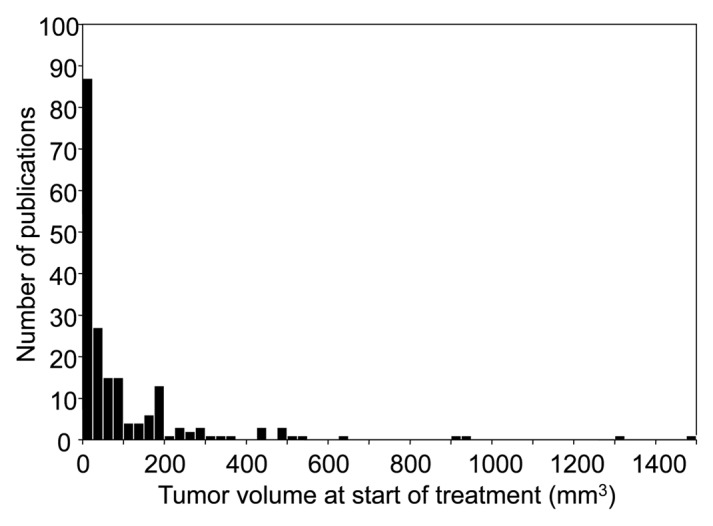
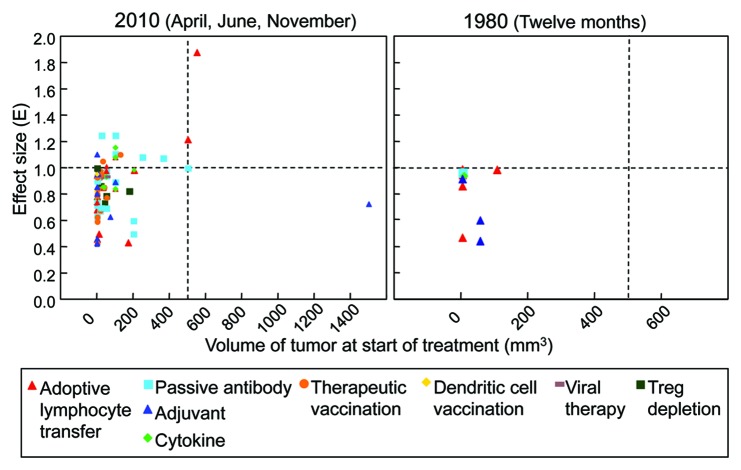
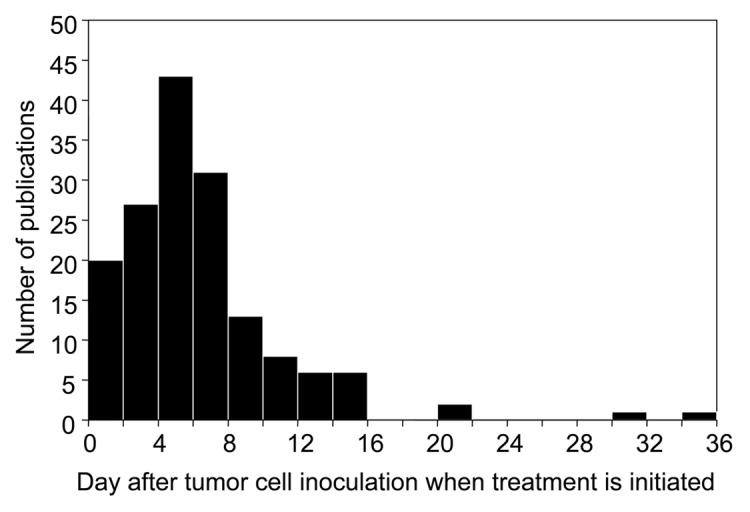
We conducted a systematic analysis to determine the reason for the apparent disparity of success of immunotherapy between clinical and experimental cancers. To do this, we performed a search of PubMed using the keywords "immunotherapy" AND "cancer" for the years of 1980 and 2010. The midspread of experimental tumors used in all the relevant literature published in 2010 were between 0.5-121 mm(3) in volume or had grown for four to eight days. Few studies reported large tumors that could be considered representative of clinical tumors, in terms of size and duration of growth. The predominant effect of cancer immunotherapies was slowed or delayed outgrowth. Regression of tumors larger than 200 mm(3) was observed only after passive antibody or adoptive T cell therapy. The effectiveness of other types of immunotherapy was generally scattered. By comparison, very few publications retrieved by the 1980 search could meet our selection criteria; all of these used tumors smaller than 100 mm(3), and none reported regression. In the entire year of 2010, only 13 used tumors larger than 400 mm(3), and nine of these reported tumor regression. Together, these results indicate that most recent studies, using many diverse approaches, still treat small tumors only to report slowed or delayed growth. Nevertheless, a few recent studies indicate effective therapy against large tumors when using passive antibody or adoptive T cell therapy. For the future, we aspire to witness the increased use of experimental studies treating tumors that model clinical cancers in terms of size and duration of growth.
我们进行了一项系统分析,以确定免疫疗法在临床和实验癌症中的成功率差异明显的原因。为此,我们使用关键词“免疫疗法”和“癌症”在 PubMed 上进行了 1980 年和 2010 年的搜索。2010 年发表的所有相关文献中使用的实验肿瘤的中位扩散体积在 0.5-121mm³之间,或者生长了四到八天。很少有研究报告了可以被认为是代表临床肿瘤的大肿瘤,无论是从大小还是生长时间来看。癌症免疫疗法的主要作用是减缓或延迟肿瘤的生长。只有在被动抗体或过继性 T 细胞治疗后,才观察到大于 200mm³的肿瘤的消退。通过比较,我们检索到的 1980 年的搜索结果中很少有符合我们选择标准的;所有这些都使用小于 100mm³的肿瘤,并且没有报告肿瘤消退。在 2010 年的全年中,只有 13 个使用大于 400mm³的肿瘤,其中 9 个报告了肿瘤消退。总的来说,这些结果表明,最近的大多数研究使用了许多不同的方法,仍然只治疗小肿瘤,以报告减缓或延迟生长。然而,最近的一些研究表明,在使用被动抗体或过继性 T 细胞治疗时,对大肿瘤的治疗有效。我们期望未来能够看到更多的实验研究使用能够模拟临床癌症的大小和生长时间的肿瘤。