Institute for Science and Technology in Medicine, Keele University, Staffordshire, ST5 5BG, UK.
Malar J. 2012 Jun 21;11:210. doi: 10.1186/1475-2875-11-210.
Several electroporation protocols exist to transfect exogenous DNA into Plasmodium falciparum. To date, however, only a subjective analysis of their relative efficiencies has been reported.
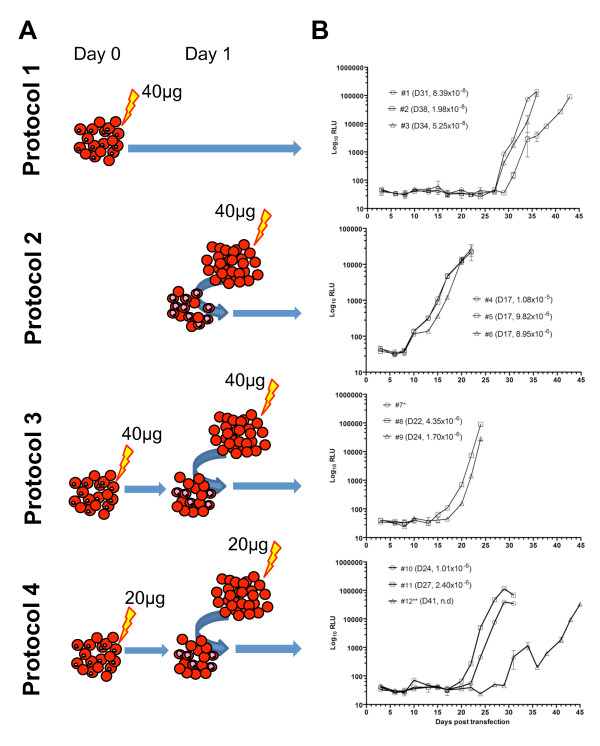
A time-course of luciferase reporter expression is used to provide an objective quantitative analysis of the absolute efficiency of three electroporation techniques; direct electroporation of ring stage infected erythrocytes, preloading of erythrocytes and a novel "double-tap" protocol that combines both approaches.
Preloading of erythrocytes shows a mean efficiency of 9.59 x 10(-6), some 5-180 fold more efficient than matched experiments utilizing the "double-tap" and direct electroporation of ring stage infected erythrocytes alone, respectively.
Evidence presented here provides the first quantitative assessment of both the absolute and relative efficiencies of a key molecular tool used to study the biology and pathogenesis of this important human pathogen.
有几种电穿孔方案可将外源 DNA 转染入恶性疟原虫。然而,迄今为止,仅报道了对其相对效率的主观分析。
用荧光素酶报告基因表达的时程提供了三种电穿孔技术的绝对效率的客观定量分析;直接电穿孔环状感染期红细胞、预先加载红细胞以及结合这两种方法的新型“双重敲击”方案。
红细胞预加载的平均效率为 9.59 x 10(-6),比分别使用“双重敲击”和直接电穿孔环状感染期红细胞的匹配实验分别高 5-180 倍。
这里提供的证据首次对用于研究这种重要人类病原体的生物学和发病机制的关键分子工具的绝对和相对效率进行了定量评估。