Zhongshan Ophthalmic Center, State Key Laboratory of Ophthalmology, Sun Yat-Sen University, Guangzhou, China.
PLoS One. 2012;7(6):e38825. doi: 10.1371/journal.pone.0038825. Epub 2012 Jun 18.
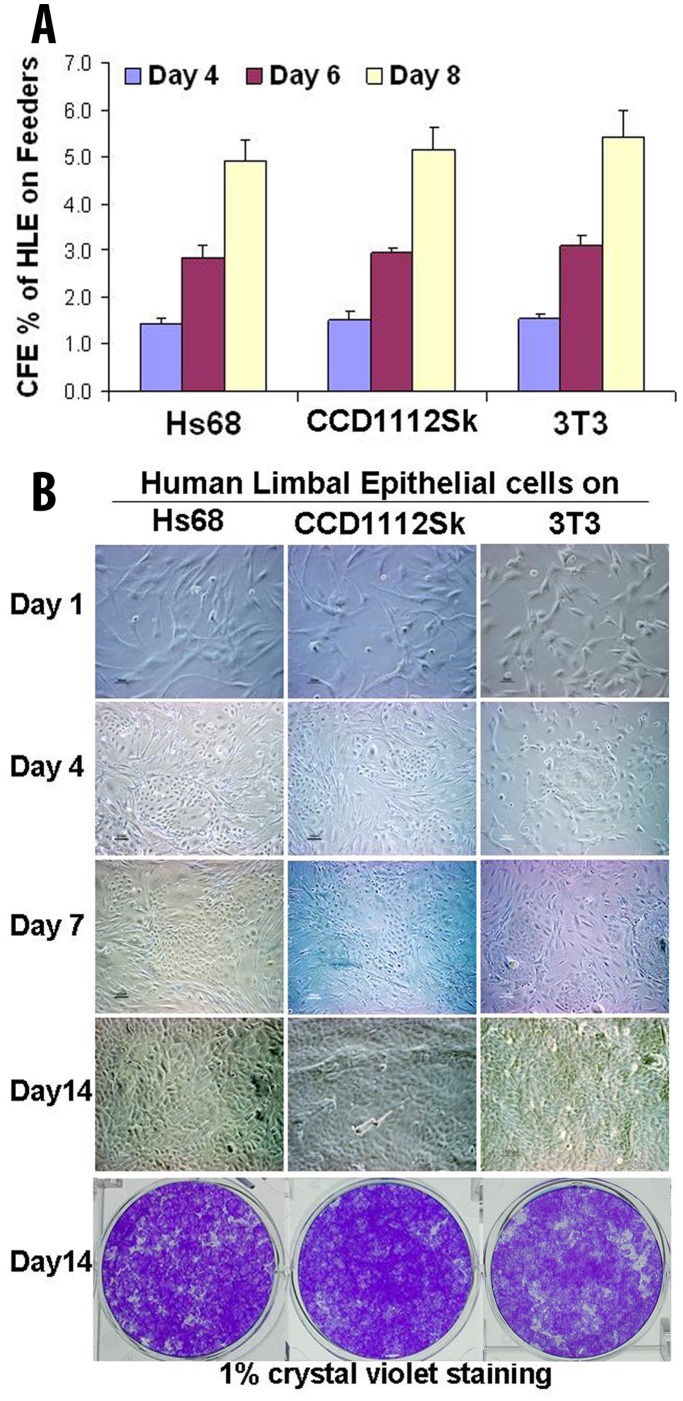
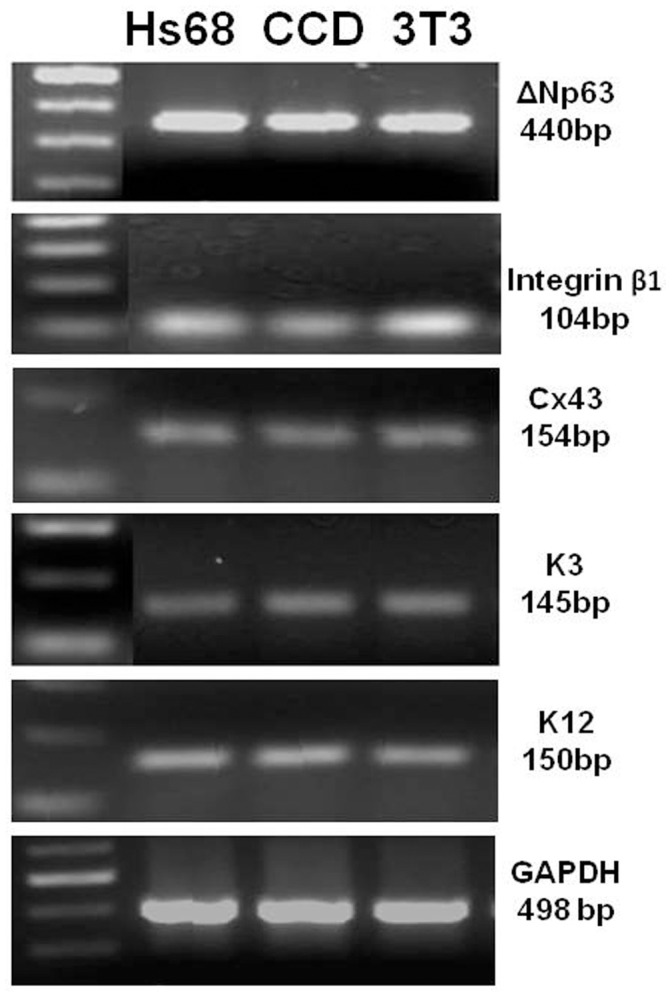
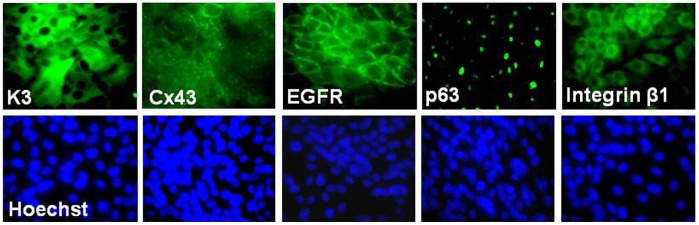
There is a great interest in using epithelium generated in vitro for tissue bioengineering. Mouse 3T3 fibroblasts have been used as a feeder layer to cultivate human epithelia including corneal epithelial cells for more than 3 decades. To avoid the use of xeno-components, we evaluated human fibroblasts as an alternative feeder supporting human corneal epithelial regeneration. Five human fibroblast cell lines were used for evaluation with mouse 3T3 fibroblasts as a control. Human epithelial cells isolated from fresh corneal limbal tissue were seeded on these feeders. Colony forming efficiency (CFE) and cell growth capacity were evaluated on days 5-14. The phenotype of the regenerated epithelia was evaluated by morphology and immunostaining with epithelial markers. cDNA microarray was used to analyze the gene expression profile of the supportive human fibroblasts. Among 5 strains of human fibroblasts evaluated, two newborn foreskin fibroblast cell lines, Hs68 and CCD1112Sk, were identified to strongly support human corneal epithelial growth. Tested for 10 passages, these fibroblasts continually showed a comparative efficiency to the 3T3 feeder layer for CFE and growth capacity of human corneal epithelial cells. Limbal epithelial cells seeded at 1 × 10(4) in a 35-mm dish (9.6 cm(2)) grew to confluence (about 1.87-2.41 × 10(6) cells) in 12-14 days, representing 187-241 fold expansion with over 7-8 doublings on these human feeders. The regenerated epithelia expressed K3, K12, connexin 43, p63, EGFR and integrin β1, resembling the phenotype of human corneal epithelium. DNA microarray revealed 3 up-regulated and 10 down-regulated genes, which may be involved in the functions of human fibroblast feeders. These findings demonstrate that commercial human fibroblast cell lines support human corneal epithelial regeneration, and have potential use in tissue bioengineering for corneal reconstruction.
人们对于利用体外培养的上皮细胞进行组织工程学研究有着浓厚的兴趣。3T3 鼠成纤维细胞已被广泛用于培养人上皮细胞,包括角膜上皮细胞,这一应用已经超过 30 年。为了避免使用异源成分,我们评估了人成纤维细胞作为一种替代饲养层来支持人角膜上皮再生的可能性。我们使用了 5 个人类成纤维细胞系进行评估,并以 3T3 鼠成纤维细胞作为对照。从新鲜角膜缘组织中分离的人上皮细胞被接种在这些饲养层上。在第 5-14 天,评估集落形成效率(CFE)和细胞生长能力。通过形态学和上皮标志物免疫染色来评估再生上皮的表型。使用 cDNA 微阵列分析支持人成纤维细胞的基因表达谱。在所评估的 5 个人类成纤维细胞株中,我们发现 2 株新生包皮成纤维细胞系 Hs68 和 CCD1112Sk 能够强烈支持人角膜上皮细胞的生长。经过 10 个传代,这些成纤维细胞在 CFE 和人角膜上皮细胞生长能力方面与 3T3 饲养层相比始终具有相当的效率。在 35mm 培养皿(9.6cm2)中以 1×10⁴ 个细胞/皿(9.6cm2)接种角膜缘上皮细胞,在 12-14 天内可融合生长(约 1.87-2.41×10⁶ 个细胞),代表在这些人饲养层上的 7-8 个倍增,细胞扩增了 187-241 倍。再生的上皮细胞表达 K3、K12、连接蛋白 43、p63、EGFR 和整合素β1,与人类角膜上皮的表型相似。DNA 微阵列显示 3 个上调基因和 10 个下调基因,这些基因可能参与人成纤维细胞饲养层的功能。这些发现表明,商品化的人成纤维细胞系支持人角膜上皮再生,并且在角膜重建的组织工程中有潜在的应用价值。