School of Kinesiology, University of British Columbia, Vancouver, British Columbia, Canada.
PLoS One. 2012;7(6):e38938. doi: 10.1371/journal.pone.0038938. Epub 2012 Jun 18.
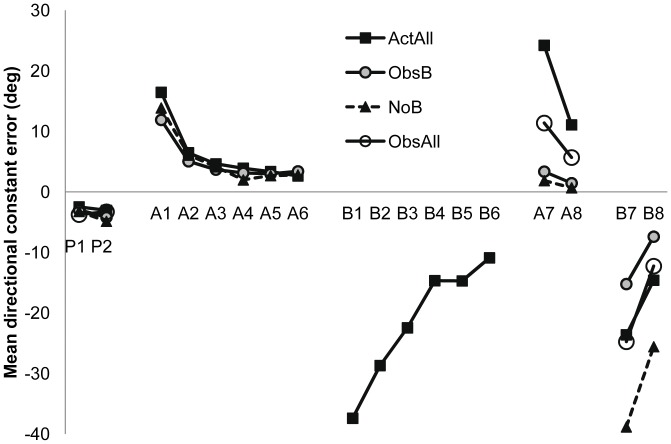
During motor adaptation learning, consecutive physical practice of two different tasks compromises the retention of the first. However, there is evidence that observational practice, while still effectively aiding acquisition, will not lead to interference and hence prove to be a better practice method. Observers and Actors practised in a clockwise (Task A) followed by a counterclockwise (Task B) visually rotated environment, and retention was immediately assessed. An Observe-all and Act-all group were compared to two groups who both physically practised Task A, but then only observed (ObsB) or did not see or practice Task B (NoB). The two observer groups and the NoB control group better retained Task A than Actors, although importantly only the observer groups learnt Task B. RT data and explicit awareness of the rotation suggested that the observers had acquired their respective tasks in a more strategic manner than Actor and Control groups. We conclude that observational practice benefits learning of multiple tasks more than physical practice due to the lack of updating of implicit, internal models for aiming in the former.
在运动适应学习过程中,连续进行两种不同任务的身体练习会影响对第一种任务的保持。然而,有证据表明,观察练习虽然仍然有效地帮助获得新技能,但不会导致干扰,因此被证明是一种更好的练习方法。观察者和演员在顺时针(任务 A)和逆时针(任务 B)的视觉旋转环境中进行练习,然后立即进行保留测试。将观察所有和行动所有组与两个仅练习任务 A 的组(观察 B 或不观察或练习任务 B(无 B))进行比较。两个观察者群体和无 B 对照组比演员更好地保留了任务 A,尽管重要的是只有观察者群体学习了任务 B。RT 数据和对旋转的明确意识表明,与演员和对照组相比,观察者以更具策略性的方式获得了各自的任务。我们得出结论,由于前者缺乏对瞄准的内隐、内部模型的更新,因此观察练习比身体练习更有利于多项任务的学习。