Department of Microbiology, University of Iowa, Iowa City, IA 52242, USA.
Trends Parasitol. 2012 Aug;28(8):335-44. doi: 10.1016/j.pt.2012.05.002. Epub 2012 Jun 21.
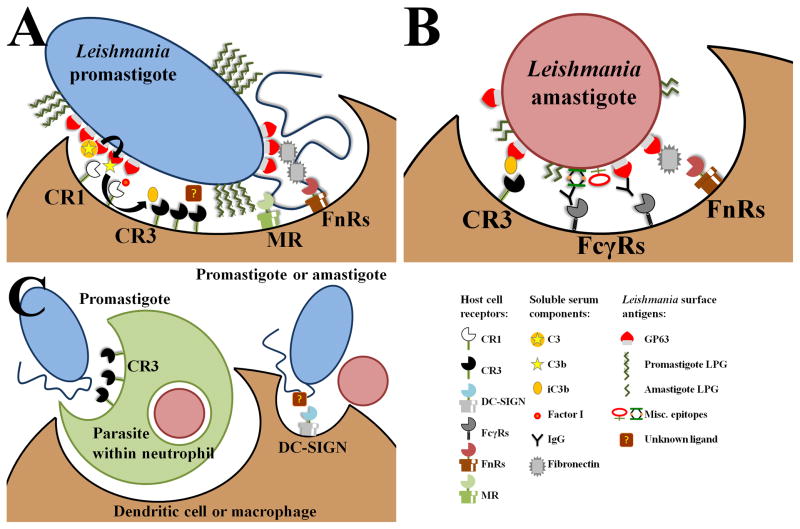
The extracellular promastigote stage of Leishmania spp. is transmitted to mammals by a sand fly vector. Leishmania promastigotes ligate host macrophage receptors, triggering phagocytosis and subsequent internalization, a crucial step for survival. Parasites transform intracellularly to the amastigote stage. Many studies document different receptors detecting promastigotes and amastigotes, but the relative importance of each interaction is ill-defined. Recent studies suggest that the macrophage receptors utilized during phagocytosis impact the intracellular fate of the parasite. This review summarizes the receptors implicated in Leishmania phagocytosis over the past 30 years. It then proceeds to weigh the evidence for or against their potential roles in intracellular parasite trafficking.
利什曼原虫属的细胞外前鞭毛体阶段通过沙蝇媒介传播给哺乳动物。利什曼原虫前鞭毛体与宿主巨噬细胞受体结合,触发吞噬作用和随后的内化,这是生存的关键步骤。寄生虫在细胞内转化为无鞭毛体阶段。许多研究记录了不同的受体来检测前鞭毛体和无鞭毛体,但每种相互作用的相对重要性尚未确定。最近的研究表明,吞噬作用过程中使用的巨噬细胞受体影响寄生虫的细胞内命运。本综述总结了过去 30 年来参与利什曼虫吞噬作用的受体。然后,它对这些受体在细胞内寄生虫运输中的潜在作用的证据进行权衡。