Qureshi Nilofer, Morrison David C, Reis Julia
Department of Basic Medical Sciences, University of Missouri, Kansas City, MO 64108, USA.
Biochim Biophys Acta. 2012 Nov;1823(11):2087-93. doi: 10.1016/j.bbamcr.2012.06.016. Epub 2012 Jun 19.
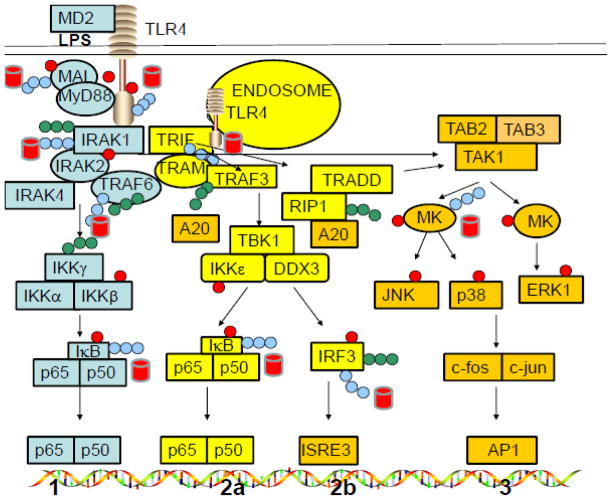
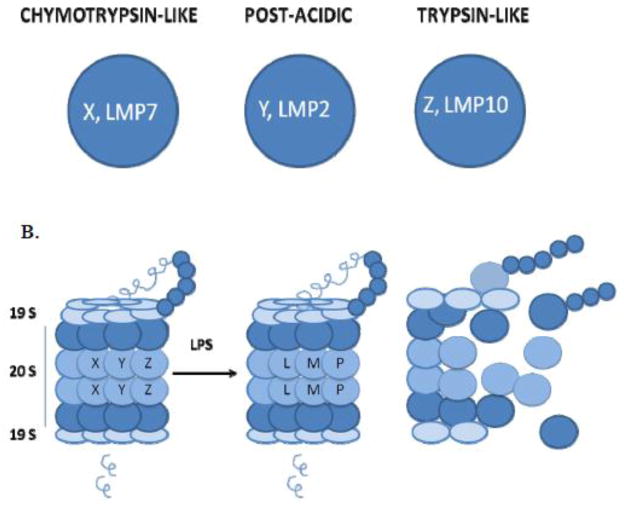
We have previously demonstrated that proteasome serves as a central regulator of inflammation and macrophage function. Until recently, proteasomes have generally been considered to play a relatively passive role in the regulation of cellular activity, i.e., any ubiquitinated protein was considered to be in discriminatively targeted for degradation by the proteasome. We have demonstrated, however, by using specific proteasome protease inhibitors and knockout mice lacking specific components of immunoproteasomes, that proteasomes (containing X, Y, and Z protease subunits) and immunoproteasomes (containing LMP7, LMP2, and LMP10 protease subunits) have well-defined functions in cytokine induction and inflammation based on their individual protease activities. We have also shown that LPS-TLR mediated signaling in the murine RAW 264.7 macrophage cell line results in the replacement of macrophage immunoproteasomal subunits. Such modifications serve as pivotal regulators of LPS-induced inflammation. Our findings support the relatively novel concept that defects in structure/function of proteasome protease subunits caused by genetic disorders, aging, diet, or drugs may well have the potential to contribute to modulation of proteasome activity. Of particular relevance, we have identified quercetin and resveratrol, significant constituents present in berries and in red wine respectively, as two novel proteasome inhibitors that have been previously implicated as disease-modifying natural products. We posit that natural proteasome inhibitors/activators can potentially be used as therapeutic response modifiers to prevent/treat diseases through pathways involving the ubiquitin-proteasome pathway (UP-pathway), which likely functions as a master regulator involved in control of overall inflammatory responses. This article is part of a Special Issue entitled: Ubiquitin Drug Discovery and Diagnostics.
我们之前已经证明蛋白酶体是炎症和巨噬细胞功能的核心调节因子。直到最近,蛋白酶体通常被认为在细胞活性调节中发挥相对被动的作用,即任何泛素化蛋白都被认为会被蛋白酶体无差别地靶向降解。然而,我们通过使用特定的蛋白酶体蛋白酶抑制剂和缺乏免疫蛋白酶体特定成分的基因敲除小鼠证明,蛋白酶体(包含X、Y和Z蛋白酶亚基)和免疫蛋白酶体(包含LMP7、LMP2和LMP10蛋白酶亚基)基于其各自的蛋白酶活性在细胞因子诱导和炎症中具有明确的功能。我们还表明,小鼠RAW 264.7巨噬细胞系中LPS-TLR介导的信号传导会导致巨噬细胞免疫蛋白酶体亚基的替换。这种修饰是LPS诱导炎症的关键调节因子。我们的研究结果支持了一个相对新颖的概念,即由遗传疾病、衰老、饮食或药物引起的蛋白酶体蛋白酶亚基结构/功能缺陷很可能有潜力促进蛋白酶体活性的调节。特别相关的是,我们已经鉴定出槲皮素和白藜芦醇,分别是浆果和红酒中的重要成分,作为两种新型蛋白酶体抑制剂,它们之前被认为是具有疾病修饰作用的天然产物。我们认为天然蛋白酶体抑制剂/激活剂有可能被用作治疗反应调节剂,通过涉及泛素-蛋白酶体途径(UP途径)的通路来预防/治疗疾病,该途径可能作为一个主要调节因子参与控制整体炎症反应。本文是名为:泛素药物发现与诊断的特刊的一部分。