Comprehensive Transplant Center, Northwestern University Feinberg School of Medicine, Chicago, IL 60611, USA.
Adv Chronic Kidney Dis. 2012 Jul;19(4):252-6. doi: 10.1053/j.ackd.2012.05.001.
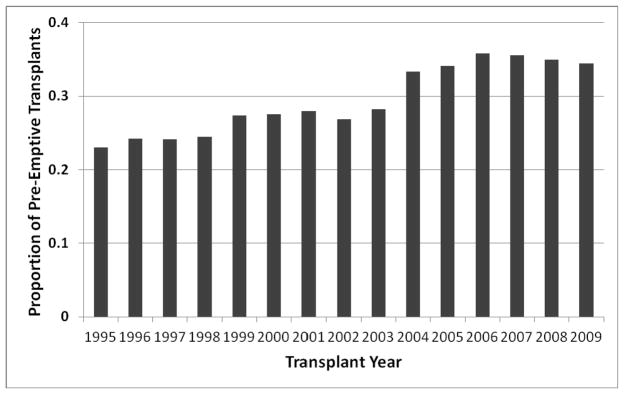
Preemptive kidney transplant (PKT)-defined as transplant before dialysis-has numerous advantages as a treatment approach for patients with advanced renal disease. In the past 15 years, PKT has become more common and has been performed at higher levels of estimated glomerular filtration rate, particularly among recipients of live-donor transplants, among whom timing of transplantation is easier to control. However, recent studies have raised important new concerns about unintended consequences of early versus late PKT. In this article, we review the convincing evidence that PKT offers diverse advantages for patients, discuss potential problems that might emerge from PKT at higher levels of renal function, examine the feasibility of a "just-in-time" PKT strategy for transplant centers, and discuss whether a new kidney allocation system could affect rates of PKT.
抢先肾移植(PKT)——定义为在透析前进行的移植——作为治疗晚期肾病患者的方法具有众多优势。在过去的 15 年中,PKT 变得更加普遍,并且在更高的估计肾小球滤过率水平下进行,尤其是在活体供体移植受者中,因为他们更容易控制移植时间。然而,最近的研究对早期与晚期 PKT 的意外后果提出了重要的新担忧。在本文中,我们回顾了 PKT 为患者带来多种优势的令人信服的证据,讨论了在更高肾功能水平下 PKT 可能出现的潜在问题,考察了移植中心“即时”PKT 策略的可行性,并讨论了新的肾脏分配系统是否会影响 PKT 的比率。