Research Unit on Children's Psychosocial Maladjustment, University of Montreal and Sainte-Justine Hospital, Montreal, QC, Canada.
Mol Psychiatry. 2013 Jul;18(7):806-12. doi: 10.1038/mp.2012.87. Epub 2012 Jun 26.
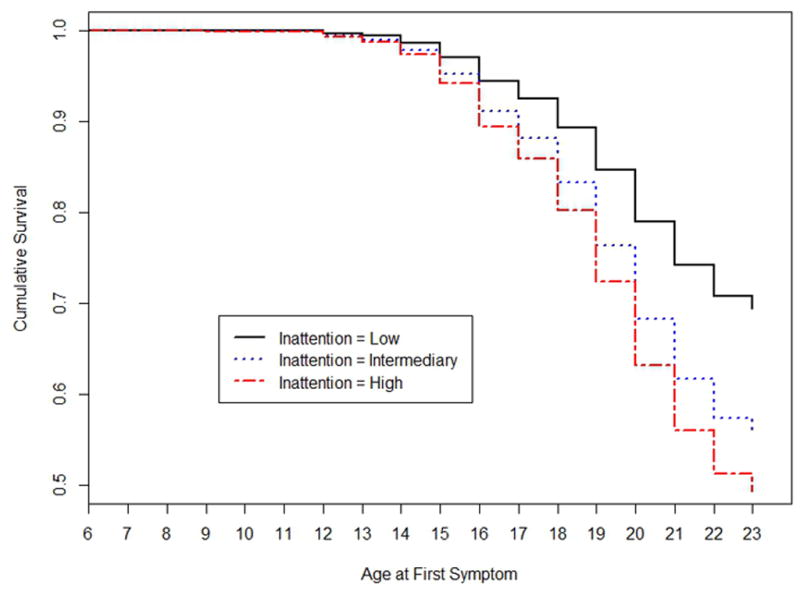
Numerous prospective studies have shown that children diagnosed with attention deficit/hyperactivity disorder (ADHD) are at higher risk of long-term substance abuse/dependence. However, there are three important limits to these studies: (a) most did not differentiate the role of hyperactivity and inattention; (b) most did not control for associated behavioral problems; and (c) most did not consider females. Our aim was to clarify the unique and interactive contributions of childhood inattention and hyperactivity symptoms to early adulthood substance abuse/dependence. Behavioral problems of 1803 participants (814 males) in a population-based longitudinal study were assessed yearly between 6 and 12 years by mothers and teachers. The prevalence of substance abuse/dependence at age 21 years was 30.7% for nicotine, 13.4% for alcohol, 9.1% for cannabis and 2.0% for cocaine. The significant predictors of nicotine dependence were inattention (odds ratio (OR): 2.25; 95% confidence interval (CI): 1.63-3.11) and opposition (OR: 1.65; 95%: 1.20-2.28). Only opposition contributed to the prediction of cannabis dependence (OR: 2.33; 95% CI: 1.40-3.87) and cocaine dependence (OR: 2.97; 95% CI: 1.06-8.57). The best behavioral predictor of alcohol abuse/dependence (opposition) was only marginally significant (OR: 1.38; 95% CI: 0.98-1.95). Frequent oppositional behaviors during elementary school were clearly the most pervasive predictors of substance abuse/dependence in early adulthood. The association of childhood ADHD with substance abuse/dependence is largely attributable to its association with opposition problems during childhood. However, inattention remained an important predictor of nicotine dependence, in line with genetic and molecular commonalities between the two phenotypes suggested in the literature.
大量前瞻性研究表明,被诊断患有注意缺陷多动障碍(ADHD)的儿童患长期物质滥用/依赖的风险更高。然而,这些研究有三个重要的局限性:(a)大多数研究没有区分多动和注意力不集中的作用;(b)大多数研究没有控制相关的行为问题;(c)大多数研究没有考虑女性。我们的目的是阐明儿童期注意力不集中和多动症状对成年早期物质滥用/依赖的独特和交互作用。通过母亲和教师在 6 至 12 岁之间每年对一项基于人群的纵向研究中的 1803 名参与者(814 名男性)的行为问题进行评估。21 岁时物质滥用/依赖的患病率为尼古丁 30.7%,酒精 13.4%,大麻 9.1%,可卡因 2.0%。尼古丁依赖的显著预测因素是注意力不集中(优势比(OR):2.25;95%置信区间(CI):1.63-3.11)和对立(OR:1.65;95%:1.20-2.28)。只有对立对大麻依赖(OR:2.33;95% CI:1.40-3.87)和可卡因依赖(OR:2.97;95% CI:1.06-8.57)的预测有贡献。对立是预测酒精滥用/依赖(对立)的最佳行为预测因素,仅略显著(OR:1.38;95% CI:0.98-1.95)。小学期间频繁的对立行为显然是成年早期物质滥用/依赖的最普遍预测因素。儿童期 ADHD 与物质滥用/依赖的关联主要归因于其与儿童期对立问题的关联。然而,注意力不集中仍然是尼古丁依赖的一个重要预测因素,这与文献中提出的两种表型之间的遗传和分子共性一致。