Department of Surgery, Kantonsspital St Gallen, 9007 St Gallen, Switzerland.
Br J Cancer. 2012 Jul 10;107(2):266-74. doi: 10.1038/bjc.2012.267. Epub 2012 Jun 26.
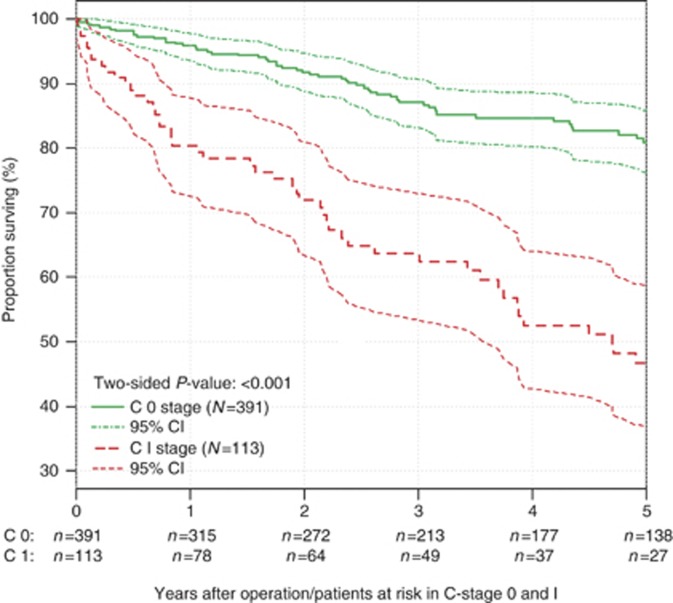
The objective of this investigation was to assess whether preoperative carcinoembryonic antigen (CEA) level is an independent predictor of overall survival in rectal cancer patients.
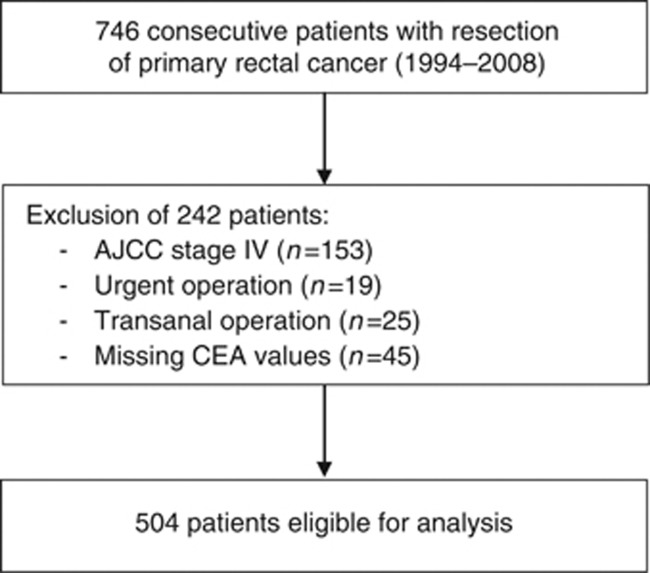
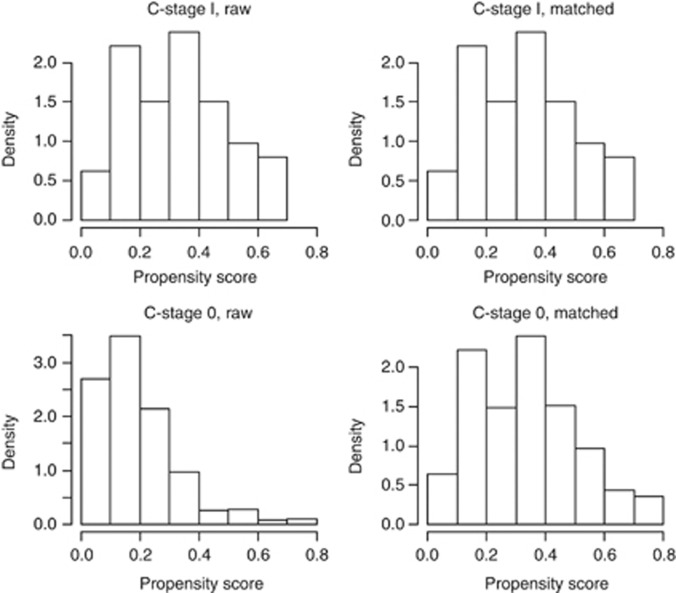
All patients (n=504) undergoing a resection for stage I-III rectal cancer at the Kantonsspital St Gallen were included into a database between 1991 and 2008. The impact of preoperative CEA level on overall survival was assessed using risk-adjusted Cox proportional hazard regression models and propensity score methods.
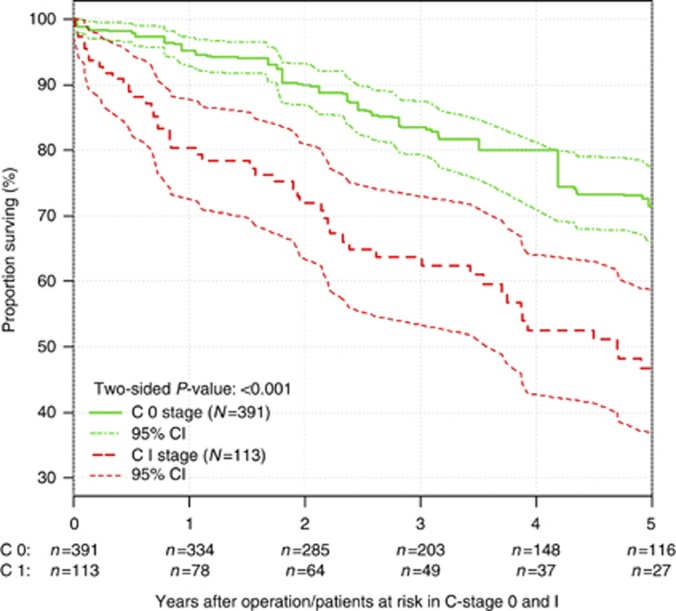
In risk-adjusted Cox proportional hazard regression analyses, preoperative CEA level (hazard ratio (HR): 1.98, 95% confidence interval (CI): 1.36-2.90, P<0.001), distance from anal verge (<5 cm: HR: 1.93, 95% CI: 1.11-3.37; P=0.039), older age (HR: 1.07, 95% CI: 1.05-1.09; P<0.001), lower body mass index (HR: 0.94, 95% CI: 0.89-0.98; P=0.006), advanced tumour stage (stage II HR: 1.41, 95% CI: 0.85-2.32; stage III HR: 2.08, 95% CI: 1.31-3.31; P=0.004), R 1 resection (HR: 5.65, 95% CI: 1.59-20.1; P=0.005) and chronic kidney disease (HR: 2.28, 95% CI: 1.03-5.04; P=0.049) were all predictors for poor overall survival.
This is one of the first investigations based on a large cohort of exclusively rectal cancer patients demonstrating that preoperative CEA level is a strong predictor of decreased overall survival. Preoperative CEA should be used as a prognostic factor in the preoperative assessment of rectal cancer patients.
本研究旨在评估术前癌胚抗原(CEA)水平是否是直肠癌患者总生存的独立预测因素。
本研究纳入了 1991 年至 2008 年间在圣加仑州立医院接受 I-III 期直肠癌切除术的所有患者(n=504)。使用风险调整 Cox 比例风险回归模型和倾向评分方法评估术前 CEA 水平对总生存的影响。
在风险调整 Cox 比例风险回归分析中,术前 CEA 水平(危险比(HR):1.98,95%置信区间(CI):1.36-2.90,P<0.001)、距肛缘距离(<5cm:HR:1.93,95%CI:1.11-3.37;P=0.039)、年龄较大(HR:1.07,95%CI:1.05-1.09;P<0.001)、较低的体重指数(HR:0.94,95%CI:0.89-0.98;P=0.006)、肿瘤分期较高(II 期 HR:1.41,95%CI:0.85-2.32;III 期 HR:2.08,95%CI:1.31-3.31;P=0.004)、R1 切除(HR:5.65,95%CI:1.59-20.1;P=0.005)和慢性肾病(HR:2.28,95%CI:1.03-5.04;P=0.049)均是总生存不良的预测因素。
这是首次基于大量单纯直肠癌患者队列的研究之一,证明术前 CEA 水平是总生存的一个强有力的预测因素。术前 CEA 应作为直肠癌患者术前评估的预后因素。