Department of Medical Biophysics, The University of Western Ontario, London, ON, Canada.
Int J Cardiovasc Imaging. 2013 Feb;29(2):497-504. doi: 10.1007/s10554-012-0086-5. Epub 2012 Jun 27.
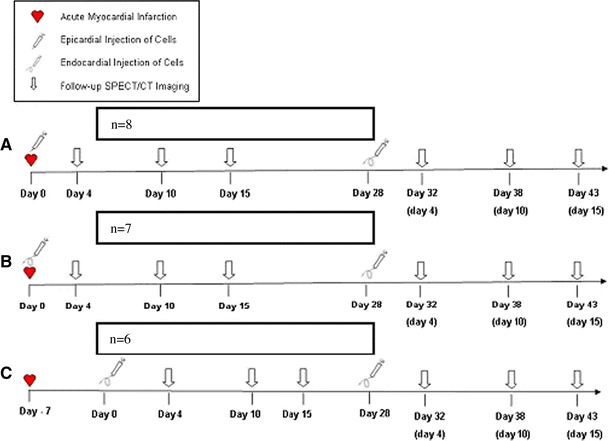
Stem cell transplantation following AMI has shown promise for the repair or reduction of the amount of myocardial injury. There is some evidence that these treatment effects appear to be directly correlated to cell residence time. This study aims to assess the effects of (a) the timing of stem cell injection following myocardial infarction, and (b) flow milieu, on cell residence times at the site of transplantation by comparing three time points (day of infarction, week 1 and week 4-5), and two models of acute myocardial infarction (sustained occlusion or reperfusion). Twenty-one dogs received 2 injections of 30 million endothelial progenitor cells. The first injections were administered by epicardial (n = 8) or endocardial injection (n = 13) either on the day of infarction (n = 15) or at 1 week (n = 6). The second injections were administered by only endocardial injection (n = 18) 4 weeks following the first injection. Cell clearance half-lives were comparable between early and late injections. However, transplants into sustained occlusion infarcts resulted in slower cell clearance 77.1 ± 6.1 (n = 18) versus reperfused 59.4 ± 2.9 h (n = 21) p = 0.009. Sustained occlusion infarcts had longer cell retention in comparison to reperfusion whereas the timing of injection did not affect clearance rates. If the potential for myocardial regeneration associated with cell transplantation is, at least in part, linked to cell residence times, then greater benefit may be observed with transplants into infarcts associated with persistent coronary artery occlusion.
AMI 后进行干细胞移植已显示出修复或减少心肌损伤的潜力。有一些证据表明,这些治疗效果似乎与细胞停留时间直接相关。本研究旨在通过比较三个时间点(梗塞发生当天、第 1 周和第 4-5 周)和两种急性心肌梗塞模型(持续闭塞或再灌注),评估(a)梗塞后干细胞注射的时间和(b)血流环境对移植部位细胞停留时间的影响。21 只狗接受了 2 次 3000 万内皮祖细胞的注射。第一次注射通过心外膜(n = 8)或心内膜注射(n = 13)进行,分别在梗塞发生当天(n = 15)或第 1 周(n = 6)进行。第二次注射仅在心内膜注射后第 4 周进行(n = 18)。早期和晚期注射之间的细胞清除半衰期相似。然而,移植到持续闭塞梗塞中导致较慢的细胞清除 77.1 ± 6.1(n = 18)与再灌注 59.4 ± 2.9 h(n = 21)相比,p = 0.009。与再灌注相比,持续闭塞梗塞的细胞保留时间更长,而注射时间不影响清除率。如果与细胞移植相关的心肌再生潜力至少部分与细胞停留时间相关,那么与持续冠状动脉闭塞相关的梗塞中移植可能会观察到更大的益处。