He Ying, Wang Zaijie Jim
Department of Biopharmaceutical Sciences, Cancer Center, University of Illinois Chicago, IL, USA.
Front Genet. 2012 Jun 21;3:110. doi: 10.3389/fgene.2012.00110. eCollection 2012.
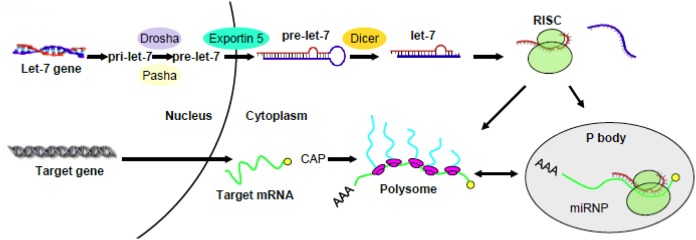
This chapter will focus on the role of microRNAs (miRs) in regulating the actions of opioid drugs through the opioid receptors. Opioids, such as morphine, are analgesics that are used for treating many forms of acute and chronic pain. However, their chronic use is limited by undesirable effects such as opioid tolerance. The μ opioid receptor (MOR) is the primary receptor responsible for opioids' analgesia and antinociceptive tolerance. The long 3'-untranslated region (3'-UTR) of MOR mRNA is of great interest since this region may contain elements for the post-transcriptional regulation of receptor expression, such as altering the stability of mRNA, influencing translational efficiency, and controlling mRNA transport. MicroRNAs are small non-coding RNA molecules that exert their functions through base-pairing with partially complementary sequences in the 3'-UTR of target mRNAs, resulting in decreased polypeptide formation from those mRNAs. Since the discovery of the first miR, lin-4 in Caenorhabditis elegans, hundreds of miRs have been identified from humans to viruses, which have provided a crucial and pervasive layer of post-transcriptional gene regulation. The nervous system is a rich source of miR expression, with a diversity of miR functions in fundamental neurobiological processes including neuronal development, plasticity, metabolism, and apoptosis. Recently, the let-7 family of miRs is found to be a critical regulator of MOR function in opioid tolerance. Let-7 is the first identified human miR. Its family members are highly conserved across species in sequence and function. In the review, we will present a brief review of the opioid receptors, their regulation, and opioid tolerance as well as an overview of miRs and a perspective how miRs may interact with MOR and serve as a regulator of opioid tolerance.
本章将聚焦于微小RNA(miR)通过阿片受体调节阿片类药物作用的角色。阿片类药物,如吗啡,是用于治疗多种急慢性疼痛的镇痛药。然而,其长期使用受到诸如阿片耐受等不良影响的限制。μ阿片受体(MOR)是负责阿片类药物镇痛和抗伤害感受耐受的主要受体。MOR mRNA的长3'非翻译区(3'-UTR)备受关注,因为该区域可能包含受体表达转录后调控的元件,如改变mRNA的稳定性、影响翻译效率以及控制mRNA转运。微小RNA是小的非编码RNA分子,它们通过与靶mRNA的3'-UTR中部分互补序列碱基配对发挥功能,导致这些mRNA形成的多肽减少。自第一个miR,即秀丽隐杆线虫中的lin-4被发现以来,已从人类到病毒中鉴定出数百种miR,它们提供了转录后基因调控的关键且普遍存在的层面。神经系统是miR表达的丰富来源,在包括神经元发育、可塑性、代谢和凋亡等基本神经生物学过程中具有多种miR功能。最近,发现let-7家族的miR是阿片耐受中MOR功能的关键调节因子。Let-7是首个被鉴定出的人类miR。其家族成员在序列和功能上跨物种高度保守。在本综述中,我们将简要回顾阿片受体、它们的调节以及阿片耐受,同时概述miR,并探讨miR如何与MOR相互作用并作为阿片耐受的调节因子。