Laboratory of Molecular Signal Transduction, Center for Neural Science, Korea Institute of Science and Technology, Seoul, South Korea.
Neuroscience. 2012 Sep 27;221:214-24. doi: 10.1016/j.neuroscience.2012.06.024. Epub 2012 Jun 26.
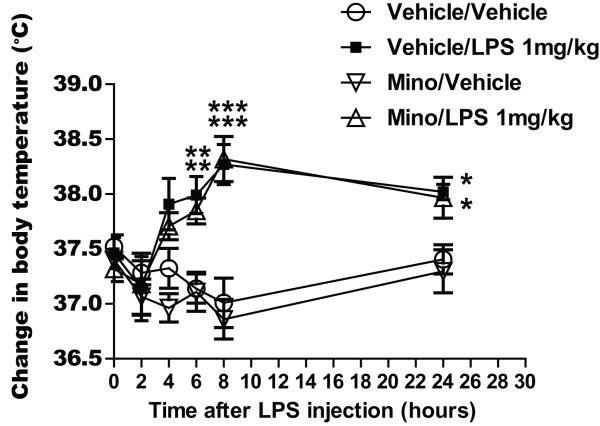
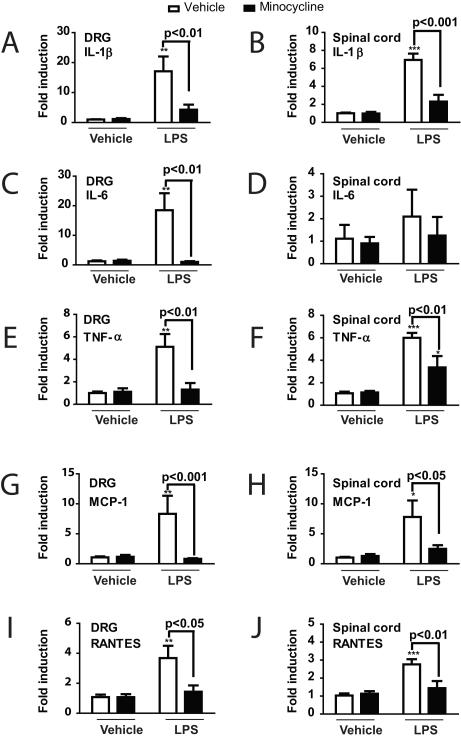
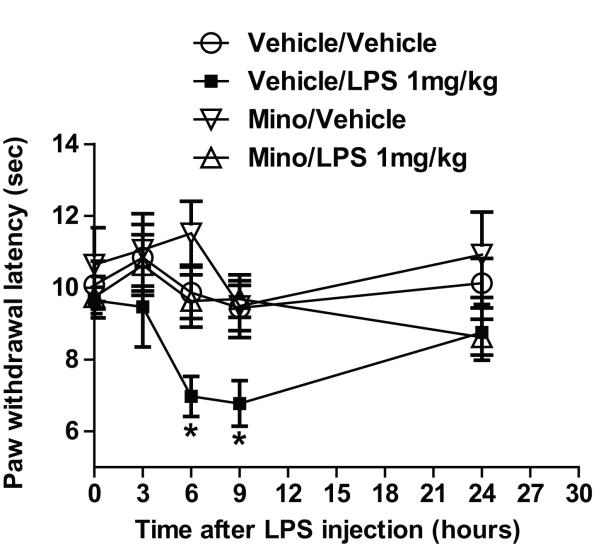
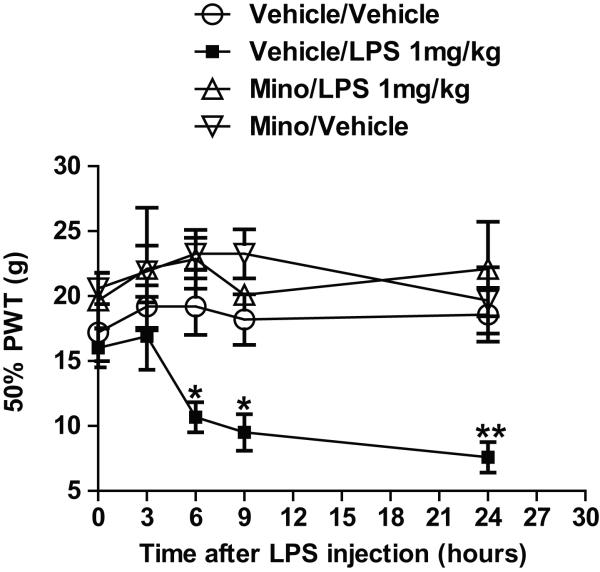
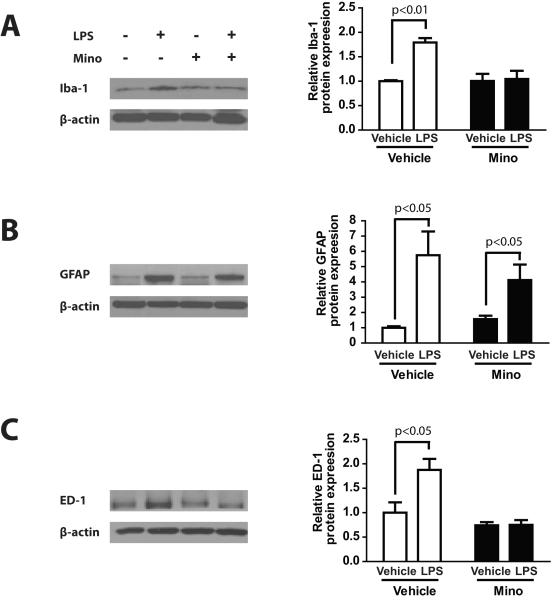
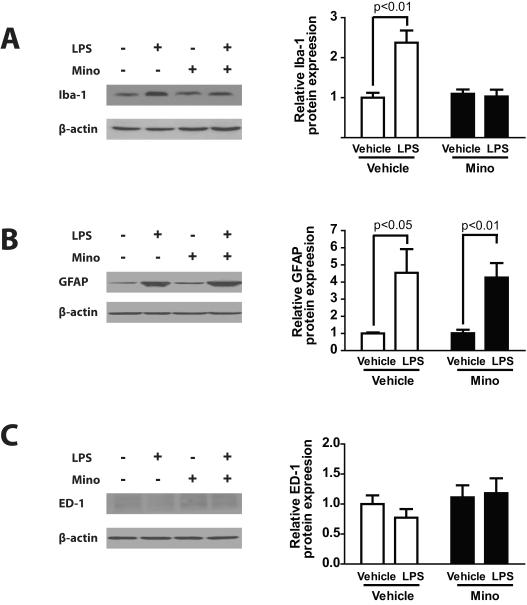
Systemic injection of lipopolysaccharide (LPS) induces a robust immune response as well as thermal and mechanical hyperalgesia. Spinal and peripheral glial cells have been implicated as important mediators in this hyperalgesia but the specific contributions of microglia versus astrocytes are not entirely clear. To better define these mechanisms, this study examined the febrile response, nociceptive sensitivity, glial cell reactivity and cytokine production in the dorsal root ganglion (DRG) and spinal cord in rats following systemic treatment with LPS and the effects of minocycline in countering these responses. Intraperitoneal LPS injection resulted in an increase in core body temperature and produced hyperalgesia to heat and mechanical stimuli. Western blot studies revealed increased expression of microgial cell, macrophage and satellite cell markers in DRG and microglial and astrocyte markers in spinal cord following LPS treatment. Real-time RT-PCR indicated that LPS treatment increased cytokine mRNA expression levels in both the DRG and the spinal cord. Minocycline suppressed all LPS-induced behavioral effects but not the febrile response. Moreover, minocycline prevented LPS-induced microglia/macrophage activation and cytokine responses in spinal cord and DRG, but did not affect the activation of astrocytes/satellite cells. These data demonstrate that LPS-induced changes in nociceptive sensitivity are likely mediated by activation of microglial cells and/or macrophages in the spinal cord and DRG.
全身注射脂多糖(LPS)会引起强烈的免疫反应以及热和机械性痛觉过敏。脊髓和外周神经胶质细胞被认为是这种痛觉过敏的重要介质,但小胶质细胞与星形胶质细胞的具体贡献尚不完全清楚。为了更好地定义这些机制,本研究在大鼠中检查了全身给予 LPS 后背根神经节(DRG)和脊髓中的发热反应、伤害感受敏感性、神经胶质细胞反应和细胞因子产生,以及米诺环素对这些反应的影响。腹腔内注射 LPS 会导致核心体温升高,并对热和机械刺激产生痛觉过敏。Western blot 研究表明,LPS 处理后 DRG 中小胶质细胞、巨噬细胞和卫星细胞标志物以及脊髓中小胶质细胞和星形胶质细胞标志物的表达增加。实时 RT-PCR 表明 LPS 处理会增加 DRG 和脊髓中细胞因子 mRNA 的表达水平。米诺环素抑制了所有 LPS 诱导的行为效应,但不抑制发热反应。此外,米诺环素预防了 LPS 诱导的脊髓和 DRG 中的小胶质细胞/巨噬细胞激活和细胞因子反应,但不影响星形胶质细胞/卫星细胞的激活。这些数据表明,LPS 诱导的伤害感受敏感性变化可能是由脊髓和 DRG 中小胶质细胞和/或巨噬细胞的激活介导的。