State University of Campinas, Campinas, Brazil.
Diagn Pathol. 2012 Jun 28;7:75. doi: 10.1186/1746-1596-7-75.
Acute promyelocytic leukemia is a cytogenetically well defined entity. Nevertheless, some features observed at diagnosis are related to a worse outcome of the patients.
In a prospective study, we analyzed peripheral (PB) leukocyte count, immunophenotype, methylation status of CDKN2B, CDKN2A and TP73; FLT3 and NPM1 mutations besides nuclear chromatin texture characteristics of the leukemic cells. We also examined the relation of these features with patient's outcome.
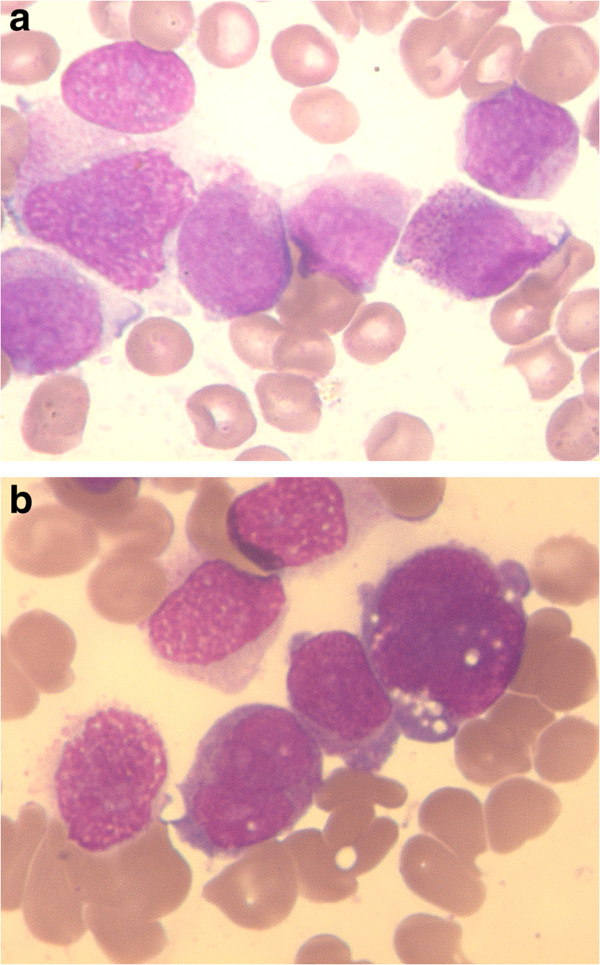
Among 19 cases, 4 had a microgranular morphology, 7 presented PB leukocytes >10x109/l, 2 had FLT3-ITD and 3 had FLT3-TKD (all three presenting a methylated CDKN2B). NPM1 mutation was not observed. PB leukocyte count showed an inverse relation with standard deviation of gray levels, contrast, cluster prominence, and chromatin fractal dimension (FD). Cases with FLT3-ITD presented a microgranular morphology, PB leukocytosis and expression of HLA-DR, CD34 and CD11b. Concerning nuclear chromatin texture variables, these cases had a lower entropy, contrast, cluster prominence and FD, but higher local homogeneity, and R245, in keeping with more homogeneously distributed chromatin. In the univariate Cox analysis, a higher leukocyte count, FLT3-ITD mutation, microgranular morphology, methylation of CDKN2B, besides a higher local homogeneity of nuclear chromatin, a lower chromatin entropy and FD were associated to a worse outcome. All these features lost significance when the cases were stratified for FLT3-ITD mutation. Methylation status of CDNK2A and TP73 showed no relation to patient's survival.
in APL, patients with FLT3-ITD mutation show different clinical characteristics and have blasts with a more homogeneous chromatin texture. Texture analysis demonstrated that FLTD-ITD was accompanied not only by different cytoplasmic features, but also by a change in chromatin structure in routine cytologic preparations. Yet we were not able to detect chromatin changes by nuclear texture analysis of patients with the FTLD-TKD or methylation of specific genes.
急性早幼粒细胞白血病在细胞遗传学上具有明确的定义。然而,诊断时观察到的一些特征与患者的预后较差有关。
在一项前瞻性研究中,我们分析了外周血(PB)白细胞计数、免疫表型、CDKN2B、CDKN2A 和 TP73 的甲基化状态;FLT3 和 NPM1 突变,以及白血病细胞核染色质纹理特征。我们还检查了这些特征与患者预后的关系。
在 19 例病例中,4 例具有微颗粒形态,7 例 PB 白细胞计数>10x109/L,2 例存在 FLT3-ITD,3 例存在 FLT3-TKD(均存在 CDKN2B 甲基化)。未观察到 NPM1 突变。PB 白细胞计数与灰度标准偏差、对比度、聚类突出度和染色质分形维数(FD)呈反比关系。存在 FLT3-ITD 的病例表现出微颗粒形态、PB 白细胞增多以及 HLA-DR、CD34 和 CD11b 的表达。关于核染色质纹理变量,这些病例的熵、对比度、聚类突出度和 FD 较低,但局部同质性和 R245 较高,表明染色质分布更均匀。在单变量 Cox 分析中,较高的白细胞计数、FLT3-ITD 突变、微颗粒形态、CDKN2B 甲基化以及核染色质的较高局部同质性、较低的染色质熵和 FD 与预后不良相关。当病例按 FLT3-ITD 突变分层时,所有这些特征均失去意义。CDNK2A 和 TP73 的甲基化状态与患者的生存无关。
在 APL 中,存在 FLT3-ITD 突变的患者表现出不同的临床特征,并且具有更均匀的染色质纹理的blasts。纹理分析表明,FLTD-ITD 不仅伴有不同的细胞质特征,而且还伴有常规细胞学制剂中染色质结构的变化。然而,我们无法通过 FTLD-TKD 患者的核纹理分析或特定基因的甲基化检测到染色质变化。