Center for Genetics, Children's Hospital Oakland Research Institute, Oakland, CA 94609, USA.
Immunogenetics. 2012 Oct;64(10):719-37. doi: 10.1007/s00251-012-0629-x. Epub 2012 Jul 1.
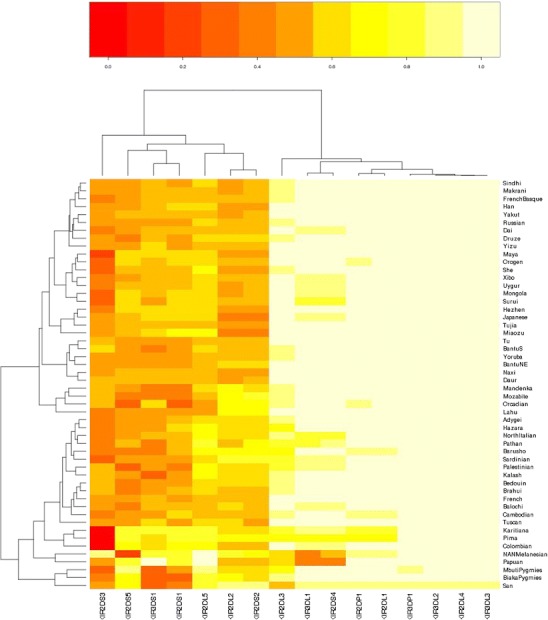
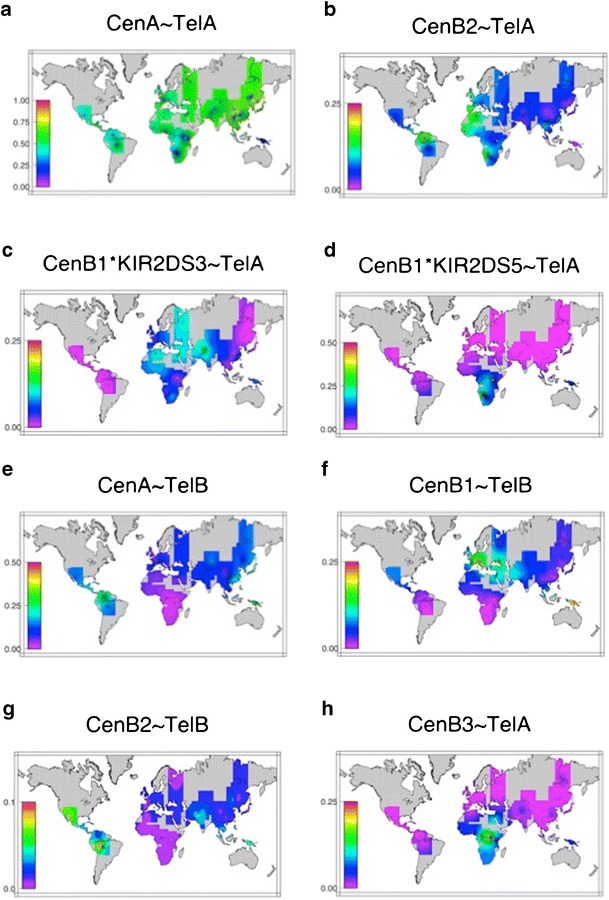
In the present study, we investigate patterns of variation in the KIR cluster in a large and well-characterized sample of worldwide human populations in the Human Genome Diversity Project-Centre d'Etude du Polymorphisme Humain (HGDP-CEPH) panel in order to better understand the patterns of diversity in the region. Comparison of KIR data with that from other genomic regions allows control for strictly demographic factors; over 500,000 additional genomic markers have been typed in this panel by other investigators and the data made publicly available. Presence/absence frequencies and haplotypic associations for the KIR region are analyzed in the 52 populations comprising the panel and in accordance with major world regions (Africa, Middle East, Central Asia, East Asia, Europe, Americas, and Oceania). These data represent the first overview of KIR population genetics in the well-documented HGDP-CEPH panel and suggest different evolutionary histories and recent selection in the KIR gene cluster.
在本研究中,我们调查了人类基因组多样性计划-人类基因组多样性研究中心(HGDP-CEPH)面板中大量经过良好特征描述的全球人类群体中 KIR 簇的变异模式,以便更好地了解该区域的多样性模式。将 KIR 数据与来自其他基因组区域的数据进行比较,可以控制严格的人口因素;该面板中已经由其他研究人员对超过 50 万个额外的基因组标记进行了分型,并公开了这些数据。在由 52 个群体组成的面板中,按照主要的世界区域(非洲、中东、中亚、东亚、欧洲、美洲和大洋洲),对 KIR 区域的存在/缺失频率和单倍型关联进行了分析。这些数据代表了在记录良好的 HGDP-CEPH 面板中 KIR 群体遗传学的第一个概述,并表明 KIR 基因簇具有不同的进化历史和近期选择。