Pidamale Raghavendra, Sowmya B, Thomas Ann, Jose Tony
Departments of Pedodontics and Preventive Dentistry, A.J. Institute of Dental Sciences, Mangalore, Karnataka, India.
Indian J Hum Genet. 2012 Jan;18(1):101-5. doi: 10.4103/0971-6866.96672.
Genetic factor to bitter taste perception appears to be largely mediated by the TAS2R38 gene. The insensitivity to bitter compounds like 6-n-propylthiouracil (PROP) is mediated by this gene. PROP, a pharmacological drug used in treatment of Graves' disease, proved to be useful tool in determining the genetic sensitivity levels to bitter and sweet taste. The purpose of this study is to show much simpler PROP sensitivity technique for the clinical examiner and its application as a diagnostic aid in Early Childhood Caries (ECC) detection among preschool children.
A total of 119 children belonging to the age group of 36 to 71 months of both sexes, were recruited from A. J. Institute of Dental Sciences, Mangalore (Karnataka). PROP sensitivity test was carried out to determine the inherent genetic ability to taste a bitter or sweet substance. This study used simpler scaling method to find out genetic sensitivity to bitter taste; one who tasted bitter as taster and one who was not able to differentiate/tasted like paper as non-taster. A questionnaire was provided to evaluate their dietary habits and caries experience was recorded. Collected data were tabulated and subjected to statistical analysis.
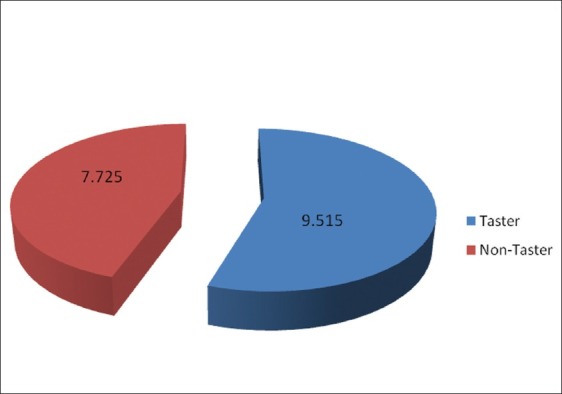
In the total of 119 children the mean dmfs was definitely higher in non-taster children compared to tasters. The tasters had a mean dmfs value of 9.5120 (S.D. 7.0543) and non-tasters had a value of 7.7250 (S.D. 8.33147), which was statistically significant. The results suggested that there was increase in caries experience among the group of non-tasters as compared to tasters. Tasters tended to be sweet dislikers and non-tasters tended to be sweet likers. On the whole, tasters had a bad dentition as compared to non tasters.
The PROP sensitivity test (filter paper test) proved to be a useful diagnostic tool in determining the genetic sensitivity levels of bitter taste. The knowledge of a child's taste perception can help us in identifying the children who are at higher risk for ECC.
对苦味感知的遗传因素似乎很大程度上由TAS2R38基因介导。对6-正丙基硫氧嘧啶(PROP)等苦味化合物不敏感是由该基因介导的。PROP是一种用于治疗格雷夫斯病的药物,被证明是确定对苦味和甜味遗传敏感水平的有用工具。本研究的目的是向临床检查者展示一种更简单的PROP敏感性技术及其作为学龄前儿童早期龋(ECC)检测诊断辅助手段的应用。
从芒格洛尔(卡纳塔克邦)的A.J.牙科学院招募了119名年龄在36至71个月的男女儿童。进行PROP敏感性测试以确定品尝苦味或甜味物质的内在遗传能力。本研究采用更简单的分级方法来找出对苦味的遗传敏感性;将尝出苦味的人归为尝味者,将无法区分/尝起来像纸一样的人归为非尝味者。提供一份问卷以评估他们的饮食习惯,并记录龋齿经历。将收集的数据制成表格并进行统计分析。
在总共119名儿童中,非尝味者儿童的平均乳牙龋失补牙面数(dmfs)明显高于尝味者。尝味者的平均dmfs值为9.5120(标准差7.0543),非尝味者的值为7.7250(标准差8.33147),具有统计学意义。结果表明,与尝味者相比,非尝味者组的龋齿经历有所增加。尝味者倾向于不喜欢甜食,而非尝味者倾向于喜欢甜食。总体而言,与非尝味者相比,尝味者的牙列状况较差。
PROP敏感性测试(滤纸测试)被证明是确定苦味遗传敏感水平的有用诊断工具。了解儿童的味觉感知有助于我们识别出患ECC风险较高的儿童。