Auta A, Banwat Sb, Sariem Cn, Shalkur D, Nasara B, Atuluku Mo
Department of Clinical Pharmacy, University of Jos, Jos, Nigeria.
J Young Pharm. 2012 Apr;4(2):119-23. doi: 10.4103/0975-1483.96627.
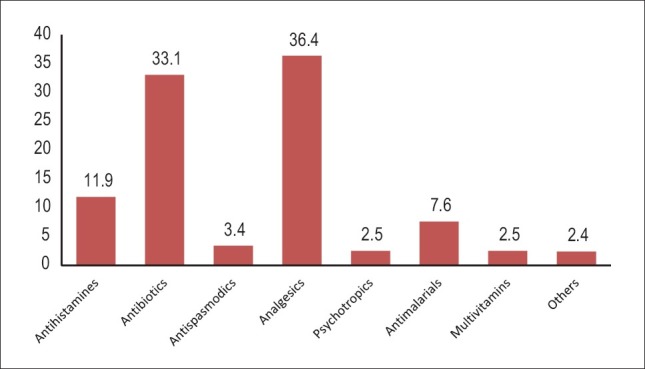
This study was aimed at identifying the types of medicines in pharmacy students' residence and to determine if a relationship exists between keeping medicines in students' accommodation and self-medication practices. A cross-sectional survey of a random sample of 240 undergraduate pharmacy students of the University of Jos, Jos, Nigeria, was carried out. Participating students were given a self-administered questionnaire, and only 188 students returned their filled questionnaire. The data collected were entered and analyzed using SPSS 16, and the χ(2)-test was used to determine associations between the variables. The results revealed that 66.0% of respondents had medicines in their room. A total of 318 medicines items (2.56 items per student's room) of which 37.1% were leftover medicines were present in respondents' rooms. Analgesics (34.3%) and antibiotics (25.2%) were the common classes of medicines present in respondents' rooms. Respondents reported getting these medicines on prescription (25.8%) and self-medication (56.5%) or both (17.7%). Self-medication practice was common among respondents (53.2%); however, no significant relationship (P>0.05) existed between having medicine in students' room and self-medication practices. Common reasons given by respondents for having medicines in their rooms were that they were leftover medicines and that they were keeping them for emergency use or for use in an event of a similar illness. Most respondents (72.2%) reported disposing of their unused medicines in a trash can/dust bin. This study demonstrated that the prevalence of medicine storage in students' room and self-medication practice is high. Analgesics and antibiotics were the most common types of medicines present in students' residence.
本研究旨在确定药学专业学生宿舍内药品的类型,并确定学生宿舍存放药品与自我药疗行为之间是否存在关联。对尼日利亚乔斯大学药学院240名本科学生进行了随机抽样横断面调查。参与调查的学生填写一份自填式问卷,只有188名学生返回了填好的问卷。收集到的数据录入SPSS 16进行分析,采用χ(2)检验确定变量之间的关联。结果显示,66.0%的受访者房间里有药品。受访者房间里共有318件药品(平均每个学生房间2.56件),其中37.1%为剩余药品。房间里最常见的药品类别是镇痛药(34.3%)和抗生素(25.2%)。受访者表示这些药品是通过处方获得的(25.8%)、自我药疗获得的(56.5%)或两者兼有(17.7%)。自我药疗行为在受访者中很常见(53.2%);然而,学生房间里存放药品与自我药疗行为之间不存在显著关联(P>0.05)。受访者在房间里存放药品的常见原因是这些是剩余药品,以及他们为应急或类似疾病发作时备用而存放。大多数受访者(72.2%)报告将未使用的药品丢弃在垃圾桶里。本研究表明,学生房间内存放药品和自我药疗行为的发生率很高。镇痛药和抗生素是学生宿舍中最常见的药品类型。