Department of Surgery, Beijing Jishuitan Hospital, the Fourth Clinical Medical College of Peking University, Xicheng District, Beijing, China.
J Hematol Oncol. 2012 Jul 3;5:37. doi: 10.1186/1756-8722-5-37.
Hepatocellular carcinoma (HCC) is one of the most common malignant tumors occurring mainly in patients with chronic liver disease. Detection of early HCC is critically important for treatment of these patients.
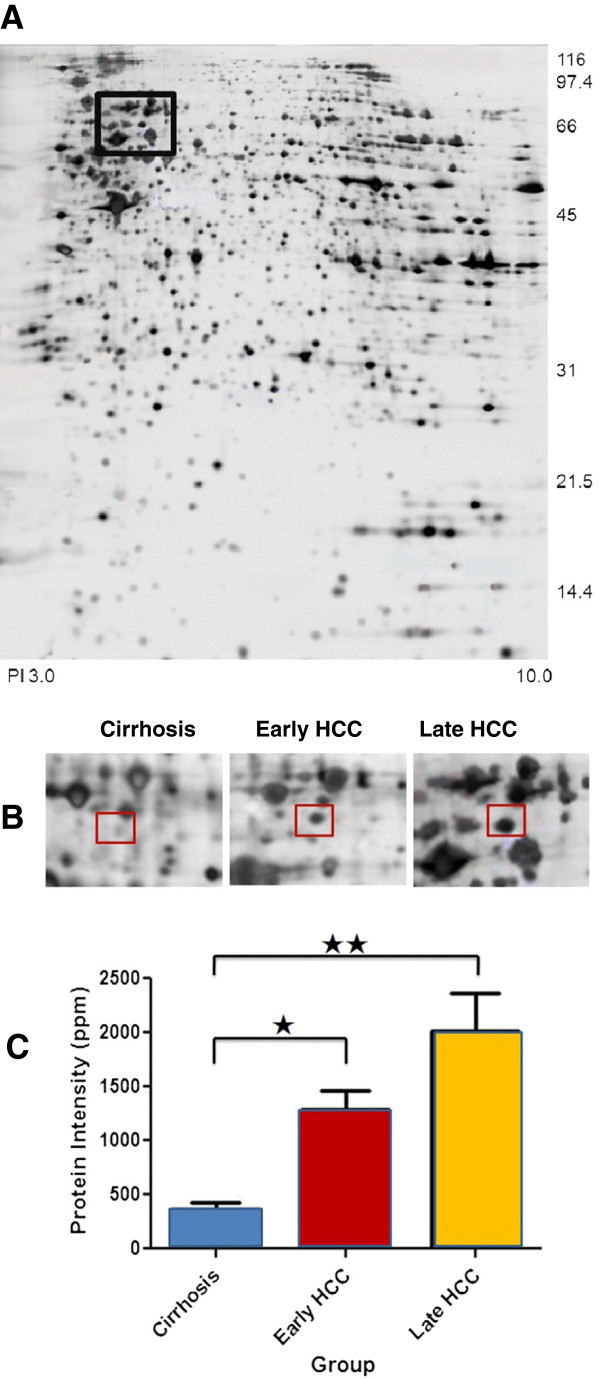
We employed a proteomic profiling approach to identify potential biomarker for early HCC detection. Based on Barcelona Clinic Liver Cancer (BCLC) staging classification, 15 early HCC and 25 late HCC tissue samples from post-operative HCC patients and their clinicopathological data were used for the discovery of biomarkers specific for the detection of early HCC. Differential proteins among cirrhotic, early, and late tissue samples were separated by two-dimensional gel electrophoresis (2-DE) and subsequently identified by mass spectrometry (MS). Receiver operating characteristic (ROC) curves analysis were performed to find potential biomarkers associated with early HCC. Diagnosis performance of the biomarker was obtained from diagnosis test.
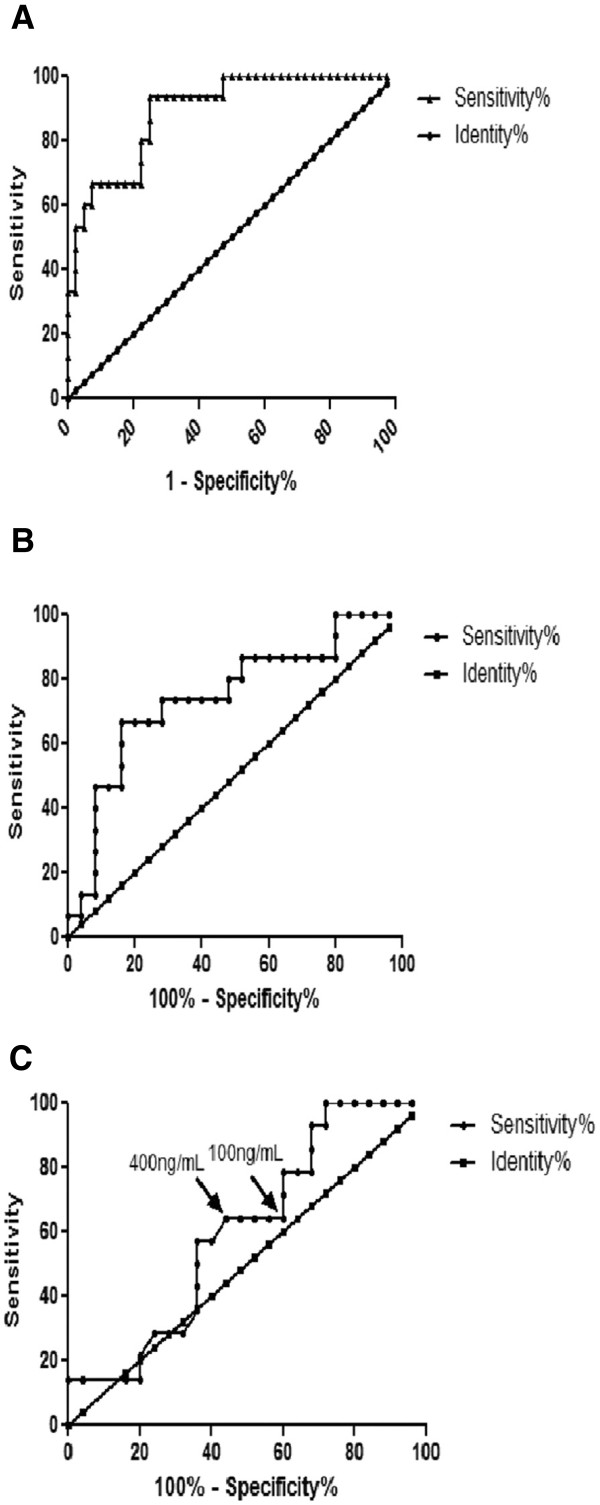
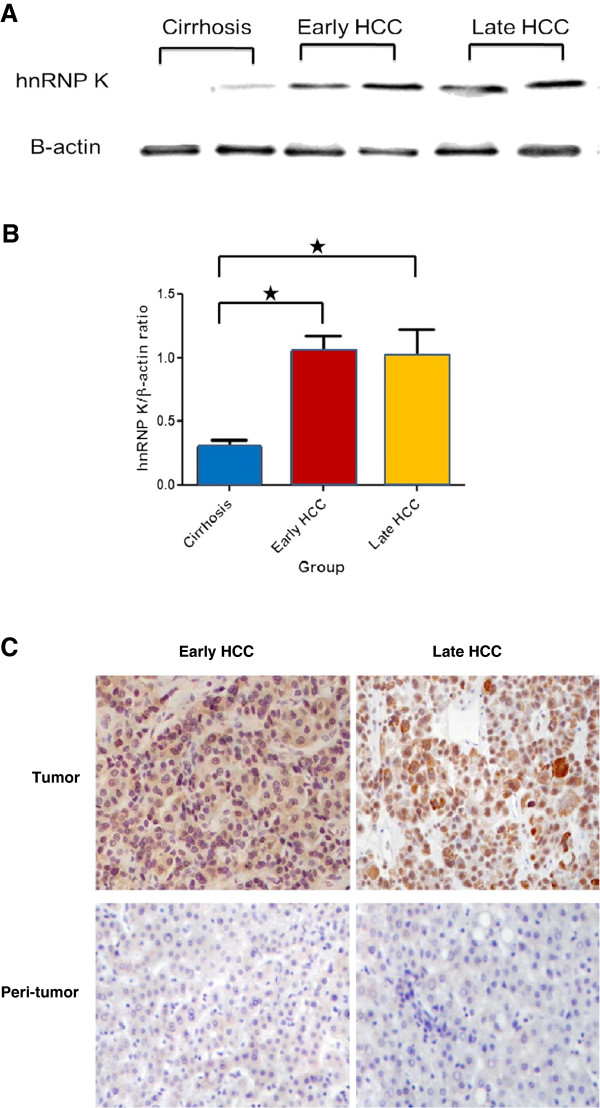
Protein spot SSP2215 was found to be significantly overexpressed in HCC, particularly in early HCC, and identified as heterogeneous nuclear ribonucleoprotein K (hnRNP K) by tandem mass spectrometry (MALDI TOF/TOF). The overexpression in HCC was subsequently validated by western blot and immunohistochemistry. ROC curve analysis showed that hnRNP K intensity could detect early HCC at 66.67 % sensitivity and 84 % specificity, which was superior to serum α-fetoprotein (AFP) in detection of early HCC. Furthermore, the diagnosis test demonstrated, when combined with hnRNP K and serum AFP as biomarker panel to detect early HCC at different cut-off value, the sensitivity and specificity could be enhanced to 93.33 % and 96 %, respectively.
hnRNP K is a potential tissue biomarker, either alone or in combination with serum AFP, for detection of early HCC. High expression of hnRNP K could be helpful to discriminate early HCC from a nonmalignant nodule, especially for patients with liver cirrhosis.
肝细胞癌(HCC)是一种常见的恶性肿瘤,主要发生在慢性肝病患者中。早期 HCC 的检测对这些患者的治疗至关重要。
我们采用蛋白质组学分析方法来鉴定早期 HCC 检测的潜在生物标志物。根据巴塞罗那临床肝癌(BCLC)分期分类,从术后 HCC 患者的肝硬化、早期和晚期组织样本中使用 15 个早期 HCC 和 25 个晚期 HCC 组织样本及其临床病理数据,用于鉴定早期 HCC 检测的特异性生物标志物。通过二维凝胶电泳(2-DE)分离肝硬化、早期和晚期组织样本中的差异蛋白,然后通过质谱(MS)进行鉴定。进行接收者操作特征(ROC)曲线分析以寻找与早期 HCC 相关的潜在生物标志物。通过诊断试验获得生物标志物的诊断性能。
发现 SSP2215 蛋白点在 HCC 中显著过表达,特别是在早期 HCC 中,并通过串联质谱(MALDI TOF/TOF)鉴定为异质核核糖核蛋白 K(hnRNP K)。Western blot 和免疫组织化学进一步验证了 HCC 中的过表达。ROC 曲线分析表明,hnRNP K 强度可以以 66.67%的灵敏度和 84%的特异性检测早期 HCC,优于血清α-胎蛋白(AFP)检测早期 HCC。此外,诊断试验表明,当将 hnRNP K 与血清 AFP 联合作为生物标志物组合,以不同的截断值检测早期 HCC 时,灵敏度和特异性分别可提高至 93.33%和 96%。
hnRNP K 是一种潜在的组织生物标志物,无论是单独使用还是与血清 AFP 联合使用,都可用于早期 HCC 的检测。hnRNP K 的高表达有助于将早期 HCC 与非恶性结节区分开来,特别是对于肝硬化患者。