Clinical Memory Research Unit, Department of Clinical Sciences, Lund University, Malmö, Sweden.
PLoS One. 2012;7(6):e38639. doi: 10.1371/journal.pone.0038639. Epub 2012 Jun 22.
Early identification of Alzheimer's disease (AD) is needed both for clinical trials and in clinical practice. In this study, we compared brief cognitive tests and cerebrospinal fluid (CSF) biomarkers in predicting conversion from mild cognitive impairment (MCI) to AD.
At a memory clinic, 133 patients with MCI were followed until development of dementia or until they had been stable over a mean period of 5.9 years (range 3.2-8.8 years). The Mini-Mental State Examination (MMSE), the clock drawing test, total tau, tau phosphorylated at Thr(181) (P-tau) and amyloid-β(1-42) (Aβ(42)) were assessed at baseline.
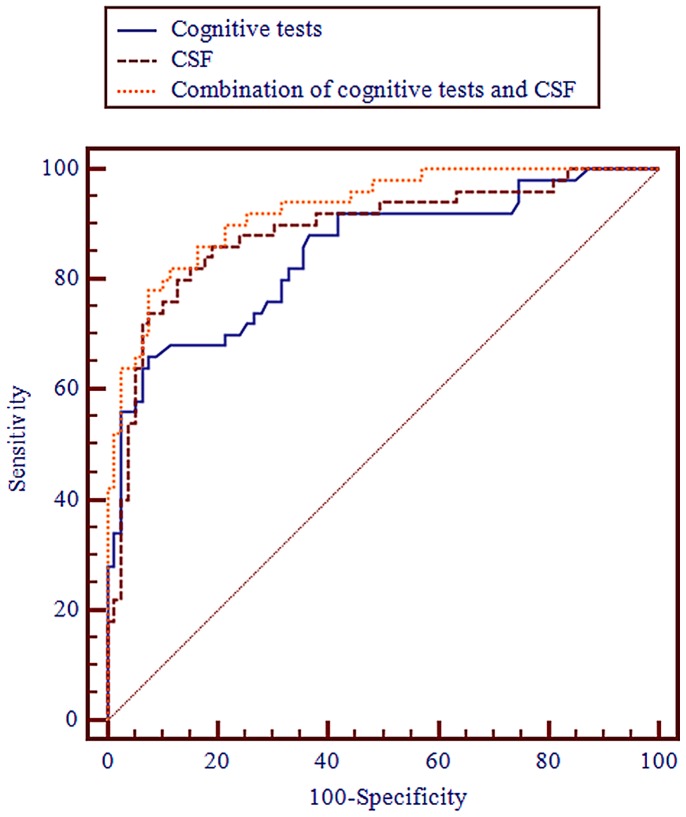
During clinical follow-up, 47% remained cognitively stable and 53% developed dementia, with an incidence of 13.8%/year. In the group that developed dementia the prevalence of AD was 73.2%, vascular dementia 14.1%, dementia with Lewy bodies (DLB) 5.6%, progressive supranuclear palsy (PSP) 4.2%, semantic dementia 1.4% and dementia due to brain tumour 1.4%. When predicting subsequent development of AD among patients with MCI, the cognitive tests classified 81% of the cases correctly (AUC, 0.85; 95% CI, 0.77-0.90) and CSF biomarkers 83% (AUC, 0.89; 95% CI, 0.82-0.94). The combination of cognitive tests and CSF (AUC, 0.93; 95% CI 0.87 to 0.96) was significantly better than the cognitive tests (p = 0.01) and the CSF biomarkers (p = 0.04) alone when predicting AD.
The MMSE and the clock drawing test were as accurate as CSF biomarkers in predicting future development of AD in patients with MCI. Combining both instruments provided significantly greater accuracy than cognitive tests or CSF biomarkers alone in predicting AD.
为了临床试验和临床实践的需要,需要尽早识别阿尔茨海默病(AD)。在这项研究中,我们比较了简短的认知测试和脑脊液(CSF)生物标志物在预测从轻度认知障碍(MCI)向 AD 转化方面的作用。
在一个记忆诊所中,对 133 名 MCI 患者进行随访,直到发展为痴呆或在平均 5.9 年(范围 3.2-8.8 年)的稳定期。在基线时评估了简易精神状态检查(MMSE)、画钟试验、总 tau、tau 磷酸化 Thr(181)(P-tau)和淀粉样β(1-42)(Aβ(42))。
在临床随访期间,47%的患者认知稳定,53%的患者发展为痴呆,发病率为 13.8%/年。在发展为痴呆的患者中,AD 的患病率为 73.2%,血管性痴呆为 14.1%,路易体痴呆(DLB)为 5.6%,进行性核上性麻痹(PSP)为 4.2%,语义性痴呆为 1.4%,脑肿瘤相关痴呆为 1.4%。当预测 MCI 患者随后发生 AD 时,认知测试正确分类了 81%的病例(AUC,0.85;95%CI,0.77-0.90),CSF 生物标志物正确分类了 83%(AUC,0.89;95%CI,0.82-0.94)。与认知测试(p=0.01)和 CSF 生物标志物(p=0.04)相比,认知测试和 CSF 的联合(AUC,0.93;95%CI 0.87 至 0.96)显著提高了 AD 的预测准确性。
MMSE 和画钟试验与 CSF 生物标志物一样,在预测 MCI 患者未来 AD 发展方面具有准确性。将两种仪器结合使用可以显著提高预测 AD 的准确性,优于单独使用认知测试或 CSF 生物标志物。