Laboratory of Dendrogeomorphology, Institute of Geological Sciences, University of Berne, Berne, Switzerland.
PLoS One. 2012;7(6):e38824. doi: 10.1371/journal.pone.0038824. Epub 2012 Jun 26.
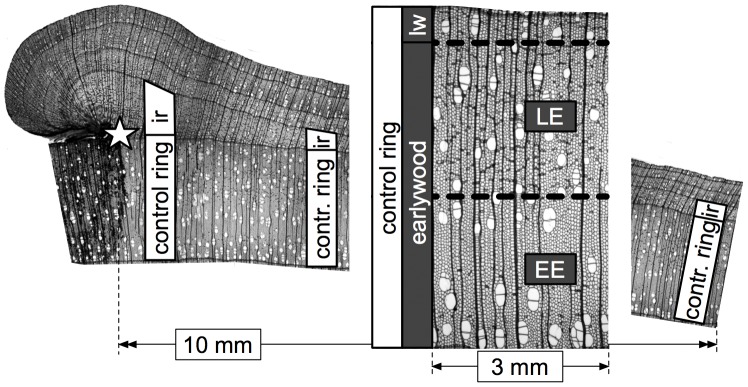
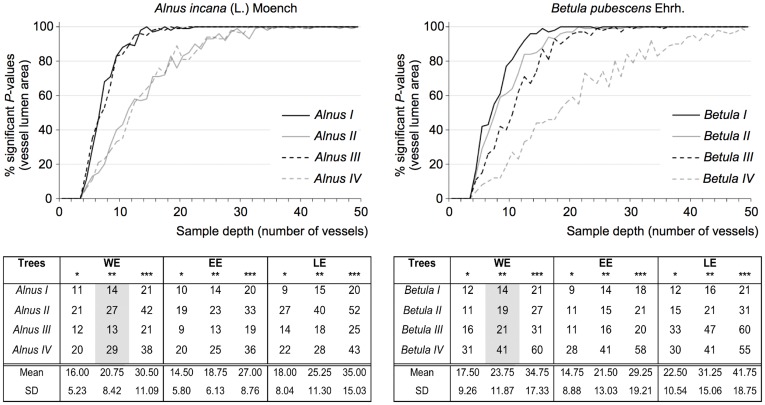
Vessels of broad-leaved trees have been analyzed to study how trees deal with various environmental factors. Cambial injury, in particular, has been reported to induce the formation of narrower conduits. Yet, little or no effort has been devoted to the elaboration of vessel sampling strategies for retrospective injury detection based on vessel lumen size reduction. To fill this methodological gap, four wounded individuals each of grey alder (Alnus incana (L.) Moench) and downy birch (Betula pubescens Ehrh.) were harvested in an avalanche path. Earlywood vessel lumina were measured and compared for each tree between the injury ring built during the growing season following wounding and the control ring laid down the previous year. Measurements were performed along a 10 mm wide radial strip, located directly next to the injury. Specifically, this study aimed at (i) investigating the intra-annual duration and local extension of vessel narrowing close to the wound margin and (ii) identifying an adequate sample of earlywood vessels (number and intra-ring location of cells) attesting to cambial injury. Based on the results of this study, we recommend analyzing at least 30 vessels in each ring. Within the 10 mm wide segment of the injury ring, wound-induced reduction in vessel lumen size did not fade with increasing radial and tangential distances, but we nevertheless advise favoring early earlywood vessels located closest to the injury. These findings, derived from two species widespread across subarctic, mountainous, and temperate regions, will assist retrospective injury detection in Alnus, Betula, and other diffuse-porous species as well as future related research on hydraulic implications after wounding.
已经对阔叶树木的导管进行了分析,以研究树木如何应对各种环境因素。特别是,有人报道说,形成层损伤会诱导形成更窄的导管。然而,几乎没有或没有努力制定基于导管腔径减小的回溯性损伤检测的导管取样策略。为了填补这一方法上的空白,在雪崩路径中收获了 4 个受伤的灰桤木(Alnus incana (L.) Moench)和毛桦(Betula pubescens Ehrh.)个体。在受伤后的生长季节中建立的损伤环与前一年形成的对照环之间,对每棵树的早材导管腔进行了测量和比较。测量沿直接位于损伤处的 10 毫米宽的径向带进行。具体而言,本研究旨在:(i)研究靠近伤口边缘的导管变窄的年内持续时间和局部扩展;(ii)确定足够数量的早材导管(细胞的数量和环内位置),以证明形成层损伤。基于这项研究的结果,我们建议在每个环中分析至少 30 个导管。在损伤环的 10 毫米宽的部分内,导管腔径减小的现象并没有随着径向和切线距离的增加而消失,但我们仍然建议优先选择靠近损伤的早期早材导管。这些发现源自两种广泛分布于亚北极、山区和温带地区的物种,将有助于在桤木、桦木和其他散孔材物种中进行回溯性损伤检测,以及未来有关受伤后水力影响的相关研究。