Museum für Naturkunde, Leibniz-Institut für Evolutions und Biodiversitätsforschung, Berlin, Germany.
PLoS One. 2012;7(6):e39056. doi: 10.1371/journal.pone.0039056. Epub 2012 Jun 25.
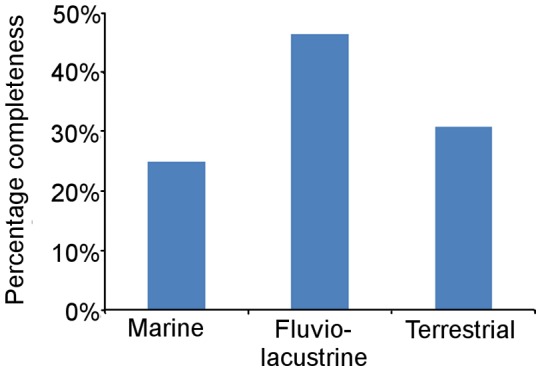
Many palaeobiological analyses have concluded that modern birds (Neornithes) radiated no earlier than the Maastrichtian, whereas molecular clock studies have argued for a much earlier origination. Here, we assess the quality of the fossil record of Mesozoic avian species, using a recently proposed character completeness metric which calculates the percentage of phylogenetic characters that can be scored for each taxon. Estimates of fossil record quality are plotted against geological time and compared to estimates of species level diversity, sea level, and depositional environment. Geographical controls on the avian fossil record are investigated by comparing the completeness scores of species in different continental regions and latitudinal bins. Avian fossil record quality varies greatly with peaks during the Tithonian-early Berriasian, Aptian, and Coniacian-Santonian, and troughs during the Albian-Turonian and the Maastrichtian. The completeness metric correlates more strongly with a 'sampling corrected' residual diversity curve of avian species than with the raw taxic diversity curve, suggesting that the abundance and diversity of birds might influence the probability of high quality specimens being preserved. There is no correlation between avian completeness and sea level, the number of fluviolacustrine localities or a recently constructed character completeness metric of sauropodomorph dinosaurs. Comparisons between the completeness of Mesozoic birds and sauropodomorphs suggest that small delicate vertebrate skeletons are more easily destroyed by taphonomic processes, but more easily preserved whole. Lagerstätten deposits might therefore have a stronger impact on reconstructions of diversity of smaller organisms relative to more robust forms. The relatively poor quality of the avian fossil record in the Late Cretaceous combined with very patchy regional sampling means that it is possible neornithine lineages were present throughout this interval but have not yet been sampled or are difficult to identify because of the fragmentary nature of the specimens.
许多古生物学分析得出结论,现代鸟类(新鸟类)的辐射起源时间不早于马斯特里赫特阶,而分子钟研究则认为起源时间更早。在这里,我们使用最近提出的一种特征完整性度量来评估中生代鸟类物种的化石记录质量,该度量计算了每个分类单元可得分的系统发育特征的百分比。将化石记录质量的估计值与地质时间作图,并与物种水平多样性、海平面和沉积环境的估计值进行比较。通过比较不同大陆地区和纬度箱中物种的完整性得分,研究了鸟类化石记录的地理控制因素。鸟类化石记录的质量随提通阶-早贝里亚阶、阿普阶和科尼亚克阶-桑托阶的高峰以及阿尔布阶-土仑阶和马斯特里赫特阶的低谷而变化很大。完整性度量与鸟类物种的“采样校正”剩余多样性曲线的相关性比与原始分类多样性曲线的相关性更强,这表明鸟类的丰度和多样性可能会影响高质量标本保存的概率。鸟类的完整性与海平面、河流湖泊地点的数量或最近构建的蜥脚类恐龙特征完整性度量均无相关性。中生代鸟类与蜥脚类恐龙的完整性比较表明,小而脆弱的脊椎动物骨骼更容易受到灭绝过程的破坏,但更容易整体保存。因此,相对于更坚固的形式,化石化沉积物可能对较小生物多样性的重建产生更强的影响。白垩纪晚期鸟类化石记录的质量相对较差,加上区域采样非常分散,这意味着新鸟类的谱系可能在整个时期都存在,但尚未被采样或由于标本的破碎性质而难以识别。