Institute of Molecular Biophysics, Florida State University, Tallahassee, Florida, United States of America.
PLoS One. 2012;7(6):e39422. doi: 10.1371/journal.pone.0039422. Epub 2012 Jun 25.
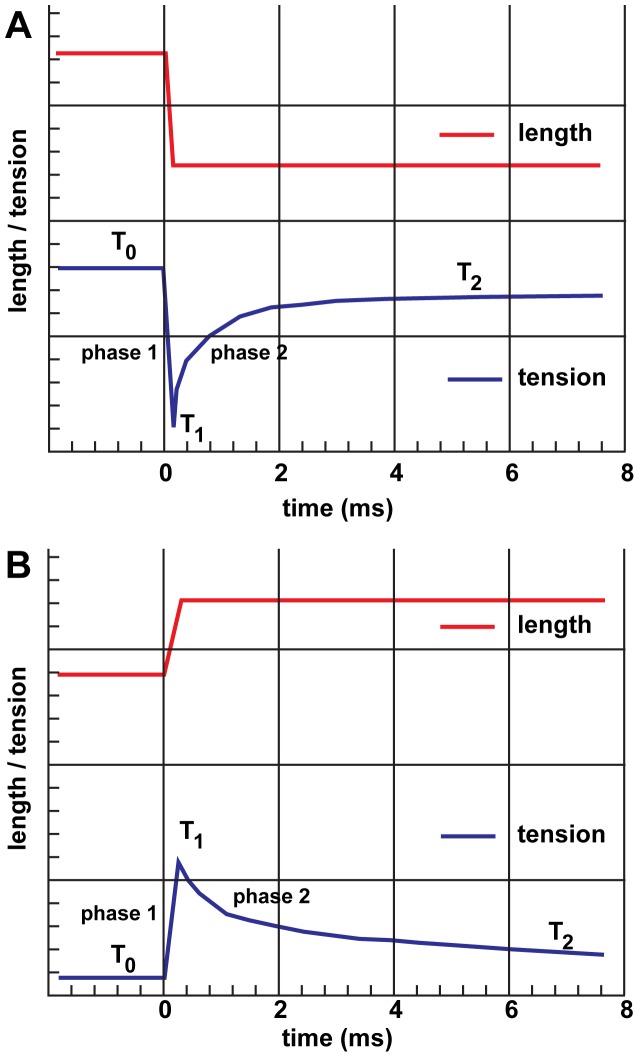
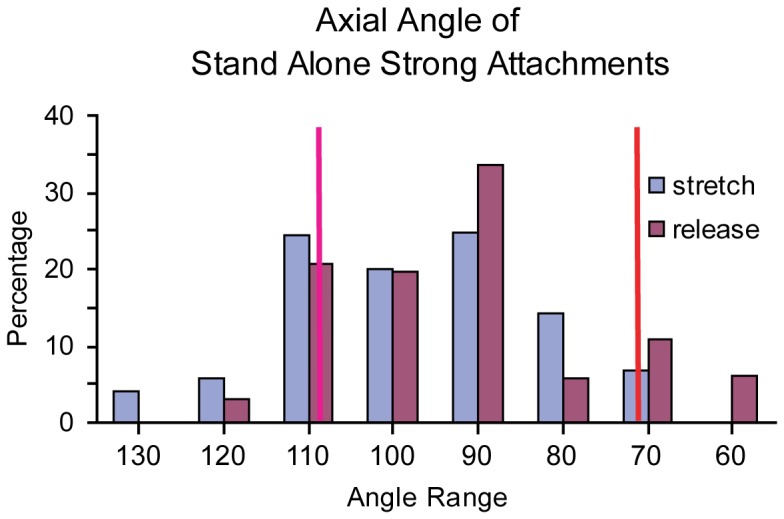
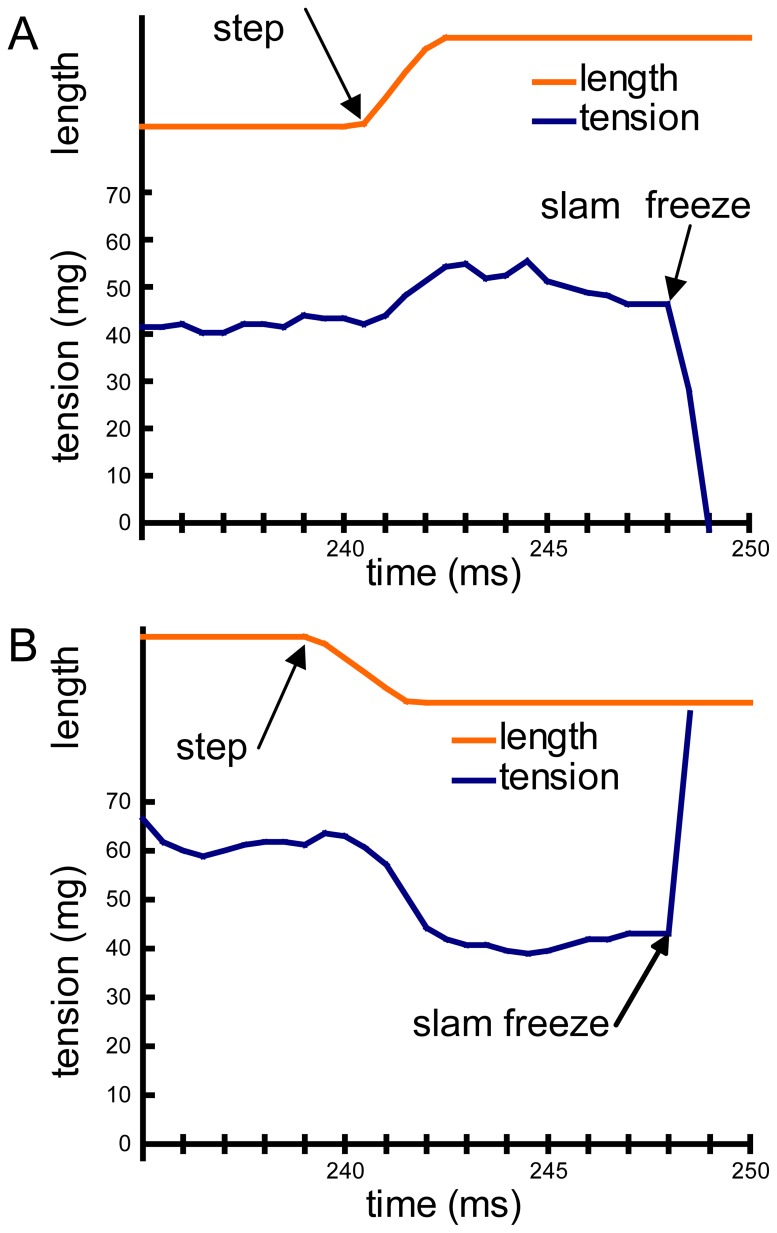
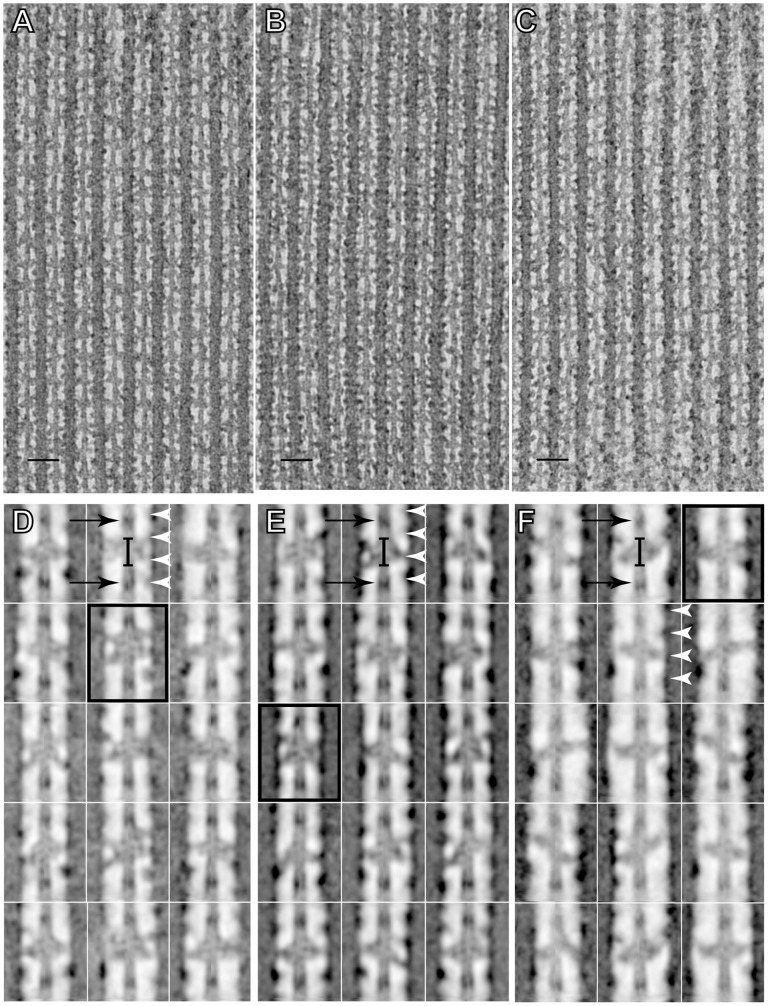
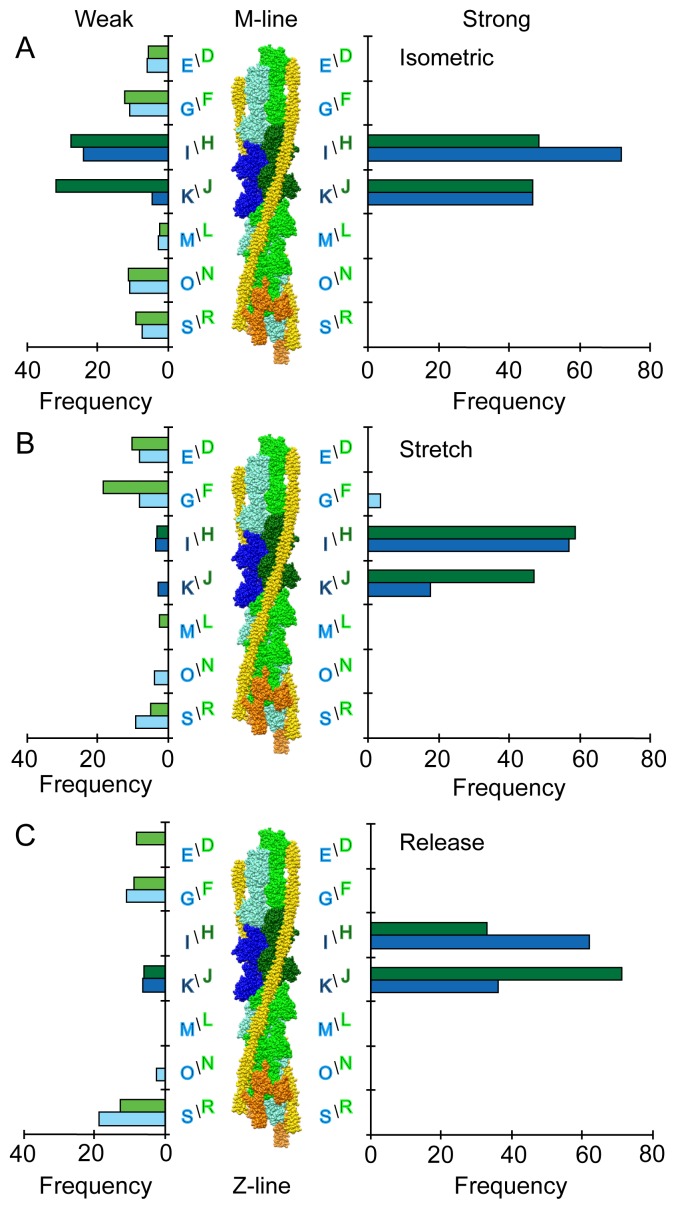
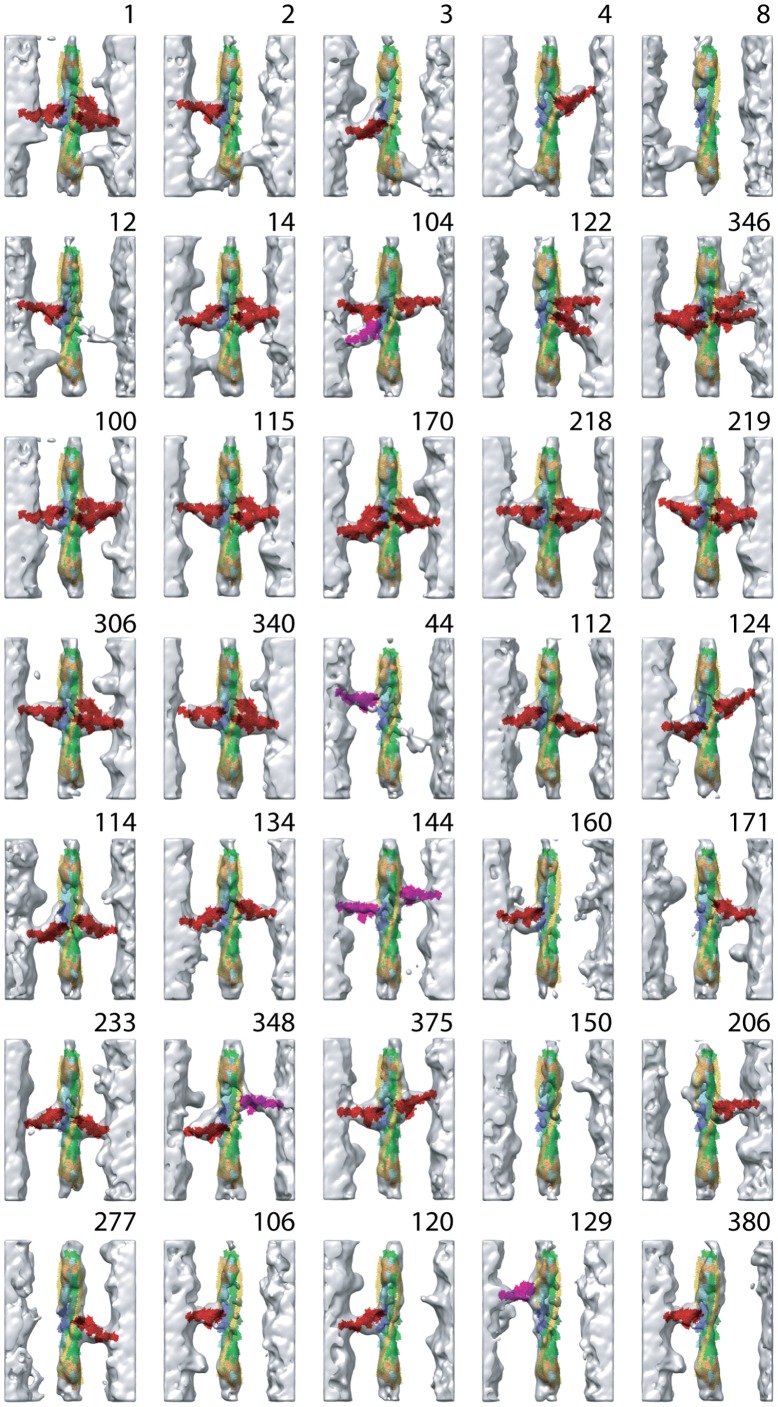
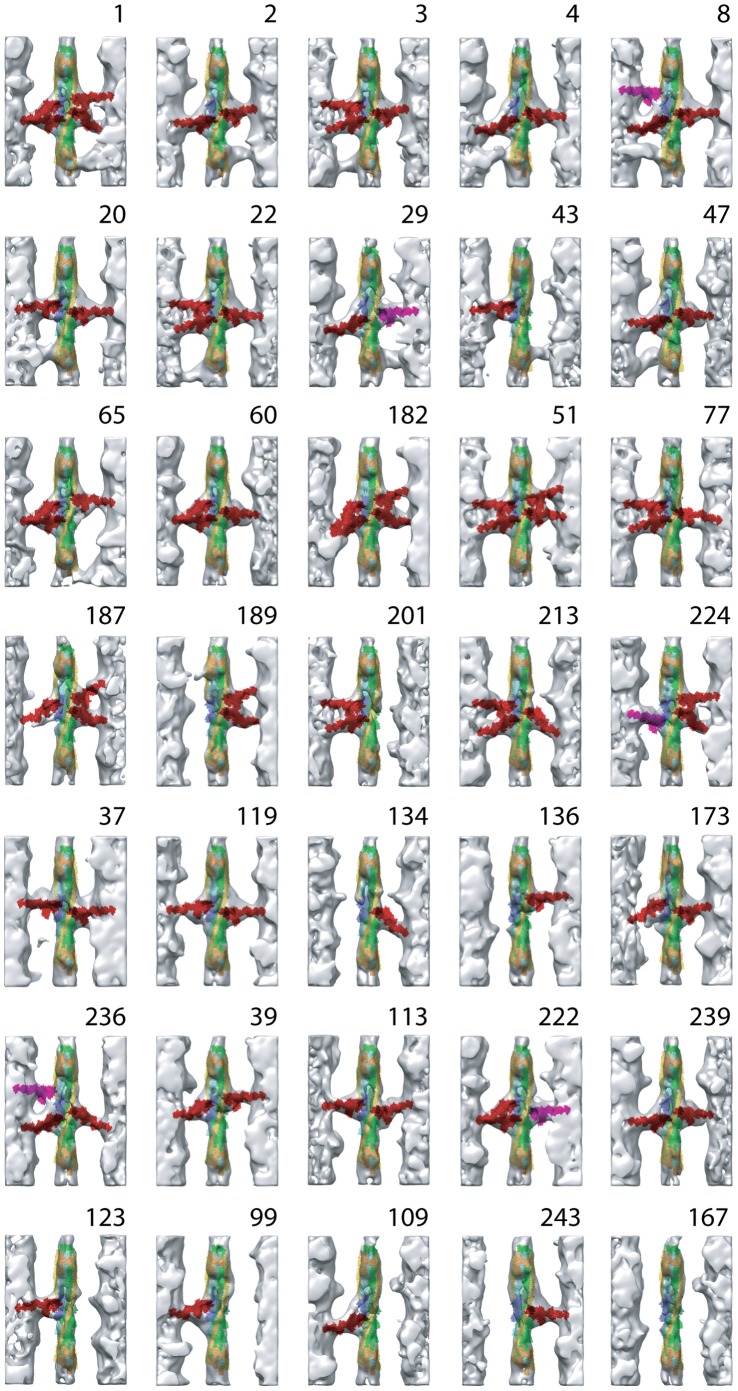
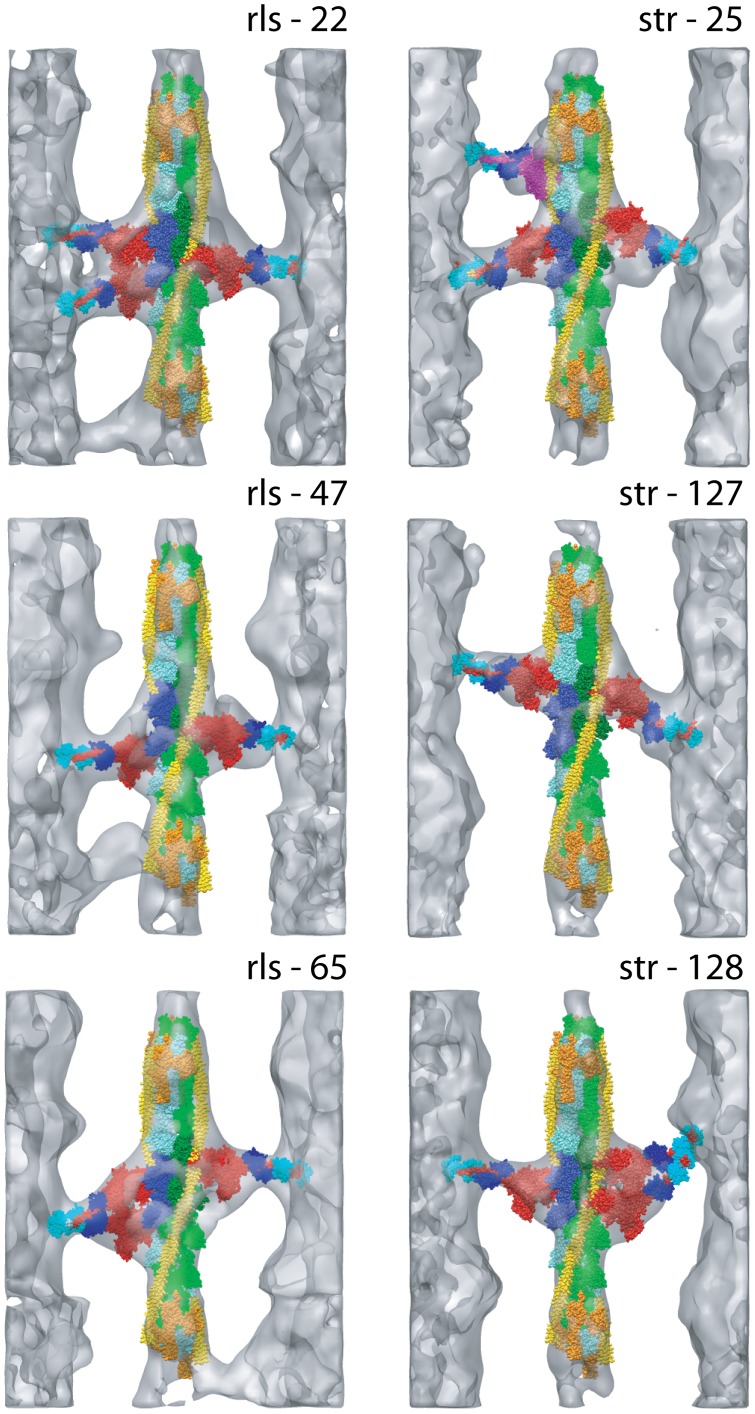
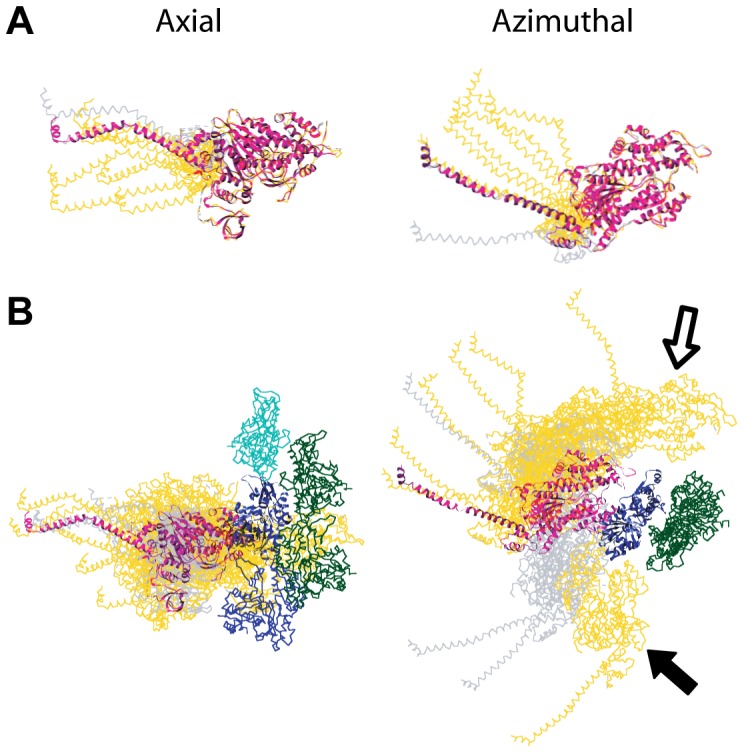
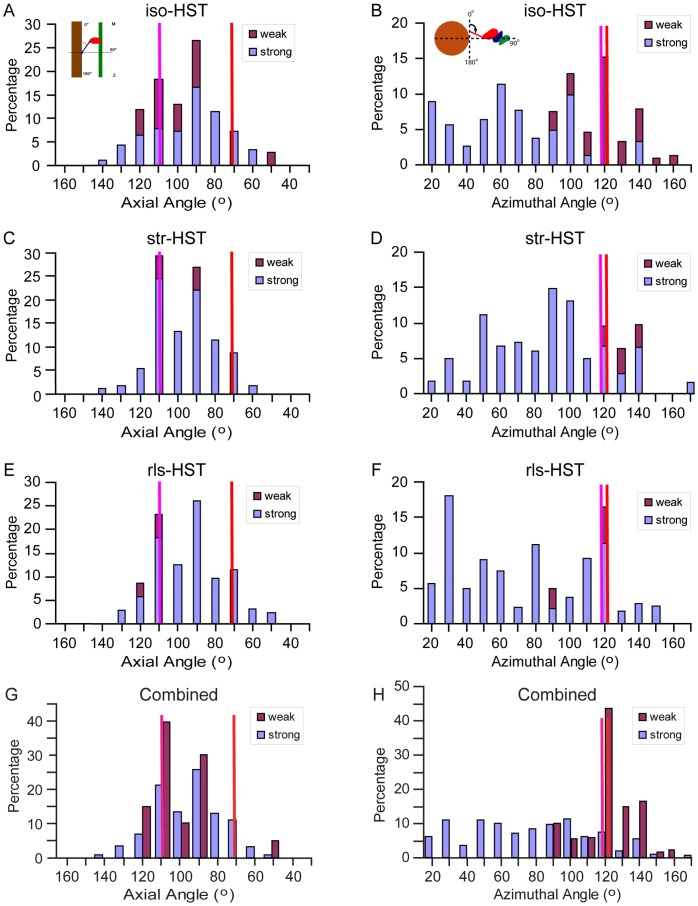
The application of rapidly applied length steps to actively contracting muscle is a classic method for synchronizing the response of myosin cross-bridges so that the average response of the ensemble can be measured. Alternatively, electron tomography (ET) is a technique that can report the structure of the individual members of the ensemble. We probed the structure of active myosin motors (cross-bridges) by applying 0.5% changes in length (either a stretch or a release) within 2 ms to isometrically contracting insect flight muscle (IFM) fibers followed after 5-6 ms by rapid freezing against a liquid helium cooled copper mirror. ET of freeze-substituted fibers, embedded and thin-sectioned, provides 3-D cross-bridge images, sorted by multivariate data analysis into ~40 classes, distinct in average structure, population size and lattice distribution. Individual actin subunits are resolved facilitating quasi-atomic modeling of each class average to determine its binding strength (weak or strong) to actin. ~98% of strong-binding acto-myosin attachments present after a length perturbation are confined to "target zones" of only two actin subunits located exactly midway between successive troponin complexes along each long-pitch helical repeat of actin. Significant changes in the types, distribution and structure of actin-myosin attachments occurred in a manner consistent with the mechanical transients. Most dramatic is near disappearance, after either length perturbation, of a class of weak-binding cross-bridges, attached within the target zone, that are highly likely to be precursors of strong-binding cross-bridges. These weak-binding cross-bridges were originally observed in isometrically contracting IFM. Their disappearance following a quick stretch or release can be explained by a recent kinetic model for muscle contraction, as behaviour consistent with their identification as precursors of strong-binding cross-bridges. The results provide a detailed model for contraction in IFM that may be applicable to contraction in other types of muscle.
快速施加长度步长应用于主动收缩的肌肉是一种将肌球蛋白横桥的响应同步的经典方法,以便可以测量整体的平均响应。或者,电子断层摄影术(ET)是一种可以报告整体中各个成员结构的技术。我们通过在 2 毫秒内对等长收缩的昆虫飞行肌(IFM)纤维施加 0.5%的长度变化(伸展或释放),然后在 5-6 毫秒后快速冷冻到液氦冷却的铜镜上来探测活性肌球蛋白马达(横桥)的结构。对冷冻替代纤维进行 ET,进行嵌入和薄切片处理,提供 3-D 横桥图像,通过多元数据分析分为约 40 个类,在平均结构、种群大小和晶格分布方面具有明显的区别。可以分辨出单个肌动蛋白亚基,从而可以对每个类别的平均结构进行准原子建模,以确定其与肌动蛋白的结合强度(弱或强)。在长度扰动后,大约 98%的强结合肌球蛋白附着物仅限于仅两个肌动蛋白亚基的“靶区”,这些靶区位于每个肌动蛋白长螺旋重复的连续肌钙蛋白复合物之间的中点。附着的类型、分布和结构发生了显著变化,这与力学瞬态一致。最引人注目的是,在长度扰动之后,在靶区内部附着的一类弱结合横桥几乎消失,这些横桥很可能是强结合横桥的前体。这些弱结合的横桥最初在等长收缩的 IFM 中观察到。它们在快速拉伸或释放后消失,可以用最近的肌肉收缩动力学模型来解释,因为它们的行为与作为强结合横桥前体的鉴定一致。这些结果为 IFM 的收缩提供了一个详细的模型,该模型可能适用于其他类型的肌肉收缩。