Section for Artificial Intelligence, Center for Medical Statistics, Informatics and Intelligent Systems, Medical University of Vienna, Austria.
Comput Methods Programs Biomed. 2012 Dec;108(3):961-72. doi: 10.1016/j.cmpb.2012.05.009. Epub 2012 Jul 3.
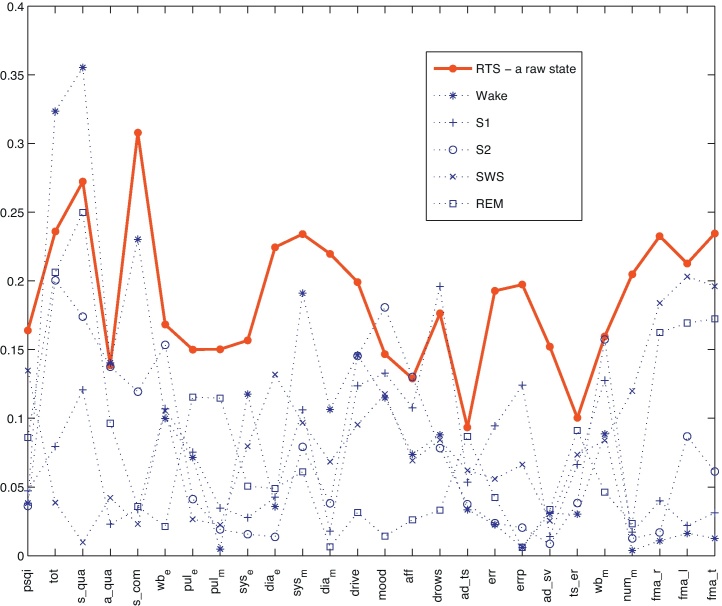
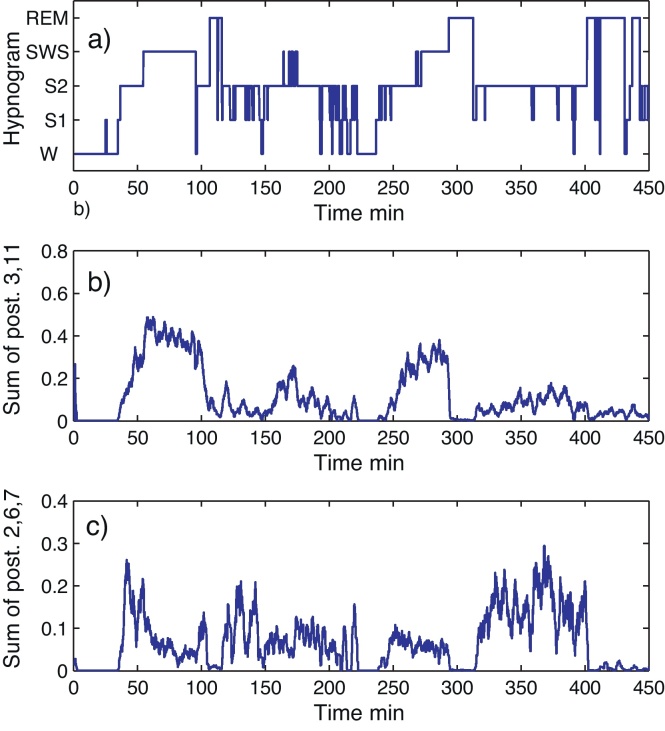
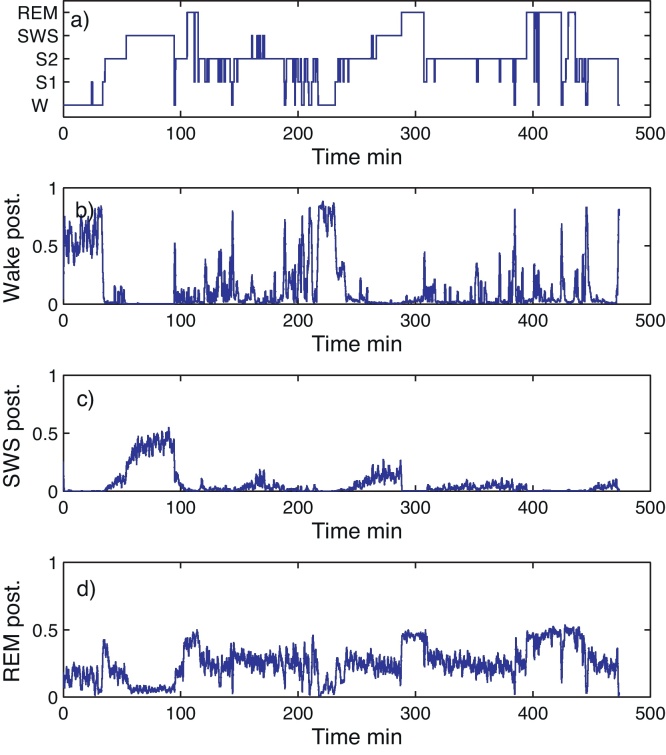
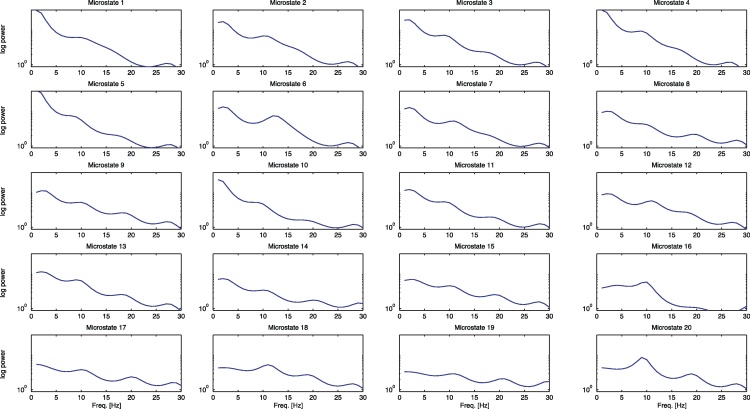
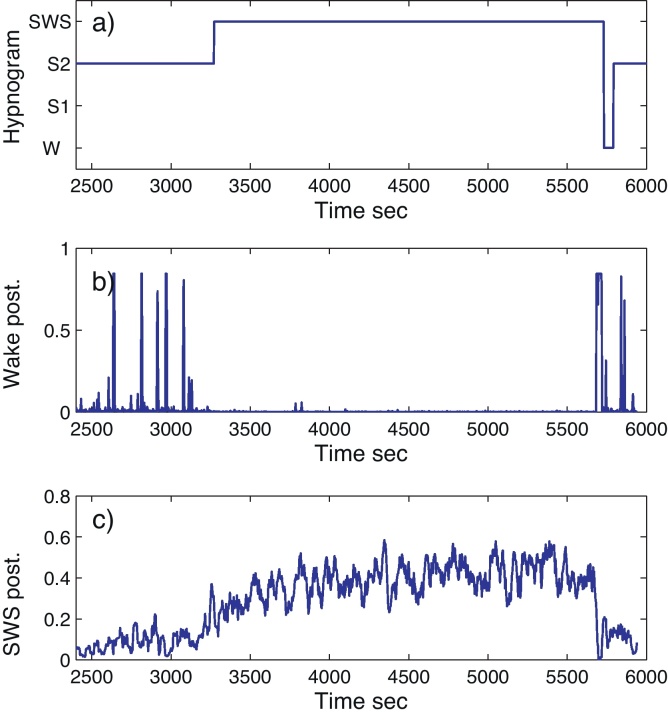
We are introducing and validating an EEG data-based model of the sleep process with an arbitrary number of different sleep stages and a high time resolution allowing modeling of sleep microstructure. In contrast to the standard practice of sleep staging, defined by scoring rules, we describe sleep via posterior probabilities of a finite number of states, not necessarily reflecting the traditional sleep stages. To test the proposed probabilistic sleep model (PSM) for validity, we correlate statistics derived from the state posteriors with the results of psychometric tests, physiological variables and questionnaires collected before and after sleep. Considering short, in this study 3s long, data window the PSM allows describing the sleep process on finer time scale in comparison to the traditional sleep staging based on 20 or 30s long data segments visual inspection. By combining sleep states and using two measures derived from the posterior curves we show that the average absolute correlations between the measures and subjective and objective sleep quality measures are considerably higher when compared with the analogous measures derived from hypnograms based on sleep staging. In most cases these differences are significant. The results obtained with the PSM support its wider use in sleep process modeling research and these results also suggest that EEG signals contain more information about sleep than what sleep profiles based on discrete stages can reveal. Therefore the standardized scoring of sleep may not be sufficient to reveal important sleep changes related to subjective and objective sleep quality indexes. The proposed PSM represents a promising alternative.
我们正在引入和验证一种基于 EEG 数据的睡眠过程模型,该模型具有任意数量的不同睡眠阶段和高精度的时间分辨率,允许对睡眠微结构进行建模。与由评分规则定义的标准睡眠分期方法不同,我们通过有限数量的状态的后验概率来描述睡眠,而不一定反映传统的睡眠阶段。为了测试所提出的概率睡眠模型 (PSM) 的有效性,我们将从状态后验中得出的统计数据与在睡眠前后收集的心理测试、生理变量和问卷的结果进行相关分析。考虑到数据较短,在这项研究中,数据窗口为 3 秒长,与传统的基于 20 或 30 秒长数据段的视觉检查的睡眠分期相比,PSM 允许在更精细的时间尺度上描述睡眠过程。通过结合睡眠状态并使用从后验曲线中得出的两个度量,我们表明,与基于睡眠分期的睡眠图得出的类似度量相比,这些度量与主观和客观睡眠质量度量之间的平均绝对相关性要高得多。在大多数情况下,这些差异是显著的。PSM 获得的结果支持其在睡眠过程建模研究中的更广泛应用,这些结果还表明,与基于离散阶段的睡眠图相比,EEG 信号包含更多关于睡眠的信息。因此,标准化的睡眠评分可能不足以揭示与主观和客观睡眠质量指标相关的重要睡眠变化。所提出的 PSM 代表了一种有前途的替代方法。