Maier Lars S
Abteilung Kardiologie und Pneumologie/Herzzentrum, Deutsches Zentrum für Herzkreislaufforschung, Georg-August-Universität Göttingen, Robert-Koch-Strasse 40, 37075, Göttingen, Germany.
Curr Heart Fail Rep. 2012 Sep;9(3):183-91. doi: 10.1007/s11897-012-0099-3.
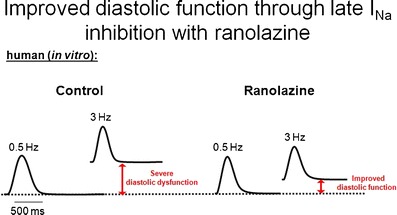
The late Na current is of pathophysiological importance for the heart. Ranolazine is an innovative anti-ischemic and antianginal agent that inhibits the late Na current, thereby reducing the Na-dependent Ca-overload, which improves diastolic tone and oxygen handling during myocardial ischemia. In addition, ranolazine seems to exert beneficial effects on diastolic cardiac function. Moreover, there are experimental and clinical data about its antiarrhythmic properties. A beneficial atrial selectivity of ranolazine has been suggested that may be helpful for the treatment of atrial fibrillation. The purpose of this review article is to discuss possible future clinical indications based on novel experimental and preclinical results and the significance of the available data.
晚钠电流对心脏具有病理生理学重要性。雷诺嗪是一种创新的抗缺血和抗心绞痛药物,它抑制晚钠电流,从而减少钠依赖性钙超载,改善心肌缺血期间的舒张期张力和氧处理。此外,雷诺嗪似乎对心脏舒张功能有有益作用。而且,有关于其抗心律失常特性的实验和临床数据。有人提出雷诺嗪具有有益的心房选择性,这可能有助于治疗心房颤动。这篇综述文章的目的是基于新的实验和临床前结果讨论未来可能的临床适应证以及现有数据的意义。