Department of Biostatistics, University of Michigan, Ann Arbor, Michigan, United States of America.
PLoS One. 2012;7(6):e39854. doi: 10.1371/journal.pone.0039854. Epub 2012 Jun 29.
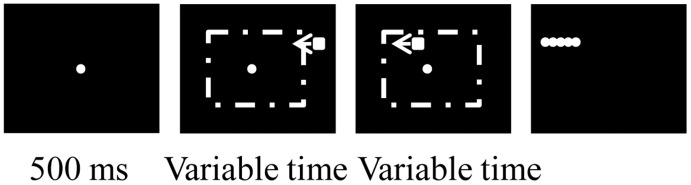
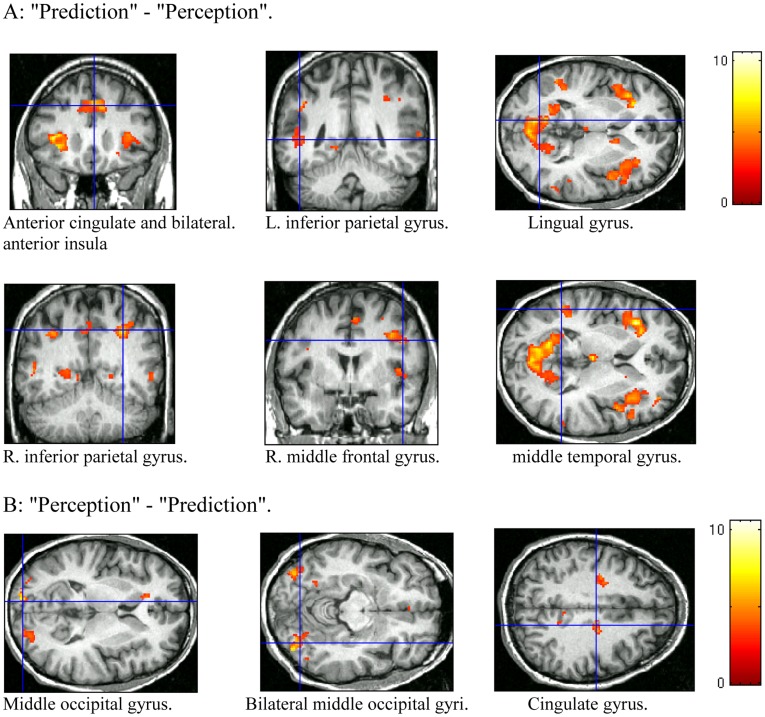
Predicting the trajectories of moving objects in our surroundings is important for many life scenarios, such as driving, walking, reaching, hunting and combat. We determined human subjects' performance and task-related brain activity in a motion trajectory prediction task. The task required spatial and motion working memory as well as the ability to extrapolate motion information in time to predict future object locations. We showed that the neural circuits associated with motion prediction included frontal, parietal and insular cortex, as well as the thalamus and the visual cortex. Interestingly, deactivation of many of these regions seemed to be more closely related to task performance. The differential activity during motion prediction vs. direct observation was also correlated with task performance. The neural networks involved in our visual motion prediction task are significantly different from those that underlie visual motion memory and imagery. Our results set the stage for the examination of the effects of deficiencies in these networks, such as those caused by aging and mental disorders, on visual motion prediction and its consequences on mobility related daily activities.
预测周围移动物体的轨迹对于许多生活场景都很重要,例如驾驶、步行、伸手、狩猎和战斗。我们在一个运动轨迹预测任务中确定了人类受试者的表现和与任务相关的大脑活动。该任务需要空间和运动工作记忆,以及在时间上推断运动信息的能力,以预测未来物体的位置。我们表明,与运动预测相关的神经回路包括额、顶、岛叶皮质以及丘脑和视觉皮质。有趣的是,许多这些区域的失活似乎与任务表现更为密切相关。运动预测与直接观察之间的差异活动也与任务表现相关。参与我们的视觉运动预测任务的神经网络与视觉运动记忆和意象所涉及的神经网络有很大的不同。我们的结果为研究这些网络的缺陷(例如由衰老和精神障碍引起的缺陷)对视觉运动预测及其对与移动性相关的日常活动的影响奠定了基础。