Oregon Osteoporosis Center, 5050 NE Hoyt Street, Suite 626, Portland, OR 97213, USA.
Osteoporos Int. 2013 Jan;24(1):227-35. doi: 10.1007/s00198-012-2052-4. Epub 2012 Jul 10.
In a phase 2 study, continued denosumab treatment for up to 8 years was associated with continued gains in bone mineral density and persistent reductions in bone turnover markers. Denosumab treatment was well tolerated throughout the 8-year study.
The purpose of this study is to present the effects of 8 years of continued denosumab treatment on bone mineral density (BMD) and bone turnover markers (BTM) from a phase 2 study.
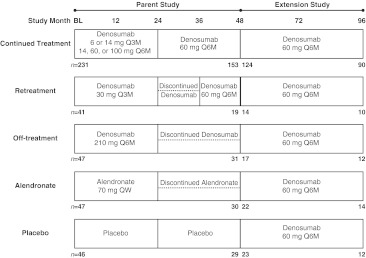
In the 4-year parent study, postmenopausal women with low BMD were randomized to receive placebo, alendronate, or denosumab. After 2 years, subjects were reallocated to continue, discontinue, or discontinue and reinitiate denosumab; discontinue alendronate; or maintain placebo for two more years. The parent study was then extended for 4 years where all subjects received denosumab.
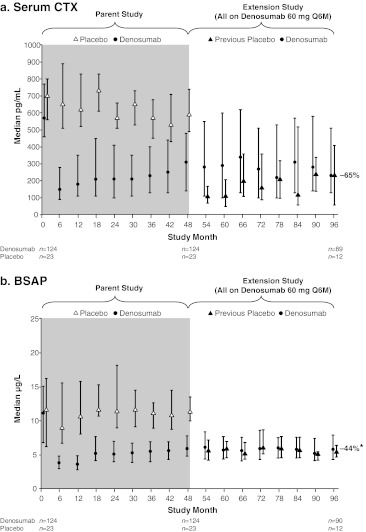
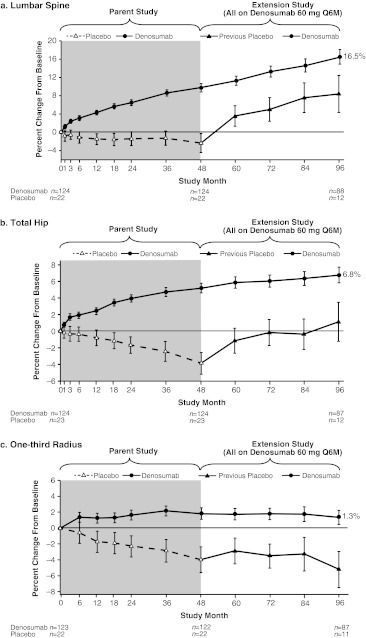
Of the 262 subjects who completed the parent study, 200 enrolled in the extension, and of these, 138 completed the extension. For the subjects who received 8 years of continued denosumab treatment, BMD at the lumbar spine (N = 88) and total hip (N = 87) increased by 16.5 and 6.8 %, respectively, compared with their parent study baseline, and by 5.7 and 1.8 %, respectively, compared with their extension study baseline. For the 12 subjects in the original placebo group, 4 years of denosumab resulted in BMD gains comparable with those observed during the 4 years of denosumab in the parent study. Reductions in BTM were sustained over the course of continued denosumab treatment. Reductions also were observed when the placebo group transitioned to denosumab. Adverse event profile was consistent with previous reports and an aging cohort.
Continued denosumab treatment for 8 years was associated with progressive gains in BMD, persistent reductions in BTM, and was well tolerated.
在一项 2 期研究中,持续接受地舒单抗治疗长达 8 年可使骨密度持续增加,并持续降低骨转换标志物。在整个 8 年的研究中,地舒单抗治疗耐受性良好。
本研究的目的是介绍一项 2 期研究中,继续接受地舒单抗治疗 8 年对骨密度(BMD)和骨转换标志物(BTM)的影响。
在为期 4 年的母研究中,绝经后低骨密度的女性被随机分配接受安慰剂、阿仑膦酸钠或地舒单抗。2 年后,受试者重新分配为继续、停止、停止后重新开始地舒单抗;停止阿仑膦酸钠;或再维持 2 年安慰剂。然后,该母研究延长了 4 年,所有受试者均接受地舒单抗治疗。
在完成母研究的 262 名受试者中,有 200 名入组扩展研究,其中 138 名完成了扩展研究。对于接受 8 年持续地舒单抗治疗的受试者,腰椎(N=88)和全髋(N=87)的 BMD 分别增加了 16.5%和 6.8%,与母研究基线相比,与扩展研究基线相比,分别增加了 5.7%和 1.8%。对于原始安慰剂组的 12 名受试者,4 年的地舒单抗治疗使 BMD 增加与母研究 4 年的地舒单抗观察结果相当。持续接受地舒单抗治疗可使 BTM 持续降低。当安慰剂组转为地舒单抗时,也观察到 BTM 的降低。不良事件谱与之前的报告一致,且随着年龄增长而变化。
持续 8 年接受地舒单抗治疗可使 BMD 持续增加,BTM 持续降低,且耐受性良好。