Weill Cornell Medical College, New York, NY 10065, USA.
Med Educ Online. 2012;17:17375. doi: 10.3402/meo.v17i0.17375. Epub 2012 Jun 11.
The purpose of this study was to test a new problem-based learning (PBL) method to see if it reinvigorated the learning experience.
A new PBL format called PBL 2.0, which met for 90 min two times per week, was introduced in 2009 into an 11-week integrated neuroscience course. One hundred second-year medical students, divided into 10 groups of 10, who had completed their first year of medical school using a traditional PBL format, participated in PBL 2.0. Students were prohibited from using computers during the first session. Learning objectives were distributed at the end of the first day to the small groups, and students were assigned to pairs/trios responsible for leading an interactive discussion on specific learning objectives the following day. Student-led 'lectures' were prohibited. All students were responsible for learning all of the learning objectives so that they could participate in their discussions.
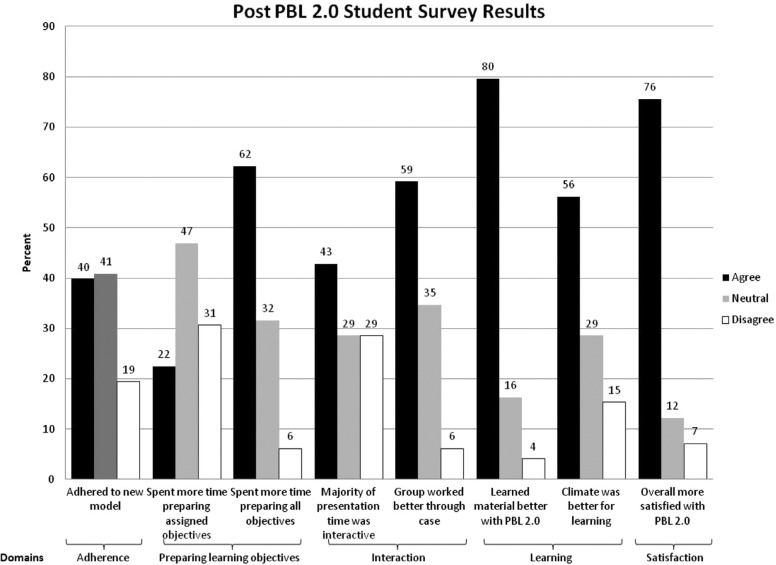
One hundred and six students were surveyed and 98 submitted answers (92% response). The majority of groups adhered to the new PBL method. Students invested more time preparing the learning objectives. Students indicated that the level of interaction among students increased. The majority of students preferred the new PBL format.
PBL 2.0 was effective in increasing student interaction and promoting increased learning.
本研究旨在测试一种新的基于问题的学习(PBL)方法,以观察其是否能重新激发学习体验。
2009 年,在为期 11 周的综合神经科学课程中,引入了一种名为 PBL 2.0 的新 PBL 模式,每周两次,每次 90 分钟。100 名二年级医学生,分为 10 个 10 人小组,他们在完成了第一年的医学课程,使用了传统的 PBL 模式后,参与了 PBL 2.0。学生在第一次会议期间被禁止使用计算机。学习目标在第一天结束时分发给小组成员,学生被分配到负责第二天进行特定学习目标互动讨论的对子/三人组。禁止学生主导的“讲座”。所有学生都有责任学习所有的学习目标,以便他们能够参与讨论。
有 106 名学生接受了调查,其中 98 名提交了答案(92%的回应率)。大多数小组都遵守了新的 PBL 方法。学生在准备学习目标方面投入了更多的时间。学生表示,学生之间的互动水平有所提高。大多数学生更喜欢新的 PBL 格式。
PBL 2.0 有效地增加了学生之间的互动,促进了学习的提高。