Zimmerman William Denney, Pergakis Melissa B, Gorman Emily F, Motta Melissa, Jin Peter H, Salas Rachel Marie E, Morris Nicholas A
From the Department of Neurology (W.D.Z., M.B.P., M.M., P.H.J., N.A.M.), University of Maryland School of Medicine; Program in Trauma (W.D.Z., M.B.P., M.M., N.A.M.), R Adams Cowley Shock Trauma Hospital; Health Sciences and Human Services Library (E.F.G.), University of Maryland; and Department of Neurology (R.M.E.S.), Johns Hopkins School of Medicine, Baltimore, MD.
Neurol Educ. 2023 Feb 21;2(1):e200048. doi: 10.1212/NE9.0000000000200048. eCollection 2023 Mar.
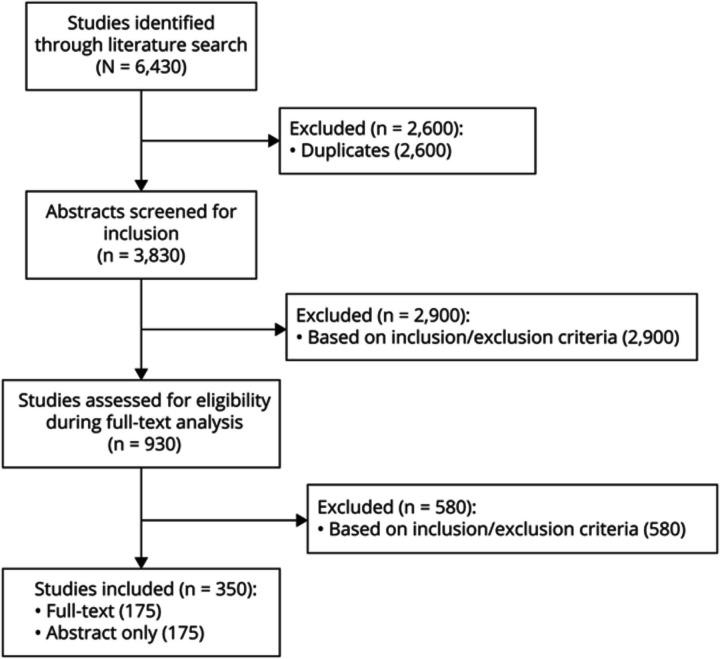
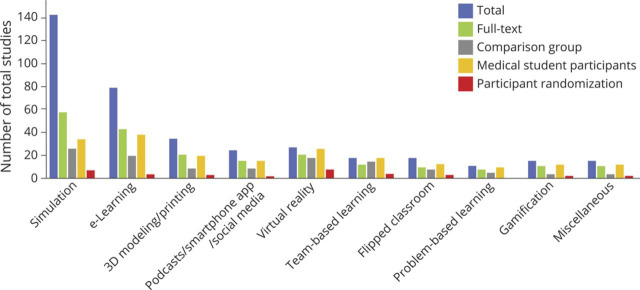
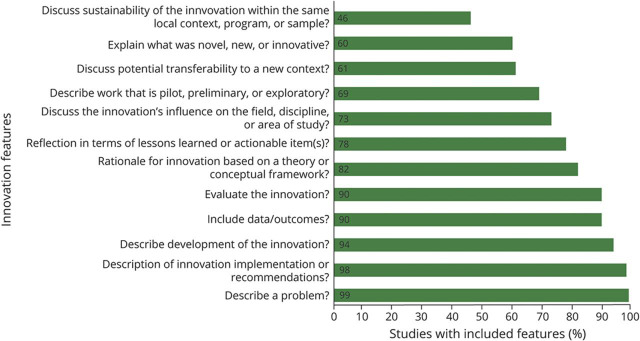
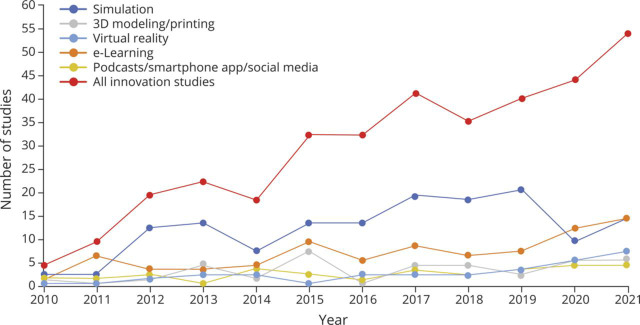
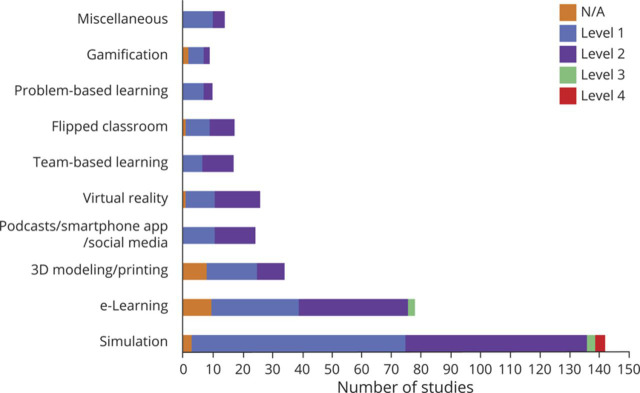
Advances in adult learning theory and instructional technologies provide opportunities to improve neurology knowledge acquisition. This scoping review aimed to survey the emerging landscape of educational innovation in clinical neurology. With the assistance of a research librarian, we conducted a literature search on November 4, 2021, using the following databases: PubMed, Embase, Scopus, Cochrane Library, Education Resources Information Center, and PsycINFO. We included studies of innovative teaching methods for medical students through attending physician-level learners and excluded interventions for undergraduate students and established methods of teaching, as well as those published before 2010. Two authors independently reviewed all abstracts and full-text articles to determine inclusion. In the case of disagreement, a third author acted as arbiter. Study evaluation consisted of grading level of outcomes using the Kirkpatrick model, assessing for the presence of key components of education innovation literature, and applying an author-driven global innovation rating. Among 3,830 identified publications, 350 (175 full texts and 175 abstracts) studies were selected for analysis. Only 13 studies were included from 2010 to 2011, with 98 from 2020 to 2021. The most common innovations were simulation (142), eLearning, including web-based software and video-based learning (78), 3-dimensional modeling/printing (34), virtual/augmented reality (26) podcasts/smartphone applications/social media (24), team-based learning (17), flipped classroom (17), problem-based learning (10), and gamification (9). Ninety-eight (28.0%) articles included a study design with a comparison group, but only 23 of those randomized learners to an intervention. Most studies relied on Kirkpatrick Level 1 and 2 outcomes-the perceptions of training by learners and acquisition of knowledge. The sustainability of the innovation, transferability of the innovation to a new context, and the explanation of the novel nature of the innovations were some of the least represented features. We rated most innovations as only slightly innovative. There has been an explosion of reports on educational methods in clinical neurology over the last decade, especially in simulation and eLearning. Unfortunately, most reports lack adequate assessment of the validity and effect of the respective innovation's merits, as well as details regarding sustainability and transferability to new contexts.
成人学习理论和教学技术的进步为改善神经学知识的获取提供了机会。本范围综述旨在调查临床神经学教育创新的新趋势。在一位研究馆员的协助下,我们于2021年11月4日使用以下数据库进行了文献检索:PubMed、Embase、Scopus、Cochrane图书馆、教育资源信息中心和PsycINFO。我们纳入了针对医学生至主治医师水平学习者的创新教学方法研究,排除了针对本科生的干预措施和既定的教学方法,以及2010年之前发表的研究。两位作者独立审查所有摘要和全文文章以确定纳入情况。如有分歧,第三位作者担任仲裁人。研究评估包括使用柯克帕特里克模型对结果水平进行分级,评估教育创新文献关键组成部分的存在情况,并应用作者驱动的全球创新评级。在3830篇已识别的出版物中,350项研究(175篇全文和175篇摘要)被选作分析。2010年至2011年仅有13项研究被纳入,2020年至2021年有98项。最常见的创新是模拟(142项)、电子学习,包括基于网络的软件和基于视频的学习(78项)、三维建模/打印(34项)、虚拟/增强现实(26项)、播客/智能手机应用程序/社交媒体(24项)、基于团队的学习(17项)、翻转课堂(17项)、基于问题的学习(10项)和游戏化(9项)。98篇(28.0%)文章包括有对照组的研究设计,但其中只有23项将学习者随机分组进行干预。大多数研究依赖柯克帕特里克一级和二级结果——学习者对培训的看法和知识的获取。创新的可持续性、创新向新环境的可转移性以及对创新新颖性的解释是最少被提及的一些特征。我们将大多数创新评为仅略有创新性。在过去十年中,关于临床神经学教育方法的报告激增,尤其是在模拟和电子学习方面。不幸的是,大多数报告缺乏对各自创新优点的有效性和效果的充分评估,以及关于可持续性和向新环境可转移性的细节。