Department of Signal Theory, Networking and Communications, University of Granada, ETSIIT, C/Periodista Daniel Saucedo Aranda s/n, E-18071, Granada, Spain.
Sensors (Basel). 2012;12(5):5791-814. doi: 10.3390/s120505791. Epub 2012 May 4.
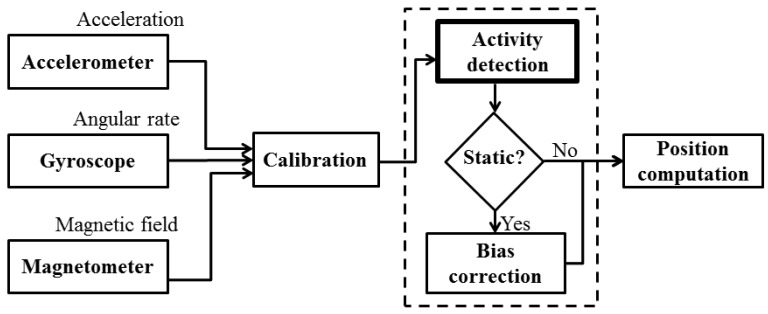
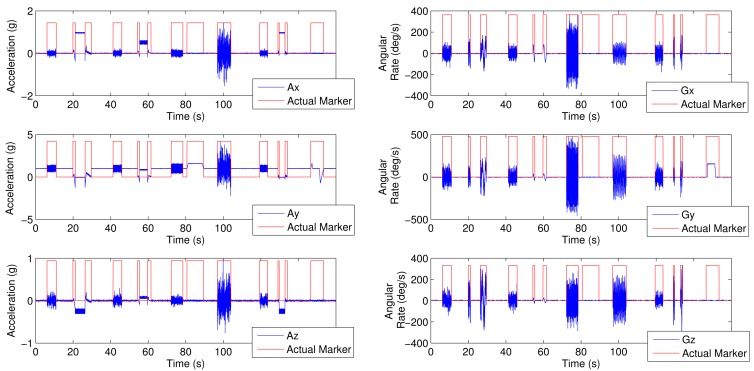
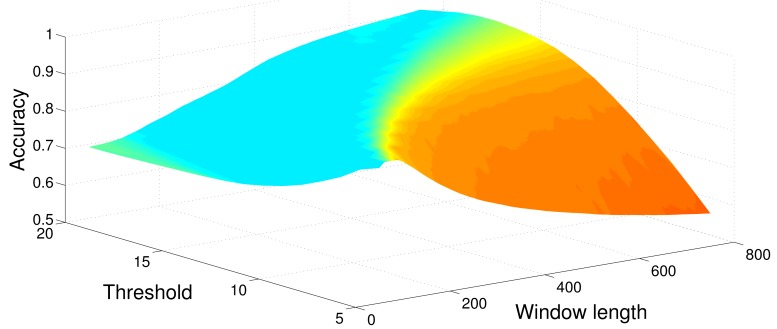
Determination of (in)activity periods when monitoring human body motion is a mandatory preprocessing step in all human inertial navigation and position analysis applications. Distinction of (in)activity needs to be established in order to allow the system to recompute the calibration parameters of the inertial sensors as well as the Zero Velocity Updates (ZUPT) of inertial navigation. The periodical recomputation of these parameters allows the application to maintain a constant degree of precision. This work presents a comparative study among different well known inertial magnitude-based detectors and proposes a new approach by applying spectrum-based detectors and memory-based detectors. A robust statistical comparison is carried out by the use of an accelerometer and angular rate signal synthesizer that mimics the output of accelerometers and gyroscopes when subjects are performing basic activities of daily life. Theoretical results are verified by testing the algorithms over signals gathered using an Inertial Measurement Unit (IMU). Detection accuracy rates of up to 97% are achieved.
当监测人体运动时,确定(不)活动期是所有人体惯性导航和位置分析应用中的强制性预处理步骤。为了允许系统重新计算惯性传感器的校准参数以及惯性导航的零速度更新 (ZUPT),需要区分(不)活动。这些参数的周期性重新计算允许应用程序保持恒定的精度。本工作对不同知名的基于惯性幅度的检测器进行了比较研究,并通过应用基于频谱的检测器和基于记忆的检测器提出了一种新方法。通过使用加速度计和角速度信号合成器进行稳健的统计比较,该合成器模拟了被试进行日常生活基本活动时加速度计和陀螺仪的输出。通过使用惯性测量单元 (IMU) 收集的信号对算法进行测试,验证了理论结果。达到了高达 97%的检测准确率。